Multi location local SEO is the work of making every branch, hotel, clinic or store of one brand easy to find in local search, maps and AI answers. Each location needs its own accurate listing, its own page on your site, steady reviews and a named owner, managed from one source of truth so facts never drift.
Key Takeaways
- AI tools are now a major local discovery source. BrightLocal's 2026 survey found 45% of US consumers use ChatGPT or other AI tools for local business recommendations, up from 6% a year earlier.
- Google is still the largest source, but it is no longer the only one. Apple Maps usage nearly doubled to 27%, and Apple moved Business Connect into the new Apple Business platform in April 2026.
- Build one page per location with unique content and LocalBusiness schema, and link each listing to its own page, not to your homepage.
- Most multi-location failures are governance failures. Use a RACI so every listing field and every review has exactly one accountable owner.
- Measure each location separately with a monthly scorecard that includes AI answer presence and accuracy, not only rankings and calls.
This guide is for marketing heads at hotel groups, clinic chains, banks, retailers and spa brands with ten or more locations. Cyberdunes builds Apex®, which includes local listings management and AI visibility tracking, and we have run digital projects for hotels and banks, so the templates below come from that work. Every statistic links to the study or announcement it comes from.
What Is Multi-Location Local SEO in the AI-First Search Era?
It is classic local SEO repeated at scale, plus a new requirement: AI assistants must describe each location correctly. The basics (listings, pages, reviews) have not changed. Where people read the result has.
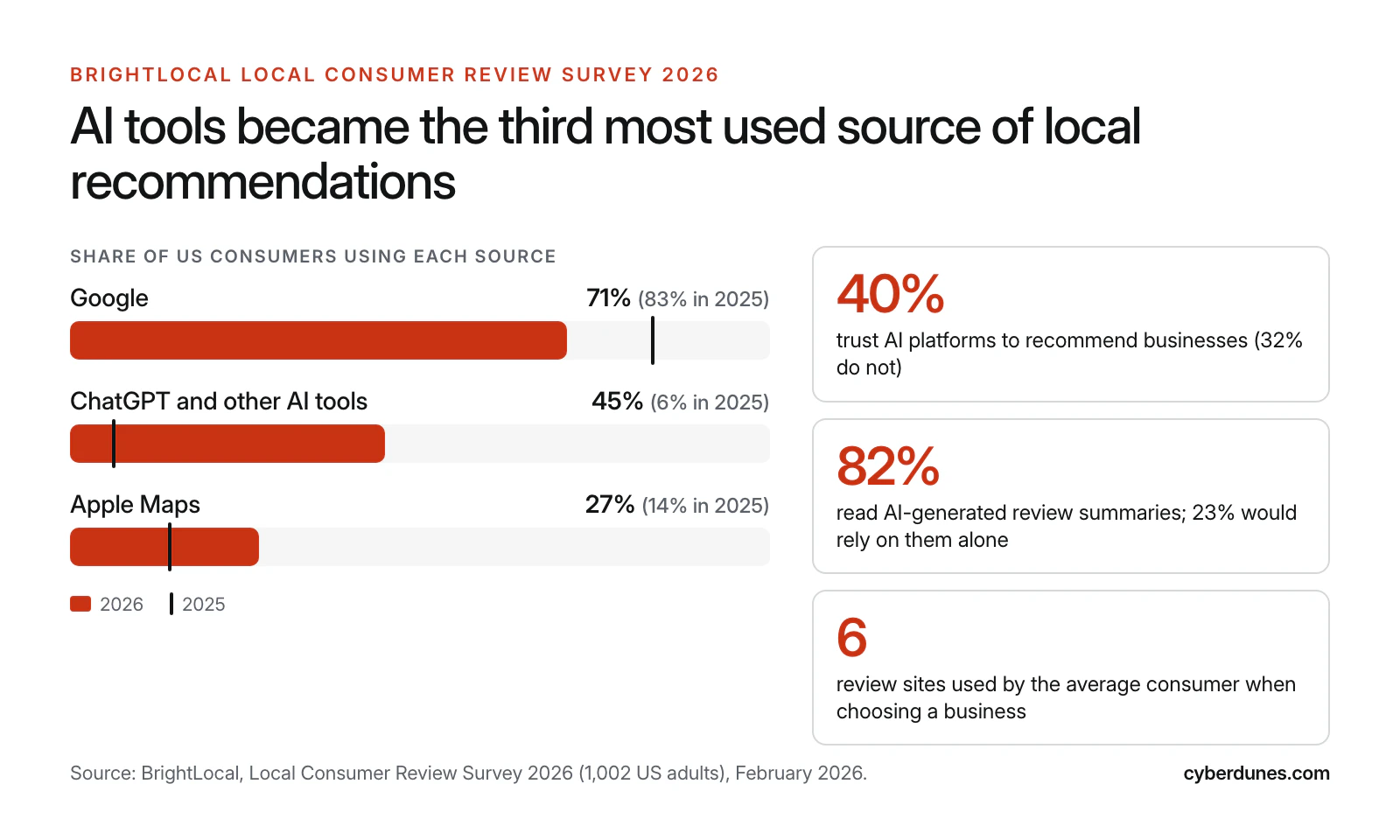
BrightLocal's Local Consumer Review Survey 2026, published in February 2026 from a panel of 1,002 US adults, shows the shift:
- 45% of consumers now use ChatGPT and other AI tools for business recommendations, "rising from 6% last year," which makes AI the third most used source.
- Google's share "dipped from 83% in 2025 to 71%," and Apple Maps "nearly doubled in usage from 14% in 2025 to 27%."
- 40% of consumers trust AI platforms to recommend businesses, against 32% who do not.
- 82% read AI-generated review summaries, and 23% would rely on those summaries alone.
Google is also putting AI inside Maps. Ask Maps, launched on March 12, 2026, answers conversational questions using information from "over 300 million places" and reviews from "more than 500 million contributors," and it began rolling out in the US and India (Google, March 2026). For a brand with 80 branches, that means 80 sets of facts that an AI model summarizes, compares and sometimes gets wrong. The prompts behind these answers branch into many sub-questions, a pattern we cover in our guide to query fan-out.
Where Local Discovery Happens Now: Google, Apple, Bing and AI Assistants
Local discovery now spans four surfaces, and each one reads your listings and website differently. Cover all four from one source of truth.
| Surface | What it reads | 2025 to 2026 change | Multi-location tool |
|---|---|---|---|
| Google Search, Maps and AI Mode | Business Profile, reviews, website, structured data | Ask Maps (March 2026); Gemini checks on edits and owner email alerts (April 2026) | Business Profile Manager with bulk verification for 10+ locations |
| Apple Maps, Safari and Spotlight | Place cards: photos, hours, location details, actions | Apple Business replaced Business Connect on April 14, 2026; Maps ads in US and Canada | Apple Business brand and location tools |
| Bing and Bing Maps | Bing Places listing, website | Import from Google Business Profile | Bulk upload of multiple businesses |
| ChatGPT, Gemini, Claude, Perplexity and Google AI Overviews | Listings, reviews, your location pages and third-party sites | 45% of US consumers use AI tools for local recommendations | Prompt tracking per location |
Apple's change matters for brands that ignored it. Apple says Apple Business, available from April 14, 2026 in more than 200 countries and regions, takes over the brand tools of Business Connect, and existing claimed locations and place card data migrate automatically (Apple, March 2026). Ads on Maps start in the US and Canada, and a business must claim its location first. Bing Places lets you "import from your Google Business Profile or upload multiple businesses easily" (Bing Places for Business), which is the fastest way to reach parity there.
For retail chains, Google also added "Let Google Call," which calls nearby stores to check stock, price and promotions for shoppers, starting in the US for toys, health and beauty, and electronics (Google, November 2025). Store staff and local inventory data are now part of local search.
How Should You Structure Location Pages?
Give every location its own page, linked from a hub, and make that page the website link on the location's Google, Apple and Bing listings. A single "Our Branches" page with 80 addresses gives search engines and AI assistants nothing specific to cite.
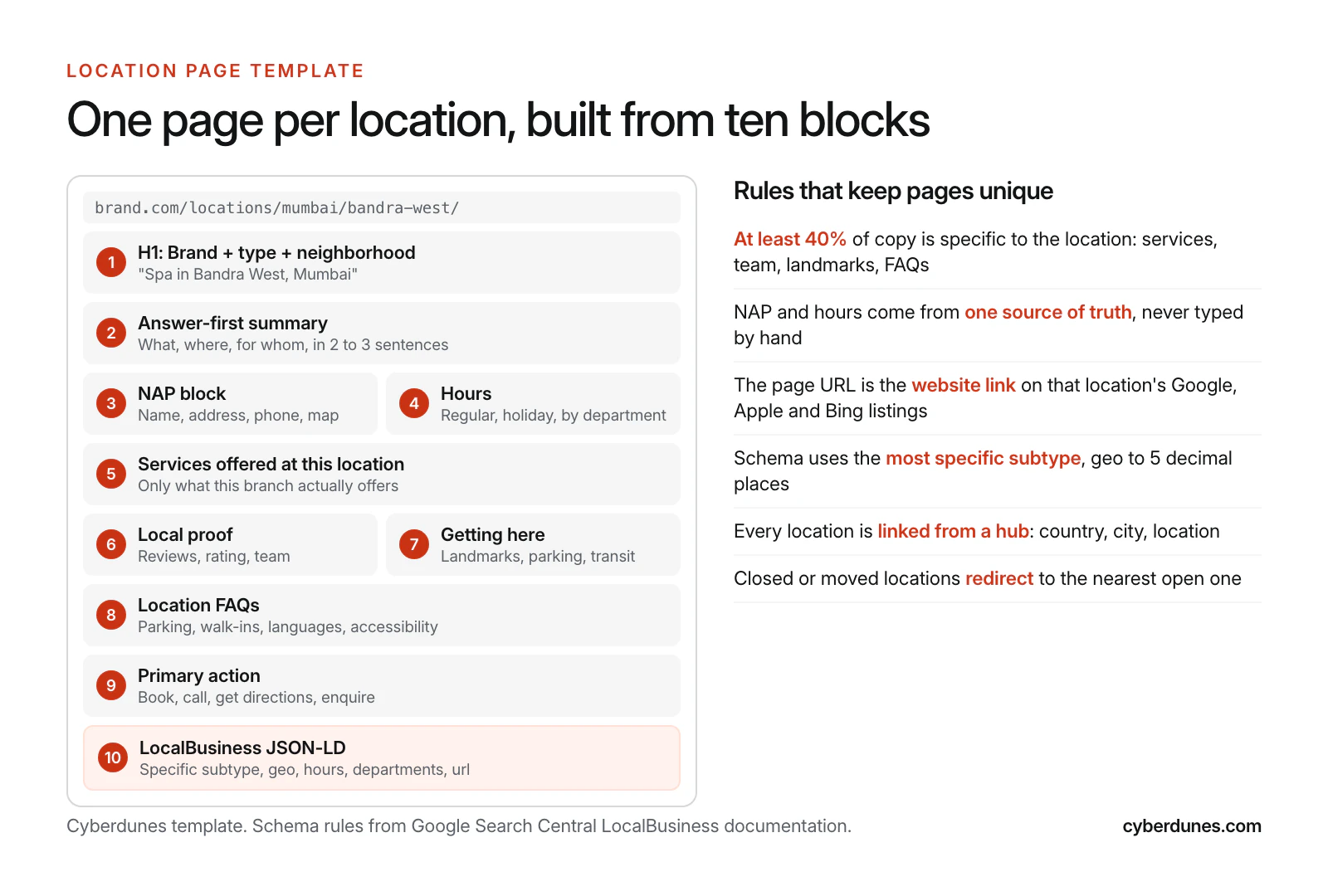
Use a simple hierarchy: /locations/ lists countries or states, then cities, then individual locations, for example /locations/mumbai/bandra-west/. Each page follows the same ten-block template, but the content inside the blocks must be specific to that location.
The Location Page Template
- H1 with brand, business type and neighborhood: "Spa in Bandra West, Mumbai."
- Answer-first summary in two or three sentences: what this location offers, where it is and who it suits.
- NAP block: name, address and phone, plus an embedded map.
- Hours, including holiday hours and department hours such as a pharmacy or a hotel restaurant.
- Services at this location, listing only what this branch actually offers.
- Local proof: rating, recent reviews and the team.
- Getting here: landmarks, parking and transit.
- Location FAQs: parking, walk-ins, languages spoken, accessibility.
- One primary action: book, call, get directions or enquire.
- LocalBusiness JSON-LD generated from the same data as the listing.
Our working rule is that at least 40% of each page should be specific to that location. If you cannot write that much, the location probably does not need a separate page yet, or your team has not collected the local facts. Hotel groups face this most, and our guide to luxury hotel branding shows how to keep a brand voice consistent while each property sounds like itself.
LocalBusiness Schema for Every Location
Mark up each location as its own LocalBusiness entity, using the most specific type available. Google's documentation says to "define each local business location as a LocalBusiness type" and to "use the most specific LocalBusiness sub-type possible" (Google Search Central).
Points that matter at scale, all from the same documentation:
- Required:
nameandaddress. - geo: latitude and longitude with "at least 5 decimal places."
- telephone: include the country code and area code.
- url: the page for that specific location.
- openingHoursSpecification: regular hours, with special hours where they apply.
- department: nested items for departments, named with the store name plus department, such as a branch and its in-store pharmacy.
A minimal example for one spa location:
{
  "@context": "https://schema.org",
  "@type": "DaySpa",
  "name": "Example Spa Bandra West",
  "url": "https://example.com/locations/mumbai/bandra-west/",
  "telephone": "+91-22-5555-0100",
  "address": {
    "@type": "PostalAddress",
    "streetAddress": "12 Hill Road",
    "addressLocality": "Mumbai",
    "postalCode": "400050",
    "addressCountry": "IN"
  },
  "geo": { "@type": "GeoCoordinates", "latitude": 19.05441, "longitude": 72.83381 },
  "openingHoursSpecification": [{
    "@type": "OpeningHoursSpecification",
    "dayOfWeek": ["Monday","Tuesday","Wednesday","Thursday","Friday","Saturday","Sunday"],
    "opens": "10:00", "closes": "21:00"
  }]
}
Generate this markup from your location database, never by hand. When hours change in one place, the listing, the page and the schema should all change together.
NAP Consistency at Scale
NAP (name, address, phone) consistency at scale is a data problem, not a writing problem. Keep one master record per location and push it to every surface.
- Build the master record. One row per location with a stable ID, legal name, display name, address, geo coordinates, phone, hours, departments, categories and page URL.
- Verify in bulk. Google allows bulk verification "if you have 10 or more locations of the same business," but not for service-area businesses, and agencies managing several businesses in one account cannot bulk verify (Google Business Profile Help).
- Sync outward. Push the master record to Google, Apple Business, Bing Places and key directories. Never let a location manager edit a listing directly without updating the master.
- Watch for outside edits. Google says it blocked 79 million inaccurate or unverified edits in 2025 and, from April 2026, sends verified owners email alerts to review important edits before they publish (Google, April 2026). Route those alerts to one owner.
- Audit monthly. Compare every surface against the master and fix drift within a week.
Wrong facts spread. Once an old phone number or closed branch reaches an AI answer, it can persist after you fix the listing. Our guide to fixing wrong AI answers about your brand covers how to correct them at the source.
Reviews Operations Across Locations
Treat reviews as an operation with service levels, not as a marketing task. Shoppers expect fresh reviews and fast replies, and AI review summaries now compress them into a verdict.
BrightLocal's 2026 survey sets the bar (BrightLocal, February 2026):
- 74% of consumers seek reviews written in the last three months, and 32% look for reviews from the last two weeks, up from 20%.
- 89% expect owners to respond to reviews, and 81% expect a reply within a week.
- 80% say they are likely to use a business that responds to all of its reviews.
| Review type | Who responds | Target time | Escalate when |
|---|---|---|---|
| Positive, 4 to 5 stars | Location manager, using approved patterns | Within 48 hours | Never; keep replies specific, not copied |
| Mixed, 3 stars | Location manager | Within 24 hours | A service fault repeats in three or more reviews |
| Negative, 1 to 2 stars | Regional manager | Within 24 hours | Safety, discrimination, health or data claims |
| Suspected fake or spam spike | Central team | Same day | Always; report through the platform |
Fake reviews are a real risk for chains. Google blocked or removed "over 292 million policy-violating reviews" in 2025 and now detects scams that "demand payment in exchange for removing fake one-star reviews," pausing new reviews during a spam spike and alerting the owner (Google, April 2026). Your central team should know that process before a location is targeted.
Google Business Profile Governance: Who Owns What
Every listing field and every review type needs exactly one accountable owner. Without that, ten people can edit the same profile and nobody answers for the result.
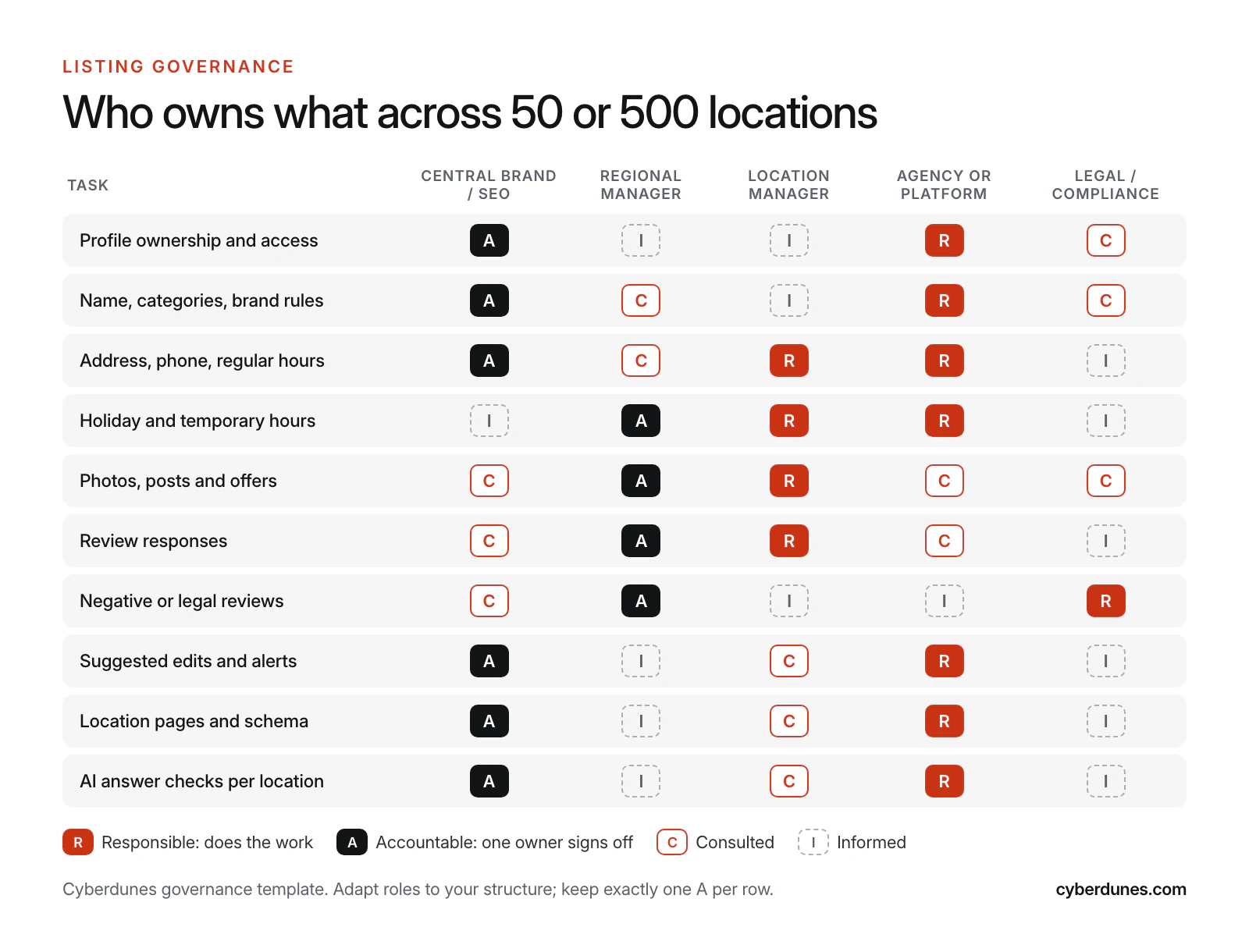
Three rules make the RACI work:
- The brand owns the profiles. Primary ownership of every Google Business Profile sits with a company account, never a personal email or an agency's account.
- Locations own local truth. Holiday hours, temporary closures and local photos come from the people on site, through the master record.
- Legal sees the hard cases. Reviews alleging safety, health or data issues go to compliance before anyone replies. Banks and clinics should set this rule on day one.
Customer experience teams often hold the review data already. Our article on customer experience management systems for hotels explains how to connect guest feedback to listing operations.
How to Test Local Prompts in AI Assistants
Run the same local questions through AI assistants every month for each location, and record whether each location is named and whether the facts are right. This is the only way to see what AI says about a branch you are not standing in.
Build a prompt set per location type, then swap in the neighborhood:
- "Best spa near Bandra West open after 8 pm"
- "Bank branch in Koregaon Park with a locker facility"
- "Family hotel in South Goa with a kids' club"
- "Pediatric clinic in Indiranagar that takes walk-ins on Sunday"
- "Is [brand] in [area] open on public holidays?"
Run each prompt in ChatGPT, Gemini, Claude, Perplexity and Google AI Overviews, and repeat it, because answers vary between runs. Log three things: presence (named or not), accuracy (hours, address, services) and source (which page or listing the assistant cited). Our guides to getting into Google AI Mode answers and to running an AI visibility check explain the method in more depth.
How to Measure Local SEO Per Location
Score each location monthly on eight metrics, then fix the red cells first. Brand-level averages hide the branches that are losing customers.
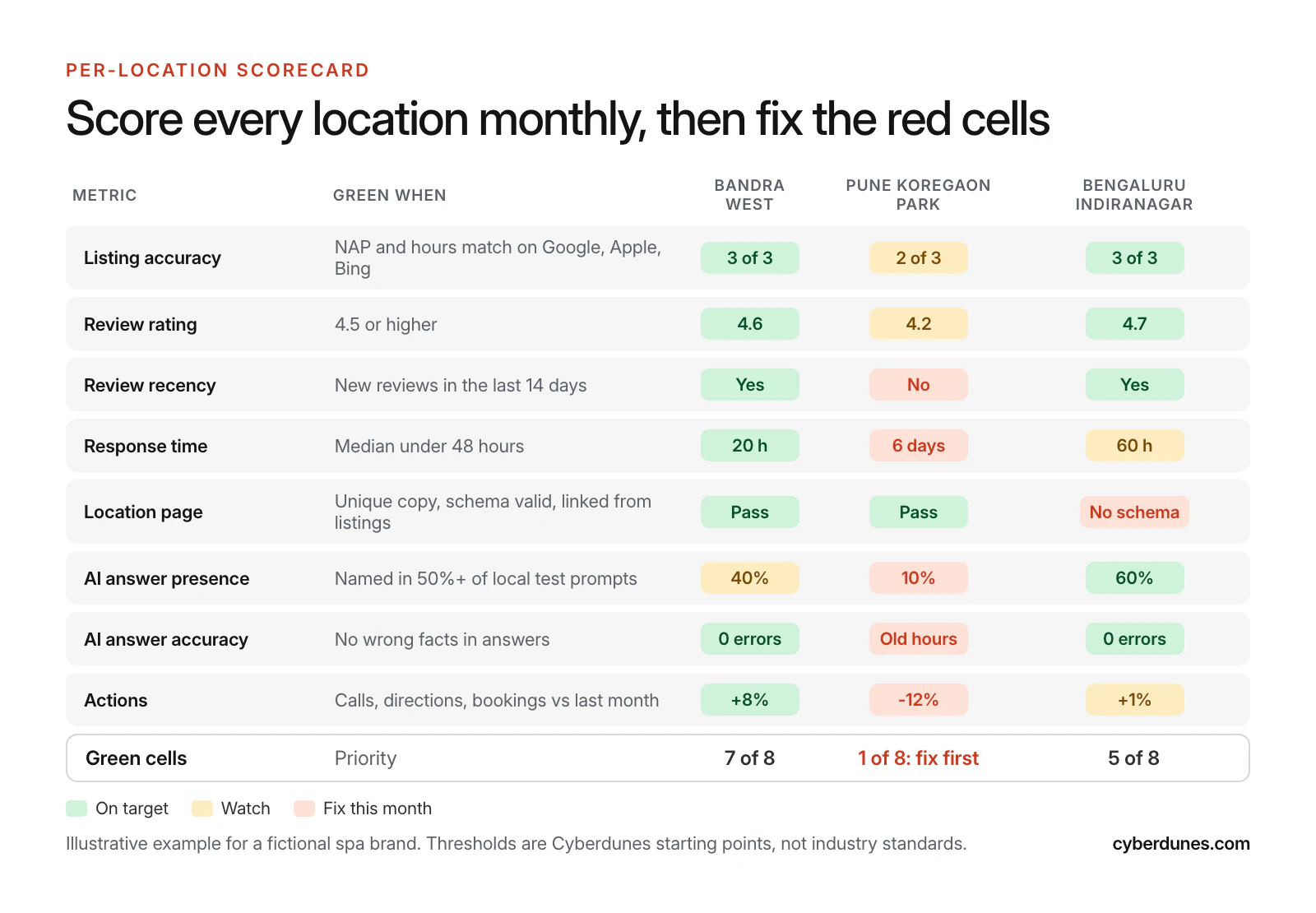
| Metric | Green when (our starting threshold) | Source |
|---|---|---|
| Listing accuracy | Name, address, phone and hours match on Google, Apple and Bing | Monthly audit against the master record |
| Review rating | 4.5 or higher | Platform dashboards |
| Review recency | At least one new review in the last 14 days | Platform dashboards |
| Response time | Median reply under 48 hours | Review management log |
| Location page | Unique copy, valid schema, linked from all listings | Site audit and Rich Results Test |
| AI answer presence | Named in at least half of local test prompts | Prompt tracking |
| AI answer accuracy | No wrong facts in answers | Prompt tracking |
| Actions | Calls, direction requests and bookings rising month on month | Business Profile performance, analytics |
Adjust the thresholds to your category: a bank branch will see fewer reviews than a café. What matters is comparing locations against each other and against their own last month.
A 90-Day Rollout Plan for Multi-Location Brands
Start with data and ownership, then pages and schema, then reviews and AI checks. Each phase depends on the one before it.
- Days 1 to 15: inventory. List every location, every listing on every surface and every person with access. Remove ex-employees and old agencies.
- Days 16 to 30: master record and RACI. Build the location database, agree the RACI and move profile ownership to company accounts.
- Days 31 to 45: listings. Verify in bulk on Google, claim locations in Apple Business and import to Bing Places. Fix every mismatch.
- Days 46 to 60: pages and schema. Publish location pages from the template, generate LocalBusiness JSON-LD, and point each listing to its page.
- Days 61 to 75: reviews. Set response service levels, approved reply patterns and escalation rules, and start a steady review request flow after each visit.
- Days 76 to 90: AI checks and scorecard. Run the first local prompt set, score every location and assign fixes for the red cells.
Talk to us about GEO for your locations
How Cyberdunes and Apex® Help Multi-Location Brands
Apex®, the AI-native digital experience platform (DXP), keeps the location facts and the location pages in one place. Its local listings management keeps name, address, hours and other details consistent across listings, and the same platform generates Schema.org JSON-LD, XML sitemaps and llms.txt for every location page. Prompt tracking follows citations and sentiment across ChatGPT, Gemini, Claude, Perplexity and Google AI Overviews, so you can see which branches AI assistants name and what they say.
Our case studies show what this foundation did for sector leaders, measured on whole sites rather than local listings alone. Canara Bank recorded 187% more page views, 95% of pages indexed by Google and 140% more leads after moving to Apex® with technical SEO built in. The Majestic Suites recorded 65% increased revenue and 73% improved operational efficiency after centralizing guest data. For spas, we publish a solution blueprint rather than client results, and our guide to DXP software for spas covers that sector.
Our GEO services team can audit your locations, build the master record and set up the scorecard with you. We do not promise rankings or AI citations; we make sure every location is accurate, consistent and easy to cite.
Sources
- Local Consumer Review Survey 2026 (BrightLocal, February 2026)
- Ask Maps and Immersive Navigation (Google, March 2026)
- New Ways We're Protecting Businesses on Maps (Google, April 2026)
- Introducing Apple Business (Apple Newsroom, March 2026)
- Local Business Structured Data (Google Search Central, accessed October 2026)
- Verify Your Business in Bulk (Google Business Profile Help, accessed October 2026)
- Bing Places for Business (Microsoft, accessed October 2026)
- Google Shopping Launches Agentic Checkout and More AI Shopping Tools (Google, November 2025)