Google AI Mode SEO is the work of making your pages the sources Google AI Mode reads, quotes and links when it answers a long, conversational question. AI Mode splits each question into many related searches, so you win by being indexed, snippet-eligible and the clearest answer to the follow-up questions your buyers ask.
Key Takeaways
- AI Mode passed 1 billion monthly users in 2026 and now runs on Gemini 3.5 Flash by default. Treat it as a primary search surface, not an experiment.
- Google says there are no special requirements: a page must be indexed and eligible to show with a snippet. No llms.txt, special schema or "chunking" is needed for Google Search.
- AI Mode and AI Overviews cite different pages. One large study found only 13.7% of cited URLs overlap, so being in one does not mean you are in the other.
- Pages that answer the follow-up questions behind a query, with evidence a model cannot find elsewhere, are the ones AI Mode has reason to use.
- Measure with Search Console's Generative AI performance report, GA4 conversions and a fixed prompt panel. Use our 12-check readiness audit and 30/60/90 plan below to start.
This guide is for marketing leaders and SEO owners who need a plan they can run this quarter. We are the SEO and generative engine optimization (GEO) team at Cyberdunes, and we build Apex®, the AI-native digital experience platform (DXP). Everything below is based on Google's own documentation, current studies and the audits we run on client sites. Where evidence is thin, we say so.
What Is Google AI Mode?
Google AI Mode is a conversational search experience inside Google Search. It answers complex questions with an AI-written response, links to supporting websites and lets the user keep asking follow-up questions in the same thread.
The timeline matters because the product has changed fast:
- March 5, 2025: Google introduced AI Mode as a Search Labs experiment built on a custom version of Gemini 2.0, aimed at questions that need "further exploration, comparisons and reasoning."
- May 20, 2025: At Google I/O, Google started rolling AI Mode out to everyone in the U.S., powered by a custom version of Gemini 2.5.
- June 24, 2025: AI Mode arrived in India as a Labs experiment in English.
- May 19, 2026: Google made Gemini 3.5 Flash the default model in AI Mode for everyone globally and said AI Mode had passed one billion monthly users, with queries more than doubling every quarter since launch. People can now ask a follow-up from an AI Overview and continue in AI Mode.
- July 22, 2026: In Alphabet's Q2 2026 earnings remarks, Sundar Pichai said AI Mode had surpassed 1 billion monthly active users since expanding globally the previous October, and that AI Overviews and AI Mode had been brought together into one Search experience.
If you want the vocabulary first, our AI search and GEO glossary defines AI Mode, AI Overviews, grounding and the other terms used here.
How Does AI Mode Choose Which Pages to Cite?
AI Mode retrieves pages from Google's own index through many related searches, then writes an answer grounded in the passages it selected. Your page has to win at the sub-query level, not just for the words the user typed.
Google's guide to optimizing for generative AI features names the two techniques involved. Retrieval-augmented generation (RAG), which Google also calls grounding, uses its core ranking systems to fetch relevant pages from the Search index. Query fan-out is "a set of concurrent, related queries generated by the model." Google's own example: a question about fixing a weedy lawn may fan out to "best herbicides for lawns", "remove weeds without chemicals" and "how to prevent weeds in lawn". For research-heavy questions, Deep Search can issue hundreds of searches and return a fully cited report.
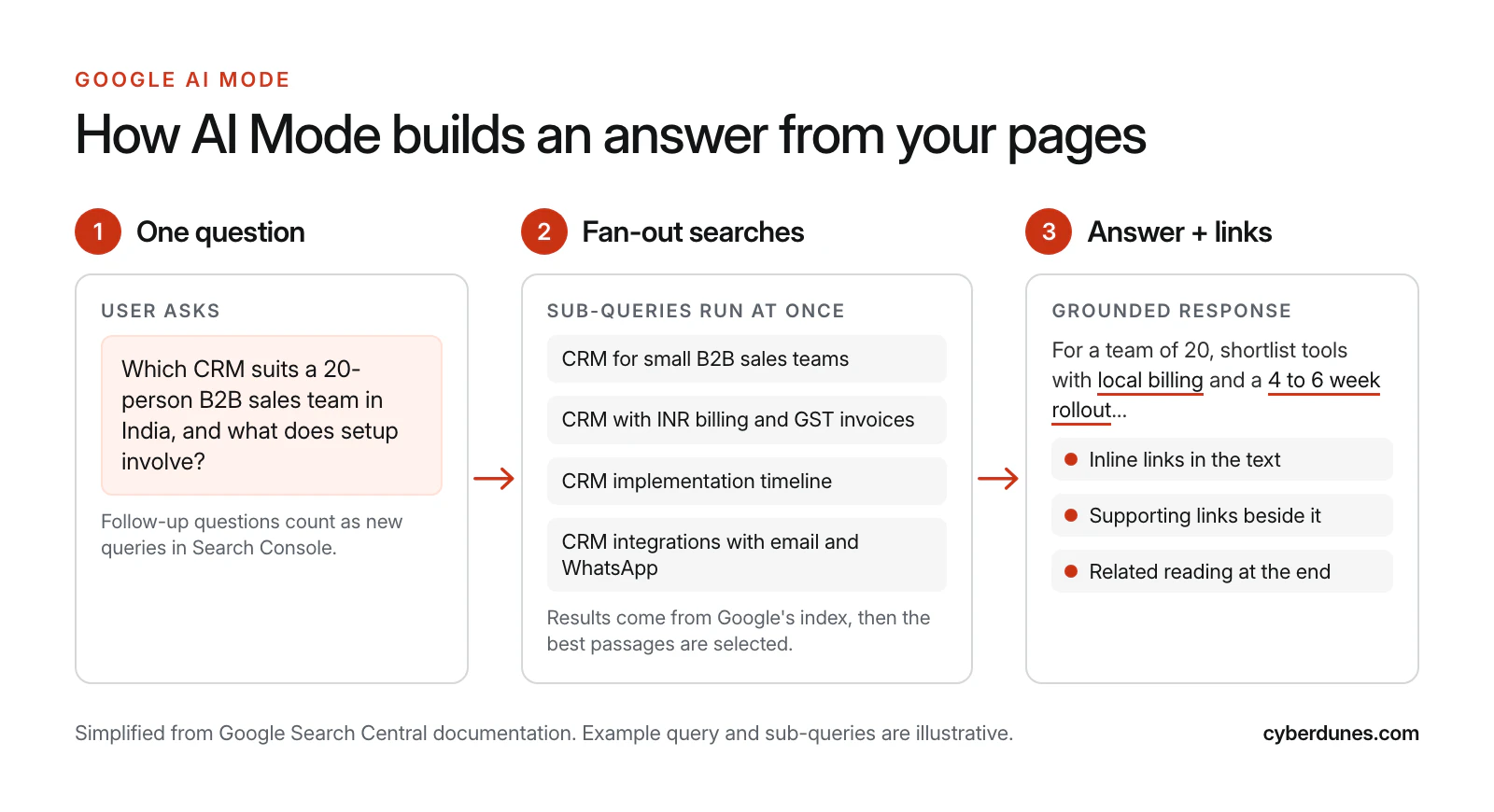
Three consequences follow for your pages:
- Rank for the follow-ups. A page that answers "CRM implementation timeline" can be cited for a broader question it never targeted. We cover the method in our guide to query fan-out and how to map it.
- Write passages that stand alone. The model selects passages, not whole pages. Our explainer on how LLMs choose sources to cite shows what a quotable passage looks like.
- Links are becoming more visible. On October 15, 2026 Google announced that inline links will appear higher in AI Mode and AI Overviews responses more often, with bigger "dive deeper" links at the end of some answers. Users who mark your site as a preferred source can see it with a "preferred" badge in AI Mode.
How Is AI Mode Different From AI Overviews?
AI Overviews are short summaries that appear only when Google judges them useful; AI Mode is a longer, conversational answer the user chooses or continues into. They draw on the same index but often cite different pages, so track them separately.
Google's AI features documentation says both may use query fan-out, but "AI Mode and AI Overviews may use different models and techniques, so the set of responses and links they show will vary." An Ahrefs study of September 2025 U.S. data, published in December 2025, put numbers on that difference.
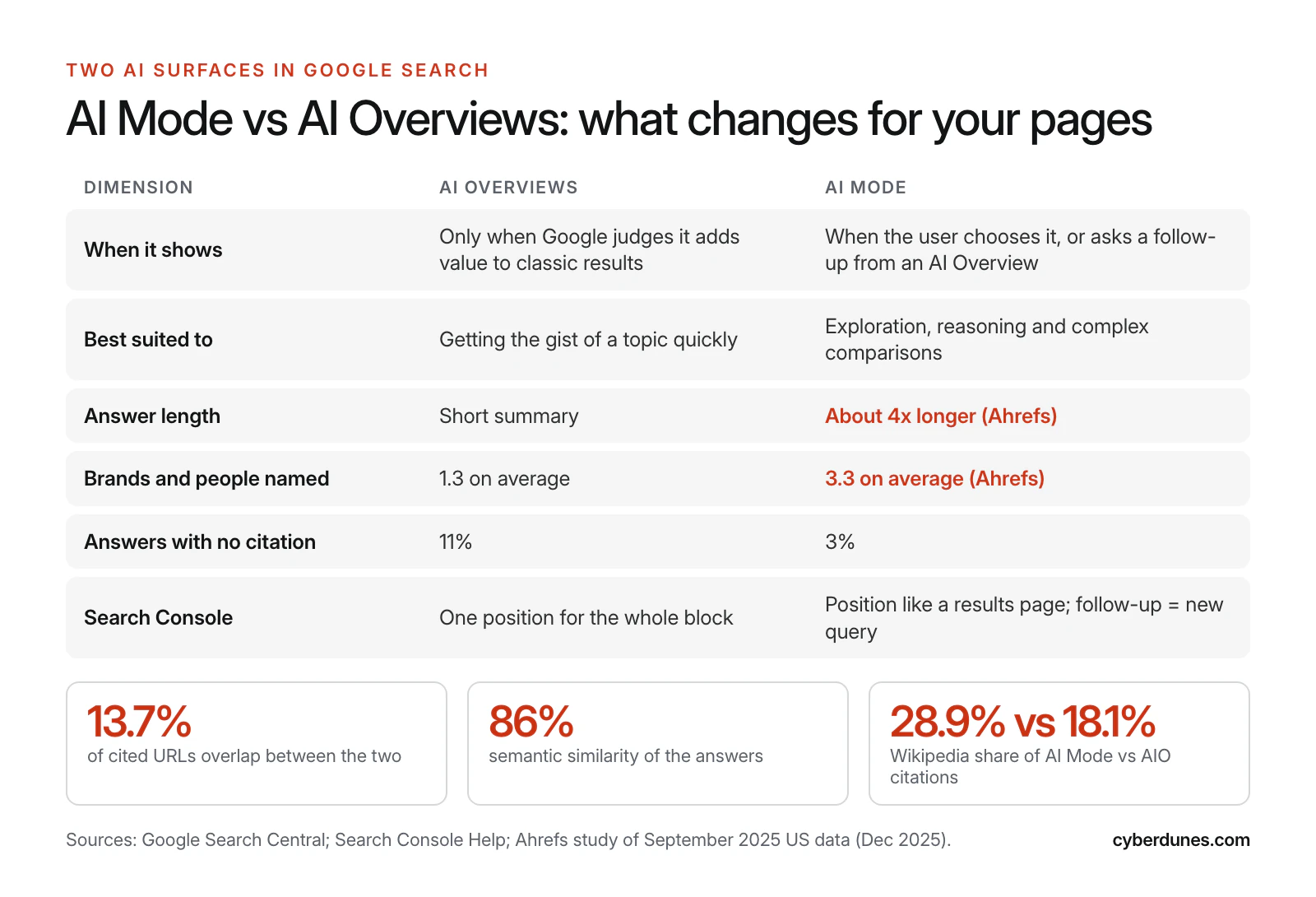
| What Ahrefs measured | AI Overviews | AI Mode |
|---|---|---|
| Citation overlap between the two | 13.7% of citations (16.3% for the top three) | |
| Semantic similarity of answers | 86% | |
| Response length | Baseline | Roughly 4x longer |
| Entities (brands, people) named per answer | 1.3 | 3.3 |
| Answers with no cited source | 11% | 3% |
| Share of citations going to Wikipedia | 18.1% | 28.9% |
The practical reading: AI Mode names more brands per answer, which is more room for you, but it also leans more on reference sources. A comparison page that names three credible options, including yours, with honest criteria fits how AI Mode writes.
What Does Google's Own Guidance Say About AI Mode SEO?
Google's position is that optimizing for AI Mode is still SEO: indexing, crawlable text, helpful content and accurate structured data. It also lists tactics you can ignore for Google Search, which saves budget. Our complete guide to generative engine optimization covers the same foundations across other AI engines.
From the AI features page and the AI optimization guide (last updated July 2026):
| Google says do | Google says you can skip (for Google Search) |
|---|---|
| Be indexed and eligible to show with a snippet; "there are no additional technical requirements" | llms.txt and other AI text files: Google Search ignores them |
| Keep the site included in Search generative AI features in Search Console | "Chunking" content into tiny pieces for AI |
| Create "non-commodity" content with a unique, first-hand point of view | Rewriting pages in a special style for AI |
| Allow crawling in robots.txt and at the CDN or host | Special schema.org markup for AI (structured data still helps rich results) |
| Keep Merchant Center and Business Profile data current | Chasing inauthentic "mentions" across the web |
Two warnings deserve a place in your brief. First, creating separate pages for every fan-out variation "primarily to manipulate rankings or generative AI responses" violates Google's scaled content abuse policy. Second, Google says "no third-party tool has access to our internal ranking or AI systems." Treat any vendor that promises AI Mode placement with suspicion.
A note on llms.txt, since Apex® supports it: Google Search does not use it, but other AI systems may. Keep it if you already have it; do not expect it to move AI Mode.
What Should You Change on Your Pages for AI Mode?
Change the pages that sell first: make each one answer the five to ten follow-up questions a buyer asks, with evidence only you have. Formatting tweaks matter far less than substance.
In our audits, the gaps that keep good brands out of AI answers are rarely technical. They are content gaps. Here is what we change, in order:
- Answer the follow-ups on the page. If buyers ask about cost drivers, setup time, integrations and who it is not for, each needs a heading and a direct two-sentence answer. Our 12-point GEO checklist covers the answer-first pattern.
- Add evidence a model cannot find elsewhere. Your own benchmarks, real timelines, named experts, photos of the actual product or property. Google's guide contrasts generic "7 tips" content with first-hand accounts for this reason.
- Publish honest comparison content. Google says AI Mode is particularly helpful for "complex comparisons." If you never state when a competitor is the better fit, the model will take that judgment from someone else's page.
- Keep entity facts consistent. Pricing approach, locations, hours and service lists should match across your site, Google Business Profile, Merchant Center and structured data. Multi-location brands should check every branch, because each listing is a separate source of facts.
- Support text with images and video. Google notes AI features can surface images and video, which means more entry points than a single link.
- Check preview controls. A stray
nosnippetormax-snippet:0removes a page from AI features entirely. We find these left over from old templates more often than you would expect.
The AI Mode Readiness Audit
Score your top 20 revenue pages on 12 checks across four layers: eligibility, answer coverage, evidence and measurement. Score each pass 2, partial 1, fail 0, and fix every eligibility fail before touching content.
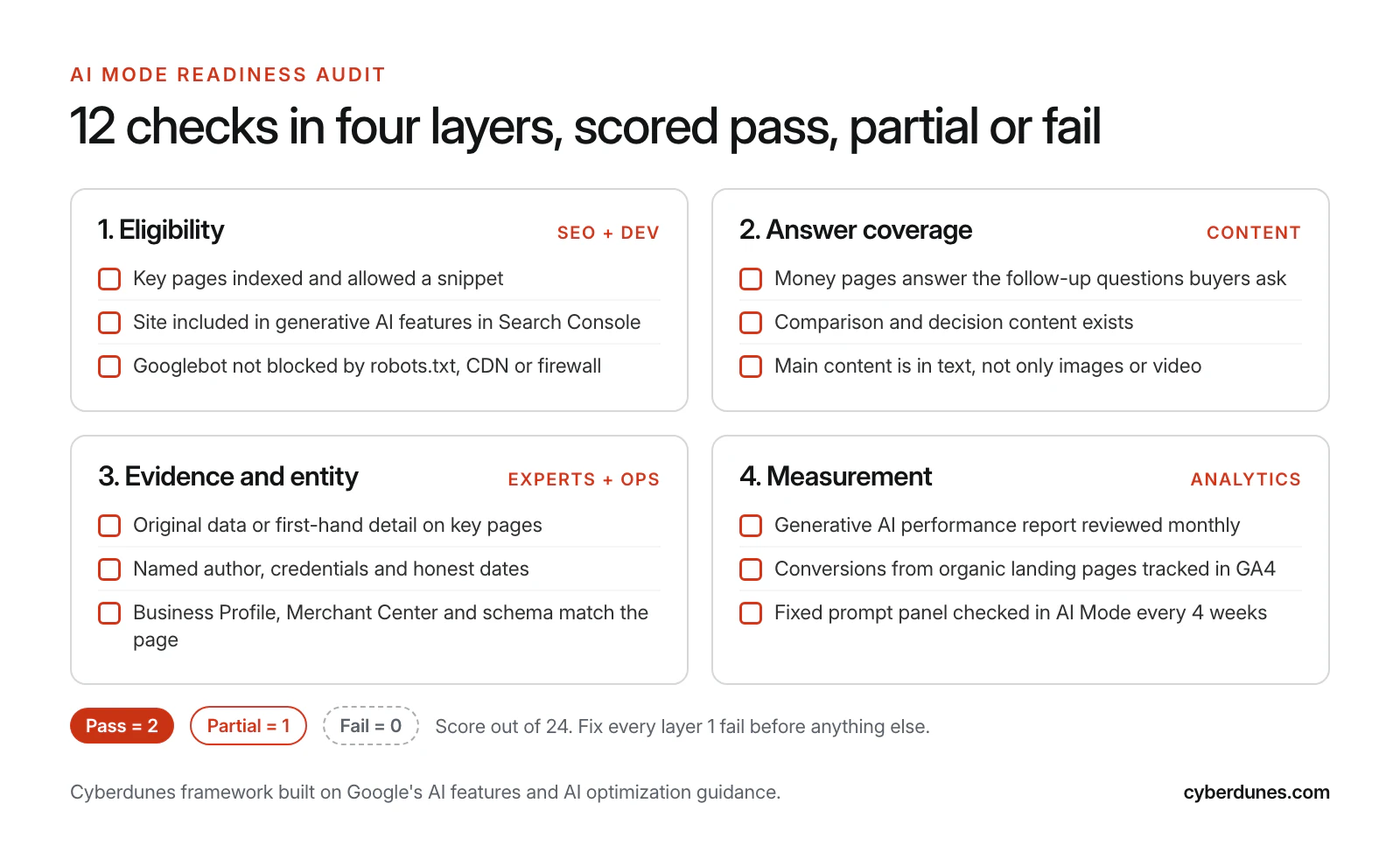
| # | Check | How to test | Owner | Effort |
|---|---|---|---|---|
| 1 | Key pages indexed and allowed a snippet | URL Inspection; search the page for nosnippet and max-snippet | SEO | Low |
| 2 | Site included in Search generative AI features | Search Console settings | SEO lead | Low |
| 3 | Googlebot not blocked by robots.txt, CDN or firewall | robots.txt tester; CDN bot logs; crawl stats | Developer | Low |
| 4 | Money pages answer buyers' follow-up questions | List 5 to 10 follow-ups per page; mark answered or not | Content | Medium |
| 5 | Comparison and decision content exists | Is there a page that says when you are and are not the right fit? | Product marketing | Medium |
| 6 | Main content is text in the rendered HTML | View rendered HTML in URL Inspection | Developer | Medium |
| 7 | Original data or first-hand detail on key pages | Could a competitor publish the same paragraph? If yes, fail | Subject expert | High |
| 8 | Named author, credentials and honest dates | Byline, author page, visible updated date | Content | Low |
| 9 | Business Profile, Merchant Center and schema match the page | Compare prices, hours, addresses across all three | Marketing ops | Low |
| 10 | Generative AI performance report reviewed monthly | Search Console; note pages and countries with impressions | Analytics | Low |
| 11 | Conversions from organic landing pages tracked | GA4 key events by landing page | Analytics | Low |
| 12 | Fixed prompt panel checked in AI Mode | Same 30 prompts every four weeks; log citations | SEO | Medium |
How to read the score: 20 or more means you are ready and should focus on evidence. 12 to 19 is typical; most of the gap sits in checks 4, 5 and 7. Below 12, or any fail in checks 1 to 3, means some pages cannot be cited at all.
How Do You Measure AI Mode Performance?
Use three sources together: Search Console for impressions and clicks, GA4 for what those visitors do, and a fixed panel of prompts you check by hand. None is complete alone.
- Search Console Performance report. AI Mode traffic is counted inside the "Web" search type. Per Search Console Help, a click on an external link in AI Mode counts as a click, position "follows the same methodology as a Google Search results page", and a follow-up question is "essentially performing a new query."
- Generative AI performance report. Launched on June 3, 2026 and rolled out to all websites worldwide by August 31, 2026, it shows impressions, pages, countries, devices and dates for AI Overviews, AI Mode and Discover AI features. It does not list a clicks metric, so pair it with the Performance report.
- GA4. Google says clicks from results pages with AI Overviews are "higher quality," with visitors spending more time on site. Judge AI Mode by conversions per landing page, not sessions. Our guide to tracking AI traffic in GA4 shows the setup.
- A prompt panel. Pick 30 buyer questions, run them in AI Mode every four weeks and log whether you are cited, mentioned or absent. Answers vary between runs, so read trends, not single results. Our AI visibility checker guide explains the metrics.
Expect fewer clicks per impression than classic results. If that worries your leadership team, our marketing plan for zero-click search explains how to report value beyond clicks.
Should You Opt Out of AI Mode?
For most businesses, no. Opting out removes you from AI answers that buyers are already reading, and Google says opted-out sites "will not receive traffic or impressions" from its generative AI features.
Google introduced a Search Console toggle on June 3, 2026 that lets site owners keep their site out of generative AI Search features, and it reached all websites worldwide on August 31, 2026. Google says the control "will not be used as a ranking signal" for results outside those features. Use this framework before anyone flips it:
| Your situation | Recommendation | Why |
|---|---|---|
| You sell services, products or stays and want to be shortlisted | Stay in | AI Mode names 3.3 brands or people per answer on average; absence hands that slot to a competitor |
| You are a publisher whose revenue depends on page views | Test before deciding | Compare AI impressions and clicks per page for 8 weeks first |
| Only certain pages are sensitive (pricing, member content) | Use page-level controls | nosnippet, data-nosnippet or noindex limit those pages without leaving AI Mode entirely |
| AI answers about you are wrong | Stay in and fix the source | Leaving does not correct third-party pages; see our guide to fixing wrong AI answers about your brand |
What Do Ads in AI Mode Mean for Organic Visibility?
Ads now appear in AI Mode, so organic citations share the answer with sponsored placements. That makes being one of the named, cited options more valuable, not less.
Google began testing Search and Shopping ads in AI Mode in the U.S. in May 2025, open to advertisers running Performance Max, Shopping or broad-match Search campaigns. At Google Marketing Live on May 20, 2026, Google announced two new AI Mode formats: Conversational Discovery ads for detailed or exploratory prompts, and Highlighted Answers inside AI Mode recommendation lists, both labeled as sponsored. If you run paid search, ask your paid team which campaigns are eligible and plan organic and paid coverage of the same prompts together.
A 30/60/90-Day Plan for Google AI Mode
Spend the first month on eligibility and a baseline, the second rebuilding five to ten money pages, and the third measuring and extending. This order stops teams from writing new content for pages Google cannot cite.
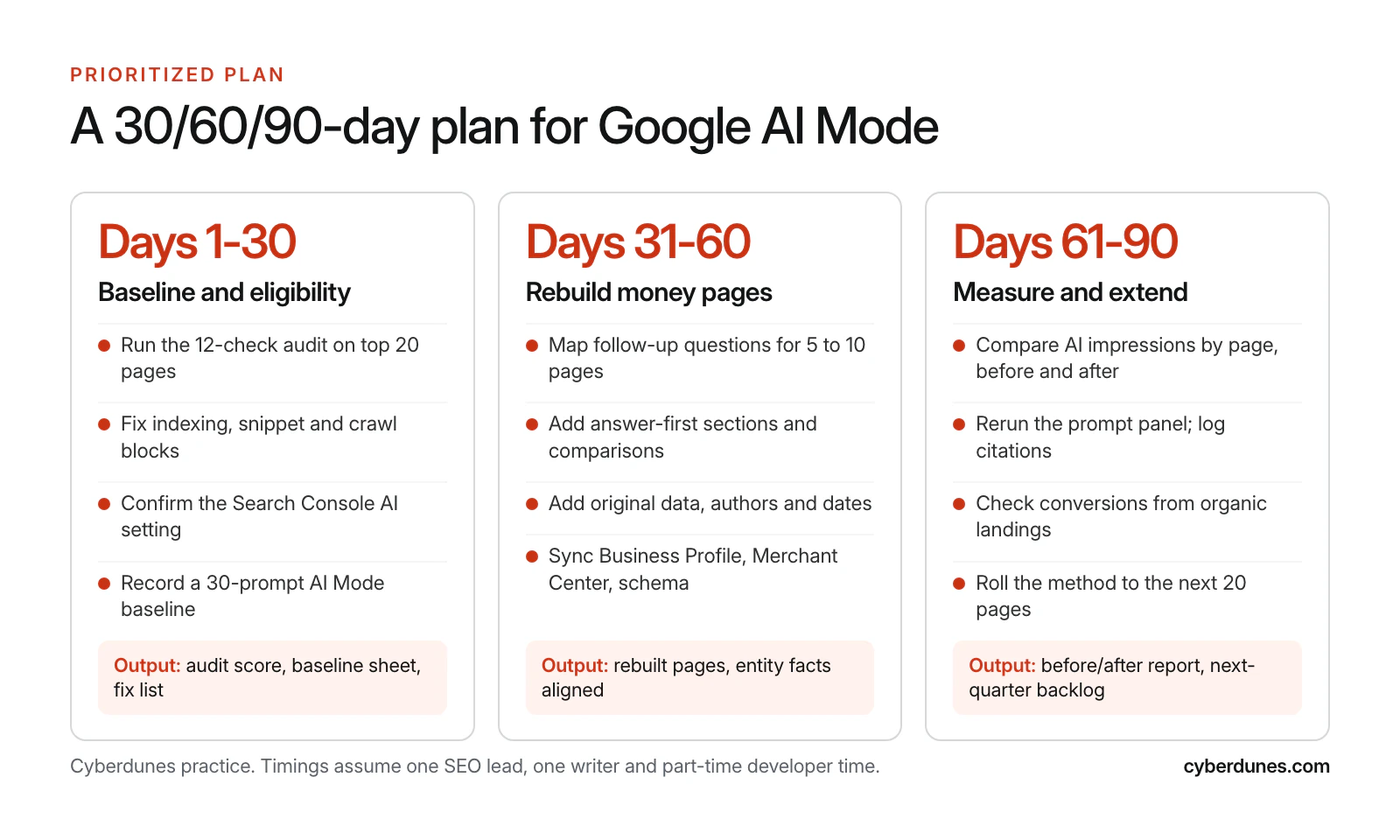
- Days 1 to 30, baseline and eligibility (owner: SEO lead). Run the 12-check audit on your top 20 revenue pages. Fix indexing, snippet and crawl blocks. Confirm the Search Console AI setting. Record a 30-prompt AI Mode baseline and export Generative AI report impressions by page.
- Days 31 to 60, rebuild money pages (owner: content lead with a subject expert). For five to ten pages, map the follow-up questions, add answer-first sections, write one honest comparison, add original data, author bylines and dates, and align Business Profile, Merchant Center and schema.
- Days 61 to 90, measure and extend (owner: analytics). Compare AI impressions and organic conversions for rebuilt pages against the baseline. Rerun the prompt panel. Turn what worked into a template and apply it to the next 20 pages.
Teams that want outside help with this cycle can work with our GEO and page speed services team.
How Cyberdunes and Apex® Help With AI Mode SEO
Apex® handles the technical layer so your team can spend its time on content. It publishes XML sitemaps, Schema.org JSON-LD and metadata, integrates Google Search Console, sends IndexNow pings and alerts you to broken links. Context Intelligence in Apex® adds site audits, topic research and an answer-first AI writer. For AI visibility, Apex® prompt tracking monitors citations and sentiment across ChatGPT, Gemini, Claude, Perplexity and Google AI Overviews; for AI Mode itself, pair it with the Search Console report and the prompt panel above. We cannot promise any page will be cited. We can make sure nothing technical stops it, and help you build pages worth citing.
Run a free AI visibility check
Sources
- Expanding AI Overviews and introducing AI Mode, Google, March 2025
- AI Mode in Google Search: Updates from Google I/O 2025, Google, May 2025
- Google Search: Introducing AI Mode in India, Google India, June 2025
- Google Search's I/O 2026 updates, Google, May 2026
- Alphabet Q2 2026 earnings: CEO remarks, Google, July 2026
- AI features and your website, Google Search Central, updated December 2025
- Optimizing your website for generative AI features on Google Search, Google Search Central, updated July 2026
- Performance report (Search results), Search Console Help, accessed October 2026
- Introducing Search Generative AI performance reports in Search Console, Google Search Central Blog, June 2026
- New controls and insights for website owners, Google, June 2026 (updated August 2026)
- AI Mode and AI Overviews updates to explore the web, Google, October 2026
- Preferred sources, Google Search Central, updated September 2026
- Are AI Mode and AI Overviews Just Different Versions of the Same Answer?, Ahrefs, December 2025
- Google is bringing ads to AI Mode, TechCrunch, May 2025
- Google Expands AI Mode With New Ad Placements For Advertisers, Search Engine Journal, May 2026