
Agentic commerce is shopping in which an AI agent does part of the buying for a person: it reads the request, compares products, checks price and delivery, fills a cart and, with the shopper's approval, pays. For a store, it means your catalog, policies and checkout must work for software as well as for people.
Key Takeaways
- Agents now shop inside Google AI Mode, the Gemini app and ChatGPT. Google's Universal Cart went live in the US on October 15, 2026, with checkout powered by the Universal Commerce Protocol (UCP).
- Discovery is ahead of checkout. OpenAI pulled back its Instant Checkout in March 2026 and now asks merchants for product feeds, while merchants keep their own checkouts.
- Product data decides whether an agent picks you: complete feeds with GTINs, structured data that matches the feed, and prices and stock that stay current within hours.
- Policies are now ranking inputs. Agents compare return windows, shipping costs and delivery dates across sellers, so vague policies cost you the sale.
- Use the 8-area agent-readiness scorecard below, then follow the 90-day roadmap for your size: SMBs fix the data first, enterprises fix price and stock drift and run a checkout pilot.
This guide is for founders, ecommerce heads and CMOs who need to decide what to change in their store before the 2027 buying season. Cyberdunes has built websites in Mumbai since 2010, and our web development team connects stores to feeds, payment gateways and structured data. Every launch date and status below comes from the company's own announcement or documentation, read in October 2026.
What Is Agentic Commerce?
Agentic commerce is ecommerce where software acts for the buyer. The shopper states a goal, and an AI agent finds, compares and, where allowed, buys.
It helps to separate three levels, because each asks different things of a merchant:
- Assisted discovery. The agent researches and recommends, then sends the shopper to your site. This is where most volume sits in 2026. Adobe measured a 693.4% year-over-year rise in traffic from generative AI tools to US retail sites over the 2025 holiday season, while noting that "the base of users remains modest" (Adobe, January 2026).
- Delegated checkout. The shopper approves a specific basket and the agent completes the purchase through a protocol such as UCP. Google's agentic checkout and Universal Cart work this way.
- Rule-based autonomy. The agent buys within limits the shopper set in advance, such as a price ceiling or a recurring grocery order. Payment networks are building for this level, but it is mostly in pilots.
Shoppers are already using AI for at least part of the job. A Visa and Morning Consult survey from October 2025 found that 47% of US shoppers use AI tools for at least one shopping task (Visa, December 2025). Agentic commerce is not a new channel to bolt on. It is a new reader of the channels you already have, and if you want the basics of promoting a store first, start with our ecommerce tips for promoting an online store.
How Does Agentic Commerce Work?
An agent turns a request into constraints, pulls candidates from a product index, verifies the offer, compares policies, then checks out or hands the cart to your site. Each step reads a different part of your store.
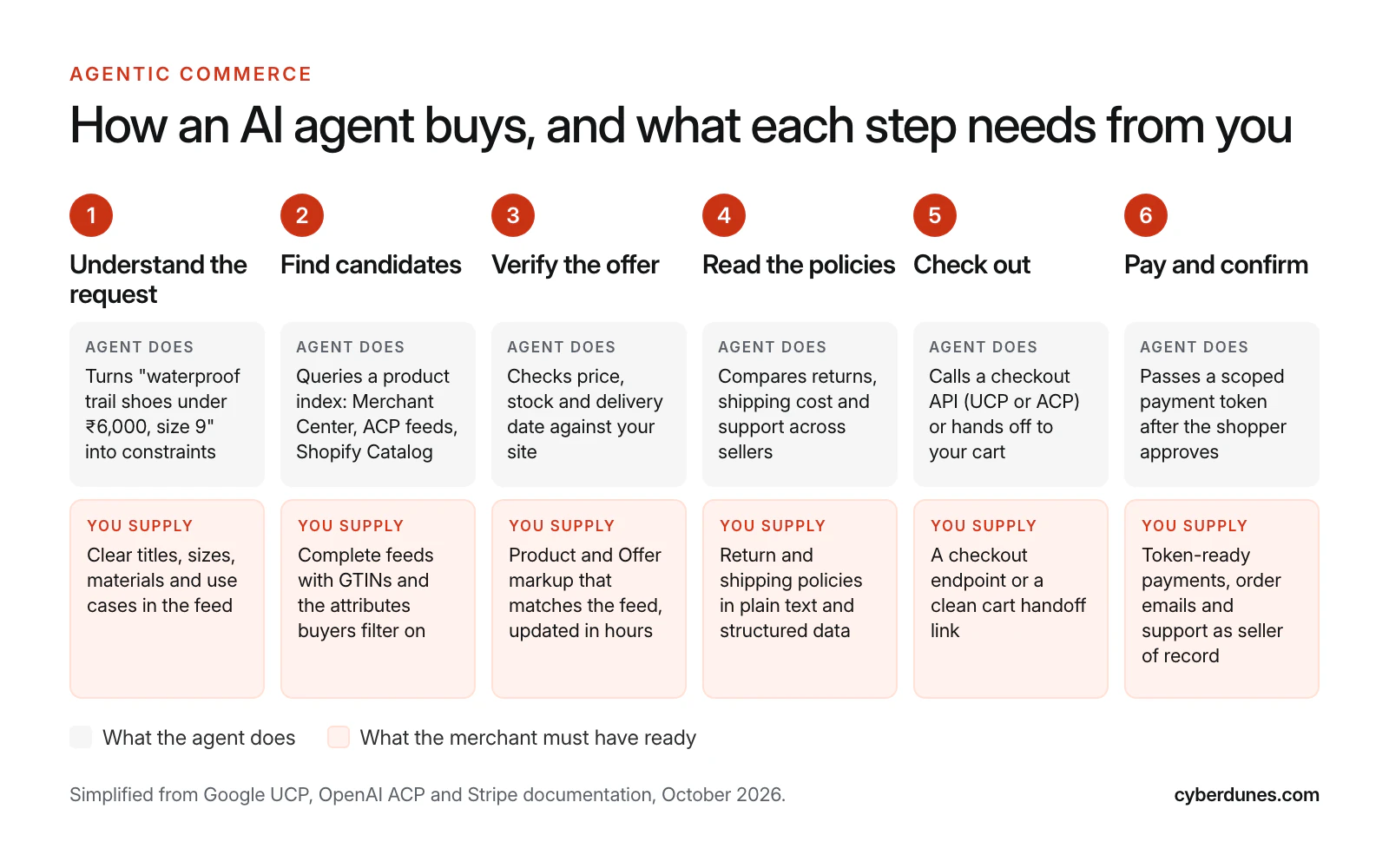
Two details matter most for merchants. First, the agent rarely browses your homepage. It queries an index built from feeds, such as Google's Shopping Graph, which Google says holds "60+ billion continually refreshed product listings" (Google, October 2026). Second, the merchant stays responsible. Under UCP, Google says retailers "will remain the seller of record" and shoppers get confirmations and support from the merchant. Returns, refunds and disputes still land on your team.
Agentic Commerce Protocols Explained: UCP, ACP and the Payment Rails
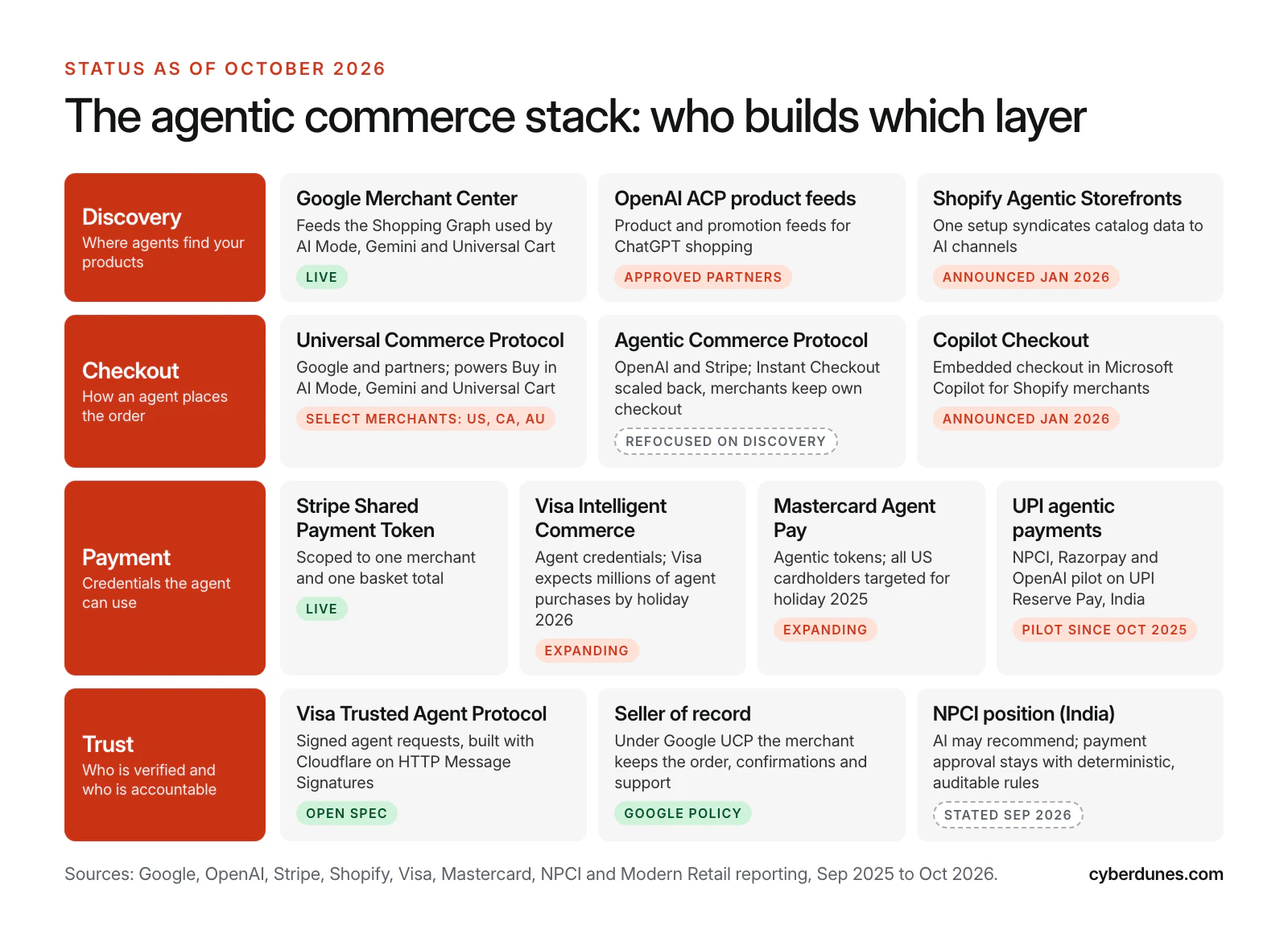
Two checkout protocols lead the market: Google's Universal Commerce Protocol and the Agentic Commerce Protocol from OpenAI and Stripe. Card networks and payment companies add the credentials agents use to pay. Here is where each stood in October 2026.
| Protocol or program | Who | What it does | Status, October 2026 |
|---|---|---|---|
| Universal Commerce Protocol (UCP) | Google, co-developed with Shopify, Etsy, Wayfair, Target and Walmart | Open standard for agent checkout; powers Buy buttons in AI Mode, Gemini and Universal Cart | Launched January 11, 2026; checkout open to select merchants for products eligible in the US, Canada and Australia |
| Agentic Commerce Protocol (ACP) | OpenAI and Stripe | Open standard for agent orders; now also carries product and promotion feeds to ChatGPT | Launched September 29, 2025 with Instant Checkout; refocused on discovery in March 2026 |
| Google agentic checkout | Google buys on the merchant's site after the shopper confirms | Rolling out in the US since November 13, 2025 (Google) | |
| Shopify Agentic Storefronts | Shopify | Syndicates merchant catalogs to ChatGPT, Copilot, AI Mode and Gemini from Shopify Admin | Announced January 11, 2026 |
| Visa Intelligent Commerce and Trusted Agent Protocol | Visa, with Cloudflare | Agent payment credentials and signed agent requests merchants can verify | Trusted Agent Protocol published October 14, 2025 |
| Mastercard Agent Pay | Mastercard | Agentic tokens with cardholder-set permissions | All US cardholders targeted by holiday 2025, global rollout to follow |
Google's Universal Commerce Protocol
Google introduced UCP on January 11, 2026 as "a new open standard for agentic commerce that works across the entire shopping journey," endorsed by more than 20 companies including Flipkart, Mastercard, Stripe and Visa (Google, January 2026). Merchant Center remains the hub for product data, and only listings with the native_commerce checkout eligibility attribute show the Buy button (Google Merchant Center Help). The default integration is native checkout inside AI Mode and Gemini, with an embedded iframe path for approved merchants, over REST or a Model Context Protocol (MCP) binding (Google for Developers). On October 15, 2026, Google launched Universal Cart in the US, a single cart across retailers that tracks price drops and restocks and lets shoppers pay with Google Pay or move items to the merchant's own cart. Our news analysis of Google agentic checkout and Universal Cart covers what changed for retailers that week.
OpenAI and Stripe's Agentic Commerce Protocol
Stripe and OpenAI released ACP on September 29, 2025, when ChatGPT users in the US could buy from US Etsy sellers inside the chat (Stripe, September 2025). Payment runs on a Shared Payment Token, scoped to one merchant and one basket total, so the AI app never sees the card.
What the ChatGPT Instant Checkout Reversal Teaches
Native checkout inside an assistant is harder than it looks. In March 2026, OpenAI said "the initial version of Instant Checkout did not offer the level of flexibility" it wanted, and merchants kept their own checkouts, as Modern Retail reported. The same report cites Walmart telling Wired that conversion was "three times lower" for items sold directly inside the chatbot than for items that sent shoppers to Walmart's site. OpenAI's developer documentation now centers on product feeds, with onboarding "currently available to approved partners" (OpenAI).
The lesson for 2027 planning: do not wait for a checkout integration. Being found and verified by agents pays off on every platform, while in-chat checkout depends on platform decisions you do not control.
Agentic Commerce in India: What Is Live and What Is Not
Indian shoppers can research with agents today, but agentic checkout for Indian merchants is limited to pilots. UCP checkout on Google covers the US, Canada and Australia, and Universal Cart is US-only.
- UPI pilot. In October 2025, NPCI, Razorpay and OpenAI launched a private beta for paying inside ChatGPT with UPI, using UPI Reserve Pay, with Axis Bank and Airtel Payments Bank as banking partners and Bigbasket among the first merchants (Electronic Payments International, October 2025).
- Regulator stance. At Global Fintech Fest on September 10, 2026, NPCI chairman Ajay Kumar Choudhary said "AI may recommend, but authentication and final settlement must follow deterministic auditable rules." A reported NPCI protocol for agent payments had not launched as of MediaNama's September 29 update, and Amazon Pay launched a "consent-based Smart Wallet for agentic UPI payments" at the same event (MediaNama, September 2026).
- Platforms. Flipkart is among the companies Google lists as endorsing UCP.
For an Indian D2C brand, the practical plan is the same as everywhere: clean feeds and structured data now, UPI and wallet readiness for when agent payments open, and a checkout pilot in the US, Canada or Australia if you already ship there.
Product Feed Quality: The Work That Decides Whether Agents Pick You
Your product feed is the storefront an agent sees. If an attribute is missing, the agent cannot match it to a request, so your product drops out before price is even compared.
Prioritize these fields on your best-selling SKUs first:
- Identifiers: GTIN, brand and MPN. They let an agent match your listing to reviews and comparisons across the web.
- Filter attributes: size, color, material, gender, age group, pattern and compatibility. These are the words shoppers put in prompts.
- Commercial fields: price, sale price, availability, shipping cost, delivery time and return window.
- Descriptions written for questions: what the product is for, who it suits and what it does not do. Agents quote specifics, not slogans.
Freshness matters as much as completeness. OpenAI recommends sending "the entire feed once a day via file upload, and then send updates throughout the day via the API," and promotions can only go through the API (OpenAI). Google's Universal Cart alerts shoppers to price drops and restocks, so stale stock data now shows up in front of buyers. On Shopify, Agentic Storefronts lets merchants "set up product data once" and syndicate it to AI channels (Shopify, January 2026). If you are still choosing a platform, our comparison of WooCommerce and Shopify covers the trade-offs.
Structured Data, Prices and Policies Agents Can Verify
Agents cross-check the feed against your product page. Structured data that matches the feed, plus policies written as clear rules, makes your offer verifiable.
Google's merchant listing documentation requires name, image, a price greater than zero and priceCurrency, and recommends gtin, availability, shippingDetails and hasMerchantReturnPolicy (Google Search Central). For shipping and returns that apply store-wide, Google recommends a global policy under Organization markup instead of repeating it per product.
Three failure modes to check first:
- Price drift. The feed shows one price, the page another after a flash sale. An agent that finds a mismatch has a reason to pick another seller.
- Policies as prose. "Easy returns" tells an agent nothing. "Returns accepted within 30 days, free pickup in metro cities, refund to source within 7 days" can be compared.
- Policies only in images or PDFs. Put the rules in HTML text and markup, then keep both in sync.
The page itself must also be usable by software: stable URLs, server-rendered prices and no login wall before the cart. Our guide on designing sites AI agents can use covers the interface side in depth.
Checkout APIs, Trust and Fraud Controls
You need a way for an agent to complete or hand off an order, and a way to tell a legitimate shopping agent from a scraper. Both are now standard engineering work.
- Checkout path. At minimum, support deep links that open a filled cart and allow guest checkout. Next, plan a UCP integration (join Google's waitlist) or an ACP integration if you sell through ChatGPT partners.
- Agent identity. Visa's Trusted Agent Protocol uses agent-specific cryptographic signatures so merchants can recognize approved agents, built on the HTTP Message Signature standard with Cloudflare (Visa, October 2025). Review bot rules so you are not blocking verified shopping agents along with scrapers. Our guide to which AI bots to allow or block helps set that policy.
- Payment credentials. Tokens limit what an agent can spend. Stripe's Shared Payment Token is limited to one merchant and basket total, and Mastercard's Agent Pay uses agentic tokens with permissions set by the cardholder (Mastercard, September 2025).
- Fraud rules. Agree with your payments team how agent orders are flagged, what velocity limits apply and who handles disputes.
Visa predicts "millions of consumers will use AI agents to complete purchases by the 2026 holiday season" (Visa, December 2025). Treat that as the vendor's forecast, and build controls before volume arrives.
How to Measure Agentic Commerce
Measure three things: how often AI answers recommend you, how much traffic and how many orders AI sends, and whether those orders are profitable after returns.
| Metric | What it tells you | Where to get it |
|---|---|---|
| AI answer share | How often assistants name or cite you for buyer prompts | Prompt tracking across ChatGPT, Gemini, Claude, Perplexity and Google AI Overviews |
| AI referral sessions and conversion | Traffic and orders from assistants | Analytics channel group for AI referrers |
| Agent-placed orders | Orders completed through UCP, ACP or cart handoff | Order source tags from your checkout or platform |
| Feed errors and disapprovals | Products agents cannot see | Merchant Center diagnostics |
| Return rate and margin on AI orders | Whether agent sales are good sales | Order management system |
Our guide to tracking AI referral traffic in GA4 shows the channel setup, and an AI visibility checker gives you a baseline of how assistants describe your products today.
The Agent-Readiness Scorecard
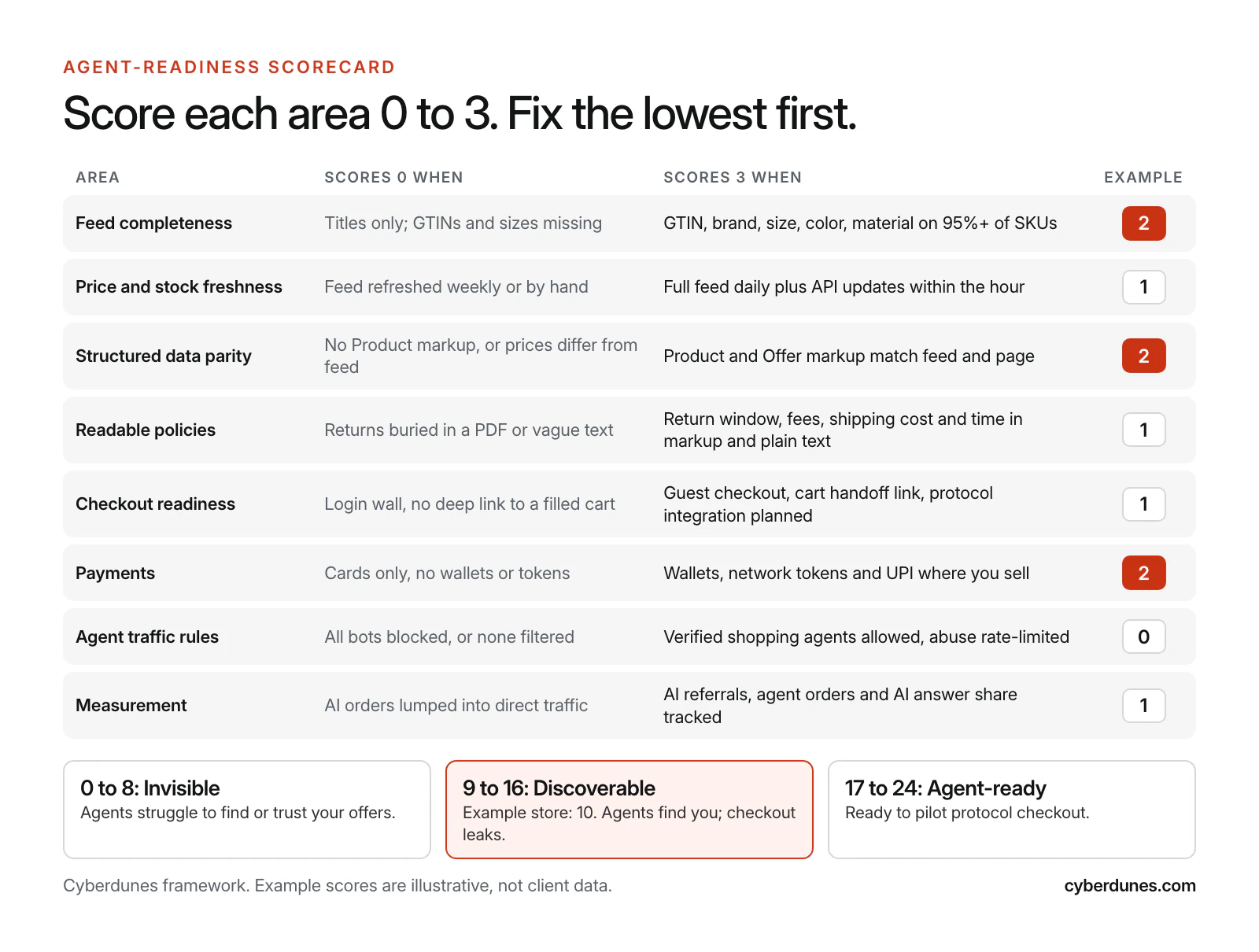
Score your store from 0 to 3 in each of eight areas, for a total out of 24. Fix the lowest scores first, because agents drop a seller at the weakest step.
How to use the bands:
- 0 to 8, invisible: spend the next month on feed completeness and structured data before anything else.
- 9 to 16, discoverable: agents find you, but freshness, policies or checkout leak orders.
- 17 to 24, agent-ready: you are ready to apply for UCP or ACP checkout and run a measured pilot.
Score with two people, one from ecommerce operations and one from engineering. The gaps between their scores usually point to the real problem.
A 90-Day Agentic Commerce Roadmap for SMBs and Enterprises
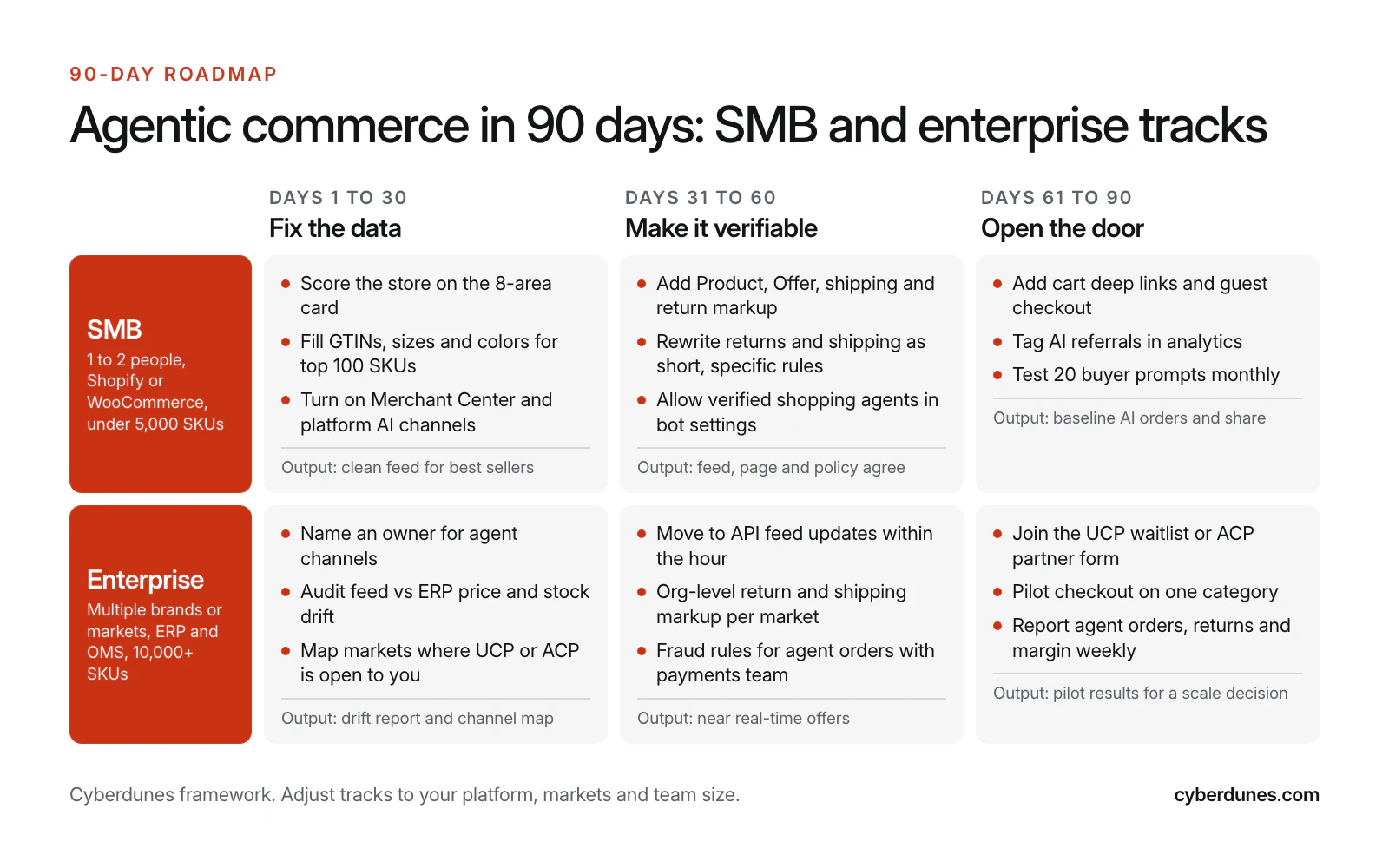
Spend the first month on data, the second on verification and the third on checkout and measurement. The work is the same in kind for both sizes; the scale and owners differ.
SMB Track (Under 5,000 SKUs)
- Days 1 to 30: score the store, fill GTINs and filter attributes for your top 100 SKUs, and connect Merchant Center plus your platform's AI channels.
- Days 31 to 60: add Product, Offer, shipping and return markup; rewrite policies as specific rules; allow verified shopping agents.
- Days 61 to 90: add cart deep links and guest checkout, tag AI referrals, and test 20 buyer prompts every month.
Enterprise Track (10,000+ SKUs, Several Markets)
- Days 1 to 30: name one owner for agent channels, audit drift between feed and ERP prices and stock, and map which markets UCP or ACP covers for you.
- Days 31 to 60: move to API updates within the hour, publish Organization-level return and shipping markup per market, and agree fraud rules for agent orders.
- Days 61 to 90: apply for UCP or ACP access, pilot checkout on one category, and report agent orders, returns and margin weekly.
Owners matter more than tools here. In enterprises, feeds often belong to performance marketing, markup to the web team and policies to legal. Put them in one weekly review, or the agent will see three versions of your store.
How Cyberdunes and Apex® Help Stores Get Agent-Ready
We help with the parts of agent readiness that sit in your website and content. Apex®, the AI-native digital experience platform (DXP), generates Schema.org JSON-LD, XML sitemaps and llms.txt, connects ecommerce, payments and CRM through its API layer, and supports MCP so AI assistants can work with your content through a standard interface. Its AI visibility tools track prompts, citations and sentiment across ChatGPT, Gemini, Claude, Perplexity and Google AI Overviews, so you can see whether agents describe your products correctly.
Our web development team handles feed and markup audits, checkout deep links and analytics setup. We do not promise placement in any AI answer; we make your store easy to find, verify and buy from.
Book an agent-readiness review
Sources
- Google's New Universal Cart Launches Today in the U.S. (Google, October 2026)
- New Tech and Tools for Retailers to Succeed in an Agentic Shopping Era (Google, January 2026)
- About the Universal Commerce Protocol and UCP-Powered Checkout (Google Merchant Center Help, accessed October 2026)
- Getting Started With Universal Commerce Protocol on Google (Google for Developers, accessed October 2026)
- Google Shopping Launches Agentic Checkout and More AI Shopping Tools (Google, November 2025)
- Merchant Listing Structured Data (Google Search Central, accessed October 2026)
- Stripe Powers Instant Checkout in ChatGPT and Releases Agentic Commerce Protocol (Stripe, September 2025)
- Agentic Commerce: Get Started (OpenAI Developers, accessed October 2026)
- What Went Wrong With ChatGPT's Instant Checkout (Modern Retail, March 2026)
- The Agentic Commerce Platform: Shopify Connects Any Merchant to Every AI Conversation (Shopify, January 2026)
- Visa Unveils Trusted Agent Protocol for AI Commerce (Visa, October 2025)
- Visa and Partners Complete Secure AI Transactions (Visa, December 2025)
- Mastercard Unveils New Tools and Collaborations to Power Smarter, Safer Agentic Commerce (Mastercard, September 2025)
- India Launches Pilot for Agentic AI Payments via ChatGPT (Electronic Payments International, October 2025)
- NPCI Says AI Shouldn't Approve UPI Payments at GFF 2026 (MediaNama, September 2026)
- Adobe Holiday Shopping Season 2025 Results (Adobe, January 2026)