Query fan-out is the technique AI search engines use to split one question into many related sub-queries, run those searches at the same time and combine the results into one answer. Google uses it in AI Mode and AI Overviews, which means your pages are judged against questions the user never typed.
Key Takeaways
- Google defines query fan-out as "a set of concurrent, related queries generated by the model" to fetch more results for the user's question.
- Ranking for the head term is no longer enough. In one study, pages ranking for both the main query and its fan-outs made up 51.2% of AI Overview citations that ranked organically.
- Google warns that creating separate pages for every fan-out variation, mainly to manipulate AI answers, breaks its scaled content abuse policy. Map sub-queries to sections first, pages second.
- Use our mapping template to list sub-queries, label their type and assign each a home on your site.
- Score coverage with weight times score. Our hotel example moves from 23% to 89% without creating a single thin page.
This guide is for marketing and content leaders who own pages that should appear in AI answers. We are the SEO and generative engine optimization (GEO) team at Cyberdunes; we map buyer questions for B2B and hospitality sites and build the Apex® AI-native digital experience platform (DXP) they publish on. The method below is ours; the facts about how fan-out works come from Google's documentation and patents, linked inline.
What Is Query Fan-Out?
Query fan-out is when an AI search system rewrites one question into several narrower searches, runs them in parallel and grounds its answer in what comes back. It is how AI Mode answers questions that would once have taken a user several separate searches.
Google named the technique when it introduced AI Mode in March 2025: it issues "multiple related searches concurrently across subtopics and multiple data sources" and then brings the results together. Its guide to generative AI features gives a plain example. A user asks "how to fix a lawn that's full of weeds"; the fan-out queries might include "best herbicides for lawns", "remove weeds without chemicals" and "how to prevent weeds in lawn". Google's AI features documentation says both AI Overviews and AI Mode may use it, and for heavier research Deep Search can issue hundreds of searches.
In short: the "query fan out meaning" for marketers is that one buyer question now creates a dozen retrieval opportunities, and your page can win any of them. For the related vocabulary, see our AI search and GEO glossary.
How Does Query Fan-Out Work?
A model reads the question and its context, writes several sub-queries, retrieves results for each from the search index, selects the passages that answer them best and writes one response with links. Each step filters out pages that are vague, hard to crawl or answer nothing specific.
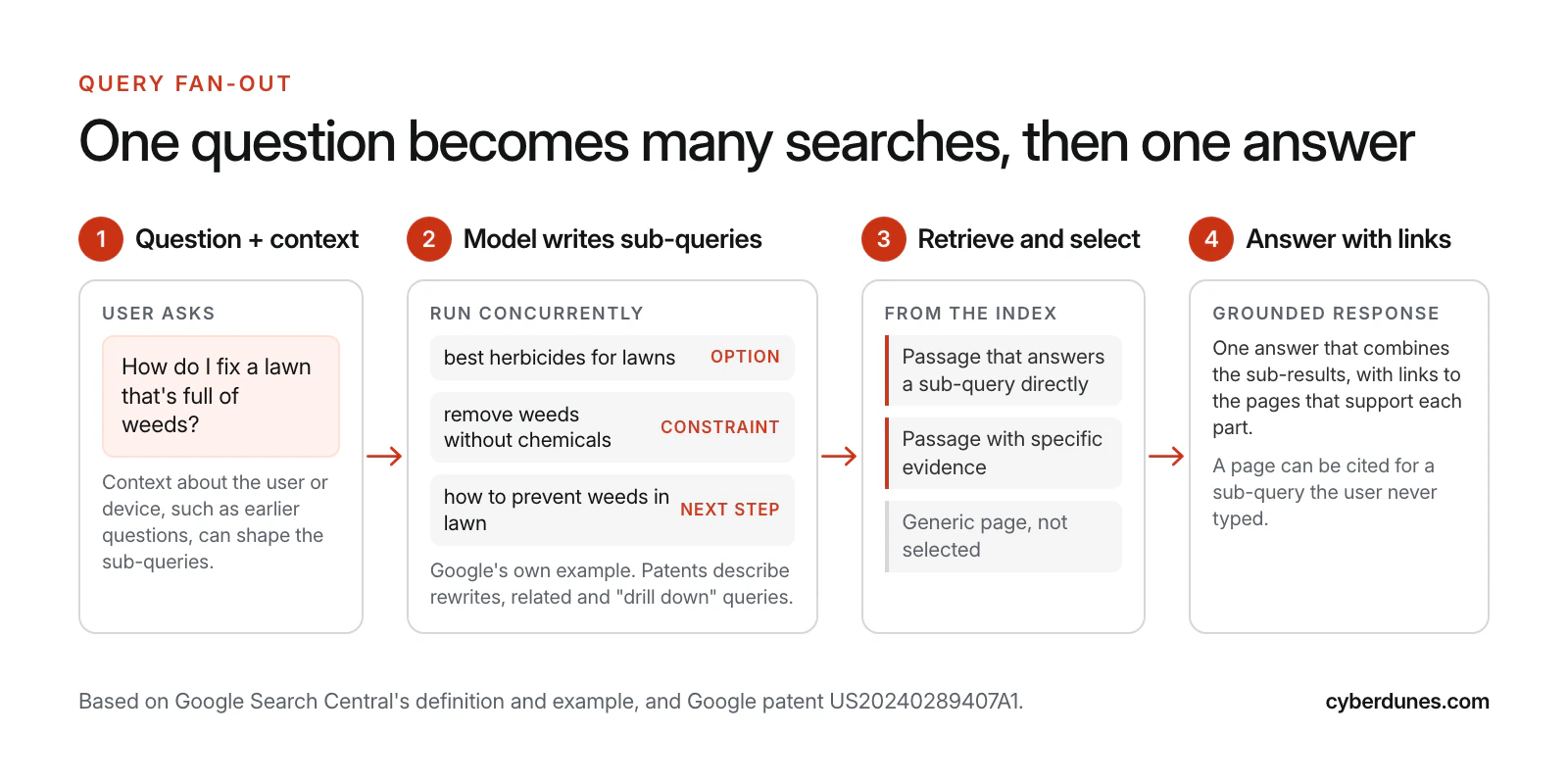
Google has not published its production system, but its patent filings show the shape of the idea. Patent application US20240289407A1, "Search with stateful chat", filed by Google in February 2024 and published in August 2024, describes generating "synthetic queries" from a generative model's output, using the user's query plus "contextual information associated with the user or the client device." It describes these as rewrites, supplemental queries and "drill down" queries, then selecting search result documents responsive to "the query and the one or more synthetic queries."
Two cautions from reading the filings ourselves:
- A patent is not a product. Filings describe what Google may do, not what AI Mode does today.
- Not every cited patent is about fan-out. Wo2024064249a1, often quoted in fan-out articles, describes using a large language model to create synthetic query-document pairs to train a retrieval model. That is about training retrievers, not about splitting a live user question.
Context matters too. In its study, Surfer notes that fan-outs vary with what is known about the user and that "only around 27% of fanouts stay consistent across multiple searches for the same prompt." Plan for clusters of likely sub-queries, not one fixed list.
Why Is Ranking for the Head Term No Longer Enough?
Because AI answers increasingly cite pages that rank for the sub-queries, not only the main query. If you rank first for the head term but have nothing on cost, risk or fit, the model finds those answers elsewhere and cites that page too, or instead.
The evidence is directional, not causal, but it points one way:
- In July 2025, Ahrefs found 76.10% of AI Overview-cited pages ranked in the top 10 for the query. Its March 2026 update, using a revised method on 863,000 keyword SERPs and 4 million AI Overview URLs, found 37.9%. Ahrefs suggests AI Overviews are "relying less on the direct search results and more on the sources showing up in fan out query SERPs." The two figures are not a like-for-like trend because the method changed.
- Surfer's study of 173,902 URLs pulled fan-outs for 10,000 keywords. Of AI Overview citations that ranked organically, 51.2% ranked for the main query and at least one fan-out, while 19.6% ranked only for the main query, which Surfer reports as 161% more likely to be cited. It measured a Spearman correlation of 0.77 between fan-outs ranked for and citation likelihood.
- The same study found 67.82% of AI Overview citations did not rank in the top 10 for either the main query or any fan-out it tracked.
Read these with care. Surfer generated its fan-outs with Gemini, not from Google's live system, and it says plainly that "correlation ≠ causation." The safe conclusion: coverage of the sub-questions is strongly associated with being cited, and it costs little to get right. Our explainer on how LLMs choose sources to cite covers the passage-level side.
What Does Google Warn Against?
Google says spinning up pages for every fan-out variation, mainly to manipulate rankings or AI responses, violates its scaled content abuse policy. Fan-out mapping should decide what your existing pages must answer, not how many new pages to publish.
Google's optimization guide is direct: creating separate content "for every possible variation of how people might search (for example, by focusing on other queries that people have asked, or fan-out queries)" primarily to manipulate results "violates Google's scaled content abuse spam policy." It adds that "a high quantity of pages doesn't make a website higher quality," and that you do not need to capture "every variation of how someone might seek content like yours" because its systems understand synonyms.
So the unit of work is the sub-question, and the default home for it is a section on a strong page. A new page is the exception, used when the sub-question has its own intent and enough substance to stand alone.
How Do You Build a Fan-Out Map for a Topic?
Start from one real buyer prompt, collect candidate sub-queries from five sources, keep the ones that recur, label each by type and assign it a home. Plan on about half a day of a strategist's time for a first map.
- Write the buyer prompt. Use the full question a buyer would type into AI Mode or ChatGPT, with their constraints. "Hotel for an offsite" is a keyword; "Which hotel near Bengaluru airport can host a 150-person corporate offsite with breakout rooms?" is a prompt.
- Collect candidates from five sources. Run the prompt three to five times in AI Mode and Gemini and note the topics each answer covers; pull Google autocomplete and "People also ask" for the head term; export related queries from Search Console; and list the questions your sales and support teams hear every week. Our roundup of keyword research tools covers the autocomplete and volume side.
- Cluster and keep what recurs. Merge near-duplicates. Keep a sub-query if it appears in at least two sources or two runs. Because fan-outs are unstable, recurrence is a better filter than any single run.
- Label each by type and intent. Use the eight types below. The type tells you what evidence the answer needs.
- Weight each sub-query 1 to 3. 3 if a wrong or missing answer would knock you off the shortlist, 2 if it shapes the choice, 1 if it is nice to have.
- Assign a home and an owner. Use the section-or-page rules later in this guide, then score coverage.
| Fan-out type | What the buyer is checking | Best answer format |
|---|---|---|
| Definition | What something is or means | Two-sentence definition under its own heading |
| Constraint | Whether you fit their requirements | Table of capacities, specs or options |
| Comparison | How options differ | Side-by-side table with honest "best for" rows |
| Cost | Budget and price drivers | Ranges or what is included, plus what changes the price |
| Process | How to do it, and how long it takes | Numbered steps with timings |
| Risk | Terms, policies, what can go wrong | Plain-language policy summary with a link to full terms |
| Proof | Whether it worked for others | Named reviews, case studies, numbers with sources |
| Context | Location, timing, surroundings | Specific facts: drive times, seasons, nearby options |
The Fan-Out Mapping Template
Keep the map in one sheet with one row per sub-query: the sub-query, its type, the intent behind it, the evidence it needs, where it is answered, a weight and a coverage score. That sheet becomes the brief for writers and the checklist for editors.
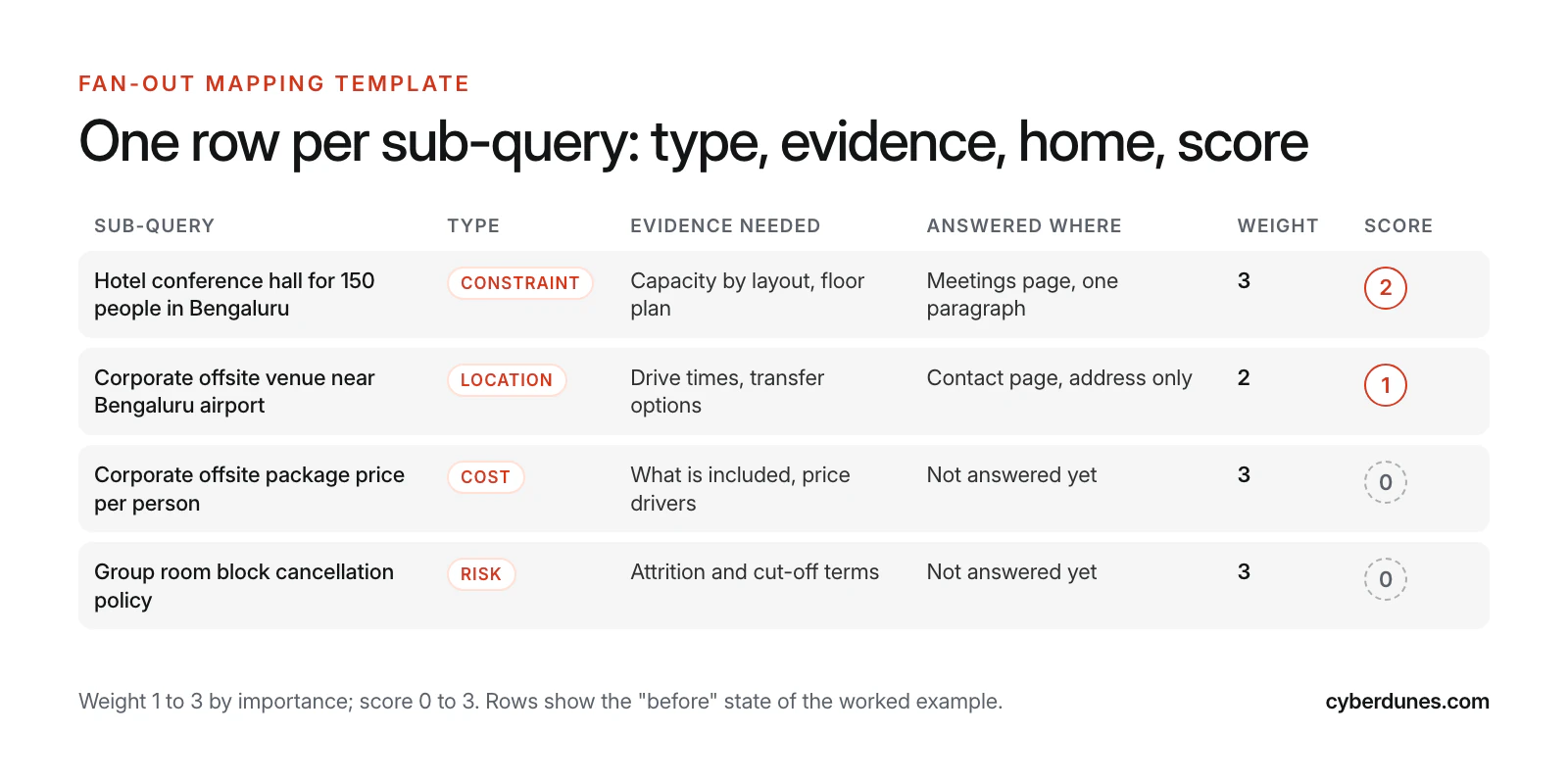
| Column | What to enter | Example |
|---|---|---|
| Sub-query | The narrow search the engine is likely to run | Group room block and cancellation policy |
| Type | One of the eight types above | Risk |
| Intent | The buyer's real question, in their words | What if our numbers change? |
| Evidence needed | The specific facts that make the answer citable | Cut-off dates, attrition terms, deposit rules |
| Answered where | URL plus heading, or "not answered" | /meetings/#group-booking-terms |
| Weight | 1 to 3, by impact on the shortlist | 3 |
| Score | 0 to 3 coverage (rubric below) | 0 before, 3 after |
| Owner | Who supplies the facts | Sales manager, events |
Worked Example: A Corporate Offsite Query for a Hotel
Here is a full map for a fictional business hotel near Bengaluru airport. The buyer prompt produced 12 recurring sub-queries; ten belong on one Meetings and Events page and two are better served by short guides.
The prompt: "Which hotel near Bengaluru airport can host a 150-person corporate offsite with breakout rooms?" The table shows each sub-query, its type, the intent, its weight and the coverage score before and after the rebuild.
| # | Sub-query | Type | Buyer intent | Weight | Before | After | Answered where |
|---|---|---|---|---|---|---|---|
| Q1 | Hotel conference hall for 150 people in Bengaluru | Constraint | Can it fit us? | 3 | 2 | 3 | Hub: capacity by layout table |
| Q2 | Corporate offsite venue near Bengaluru airport | Location | Is it easy to reach? | 2 | 1 | 3 | Hub: location and access, with drive times |
| Q3 | Hotel with breakout rooms for workshops | Constraint | Can we split into groups? | 2 | 1 | 3 | Hub: breakout rooms and sizes |
| Q4 | Corporate offsite package price per person | Cost | What budget do we need? | 3 | 0 | 2 | Hub: packages and pricing, with price drivers |
| Q5 | Residential conference package vs day delegate rate | Comparison | Which format suits us? | 2 | 0 | 3 | Hub: packages and pricing |
| Q6 | Hotel AV and hybrid meeting setup | Constraint | Will remote staff join easily? | 2 | 1 | 3 | Hub: AV and hybrid setup |
| Q7 | Team-building activities near the venue | Context | What fills the evenings? | 1 | 0 | 2 | Guide: team activities |
| Q8 | Group room block and cancellation policy | Risk | What if numbers change? | 3 | 0 | 3 | Hub: group booking terms |
| Q9 | Best months for an offsite in Bengaluru | Context | When should we go? | 1 | 0 | 2 | Guide: offsite planning |
| Q10 | Vegetarian and Jain catering for corporate events | Constraint | Can everyone eat well? | 2 | 1 | 3 | Hub: catering |
| Q11 | Reviews of the hotel for corporate events | Proof | Has it worked for firms like us? | 3 | 1 | 2 | Hub: corporate reviews and past events |
| Q12 | Hotel GST invoice for company bookings | Risk | Will finance approve it? | 1 | 0 | 3 | Hub: billing |
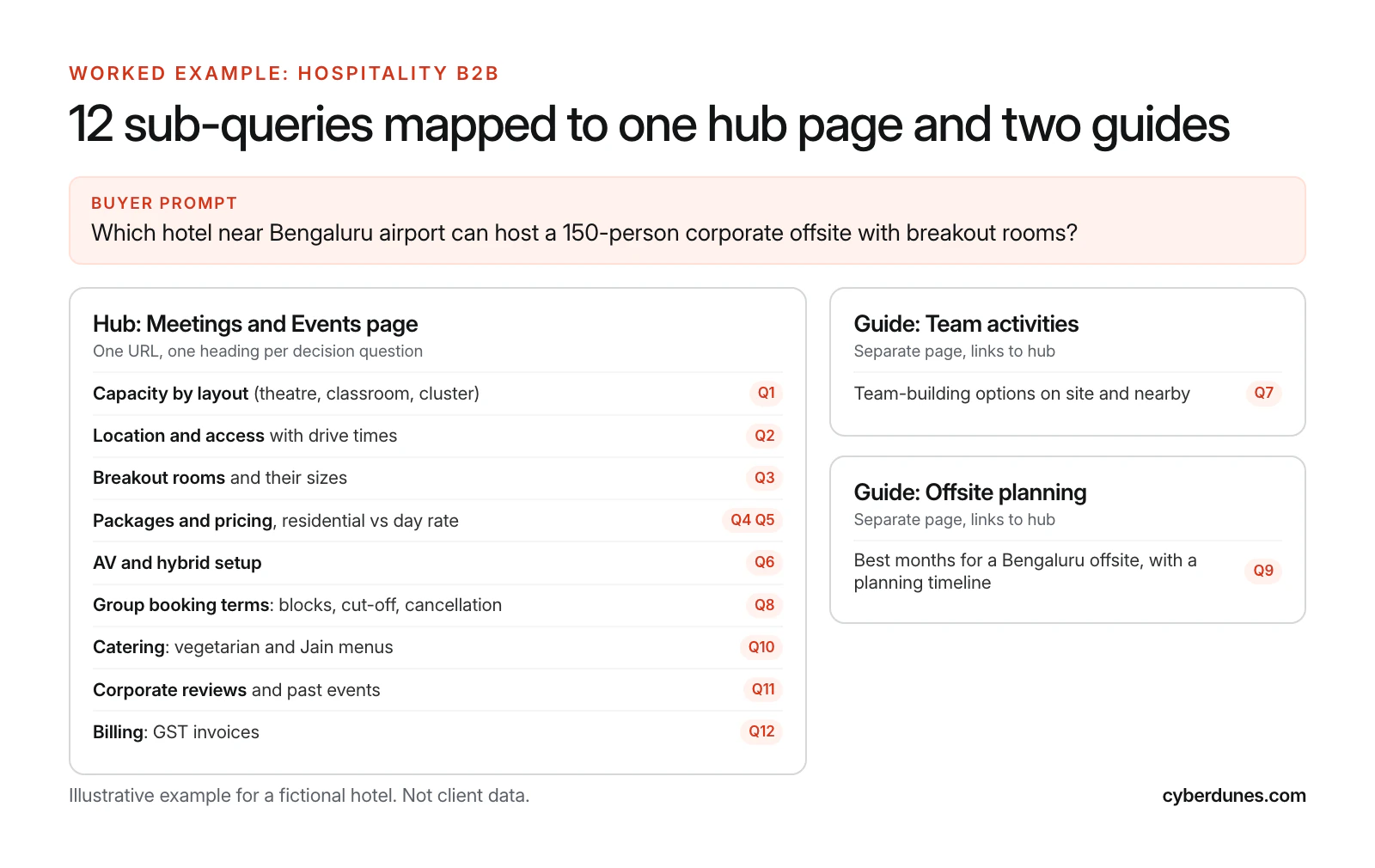
Three things stand out. The highest-weight gaps (price, group terms, corporate proof) were the ones the old page skipped or only mentioned, because they felt "sales" rather than "content." Two sub-queries are context questions a planner asks before choosing any hotel, so a short guide that links to the hub serves them better than padding the hub. And the GST invoice answer took one sentence from the finance team, yet scores a full 3. If you run a hotel, our hotel marketing guide covers the wider funnel.
How Do You Score Fan-Out Coverage?
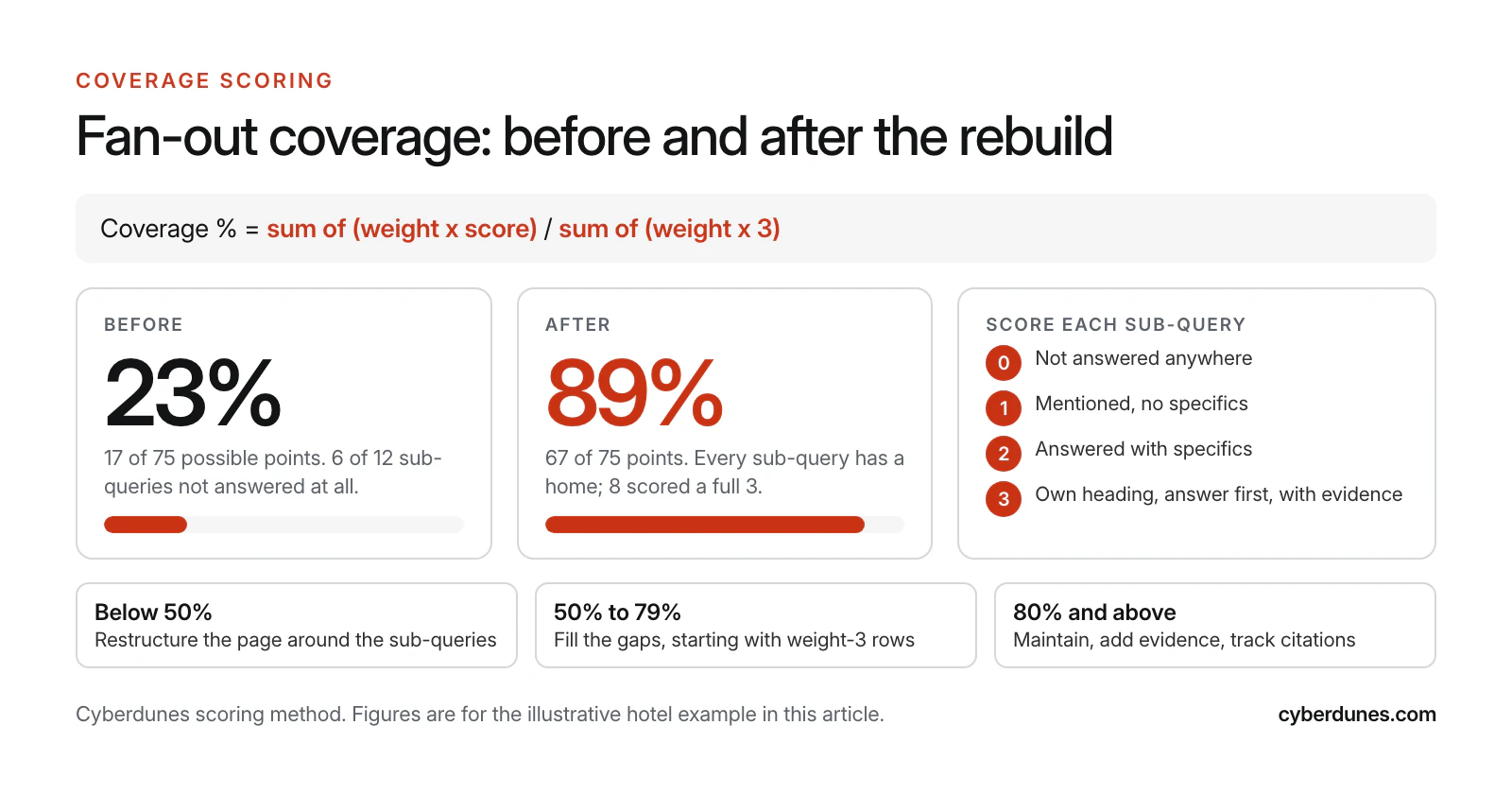
Score each sub-query 0 to 3, multiply by its weight, add up the results and divide by the maximum possible. The percentage tells you whether to restructure the page, fill gaps or maintain it.
- 0: not answered anywhere on the site.
- 1: mentioned, but with no specifics a model could quote.
- 2: answered with specifics, but buried in another section or without evidence.
- 3: its own heading, a direct answer in the first two sentences, and evidence such as numbers, a table or a named source.
Coverage % = sum of (weight × score) / sum of (weight × 3). In the hotel example the weights add up to 25, so the maximum is 75 points. Before the rebuild the page scored 17 points: 17 / 75 = 23%. After, it scored 67 points: 67 / 75 = 89%.
| Coverage | What it usually means | Next action |
|---|---|---|
| Below 50% | The page was written around a keyword, not a decision | Restructure around the weight-3 sub-queries first |
| 50% to 79% | Good bones, missing the uncomfortable answers | Fill gaps in price, risk and proof |
| 80% and above | Complete for this prompt | Add original evidence; track citations; map the next prompt |
Add one more check per sub-query: does any of your pages rank in the top 10 for it? Coverage measures whether you answer the question; ranking measures whether retrieval can find the answer. Both matter.
Should a Sub-Query Get a Section or Its Own Page?
Default to a section. Give a sub-query its own page only when it has a distinct intent, real search demand of its own and enough substance to help a reader who never sees the hub.
| Signal | Section on the hub | Separate page | FAQ entry |
|---|---|---|---|
| Same buyer, same decision as the hub | Yes | No | If one line |
| Different stage (research before choosing a vendor) | No | Yes, linked to the hub | No |
| Answer needs 400+ words, steps or media | Maybe | Yes | No |
| Answer is a single fact (invoice, parking, hours) | Short section | No | Yes |
| Only differs from another page by wording | Merge | No, this is the pattern Google warns about | No |
This is the same hub-and-guide structure we recommend in our complete guide to generative engine optimization, applied one prompt at a time.
Which Query Fan-Out Tools Can You Trust?
No tool can show you Google's real fan-out queries. Google states that "no third-party tool has access to our internal ranking or AI systems," so every "query fan-out tool" or generator is a simulation by another model.
Simulations are still useful for brainstorming candidates, as long as you treat them as one source among five and keep only what recurs. What you can measure directly:
- Search Console. AI Mode activity is counted in the Performance report, and Search Console Help notes that a follow-up question in AI Mode counts as a new query. Watch for longer, sub-query-shaped queries appearing against your hub page.
- Generative AI performance report. Since June 2026, Search Console shows impressions by page, country and device for AI Overviews, AI Mode and Discover AI features. Compare a rebuilt page before and after.
- A prompt panel. Track the original buyer prompt and five variants every four weeks for citations and mentions.
Context Intelligence in Apex® combines topic research, an answer-first AI writer and site audits, which shortens steps 2 to 6 of the method. For the full Google side of this, read our sibling guide to Google AI Mode SEO.
What Does Query Fan-Out Mean for B2B Marketing Teams?
It moves content planning closer to sales. The sub-queries that decide shortlists are about price, risk, integration and proof, and the people who know those answers sit in sales, finance and delivery, not marketing.
Three changes we suggest to clients: give each money page a named fact owner outside marketing; review the fan-out map in the same meeting as lost-deal reasons; and publish the uncomfortable answers (pricing approach, contract terms, who you are not right for). Buyers now ask AI for shortlists, as our guide on how B2B buyers use AI to shortlist vendors explains, and those answers are what the model needs to include you. Many of these answers will be read in the AI response without a click; our plan for zero-click search covers how to report that value.
How Cyberdunes and Apex® Help With Query Fan-Out
Our GEO and page speed services team builds fan-out maps for your priority prompts, scores coverage and rebuilds the pages that score under 50%. Apex® handles the technical layer: XML sitemaps, Schema.org JSON-LD, metadata, Google Search Console integration and IndexNow. Apex® prompt tracking then monitors whether ChatGPT, Gemini, Claude, Perplexity and Google AI Overviews cite and mention you for the prompts you mapped. We do not promise citations; we make sure your pages answer the questions that earn them.
Run a free AI visibility check
Talk to us about a fan-out audit
Sources
- Optimizing your website for generative AI features on Google Search, Google Search Central, updated July 2026
- AI features and your website, Google Search Central, updated December 2025
- Expanding AI Overviews and introducing AI Mode, Google, March 2025
- AI Mode in Google Search: Updates from Google I/O 2025, Google, May 2025
- US20240289407A1: Search with stateful chat, Google LLC via Google Patents, published August 2024
- WO2024064249A1: Systems and methods for prompt-based query generation for diverse retrieval, Google LLC via Google Patents, published March 2024
- 76% of AI Overview Citations Pull From the Top 10, Ahrefs, July 2025
- Update: 38% of AI Overview Citations Pull From The Top 10, Ahrefs, March 2026
- Ranking for Multiple Fan-Out Queries Dramatically Increases Your Chances of Getting Cited in AIOs, Surfer, updated September 2026
- Performance report (Search results), Search Console Help, accessed October 2026
- Introducing Search Generative AI performance reports in Search Console, Google Search Central Blog, June 2026