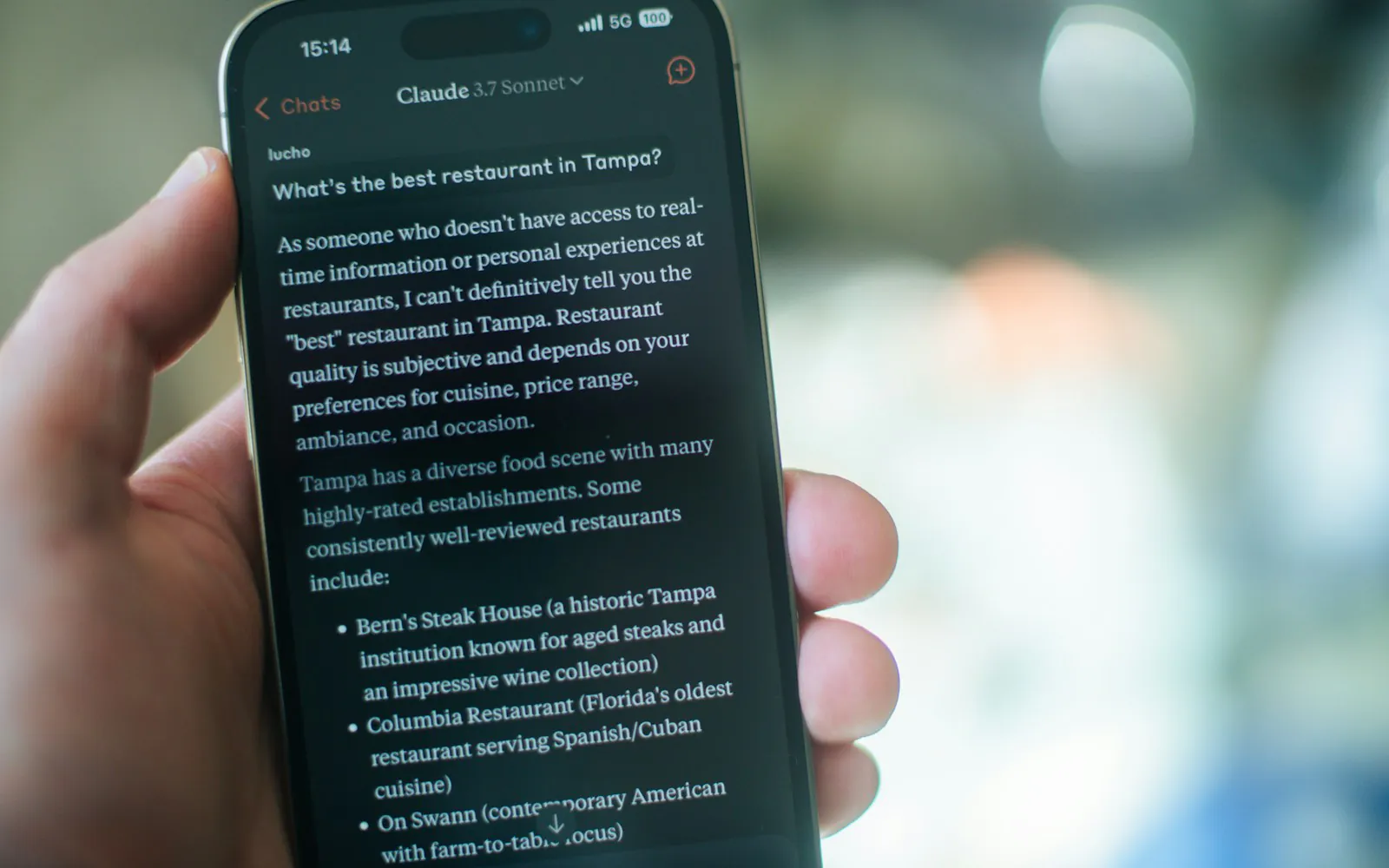
AI hallucinations about your brand are confident but wrong statements that ChatGPT, Gemini, Claude, Perplexity or Google AI Overviews make about your company: an old price, a closed location, a former CEO, a feature you never built, or facts borrowed from a similarly named business. You cannot edit the answer directly, but you can fix the sources it draws on.
Key Takeaways
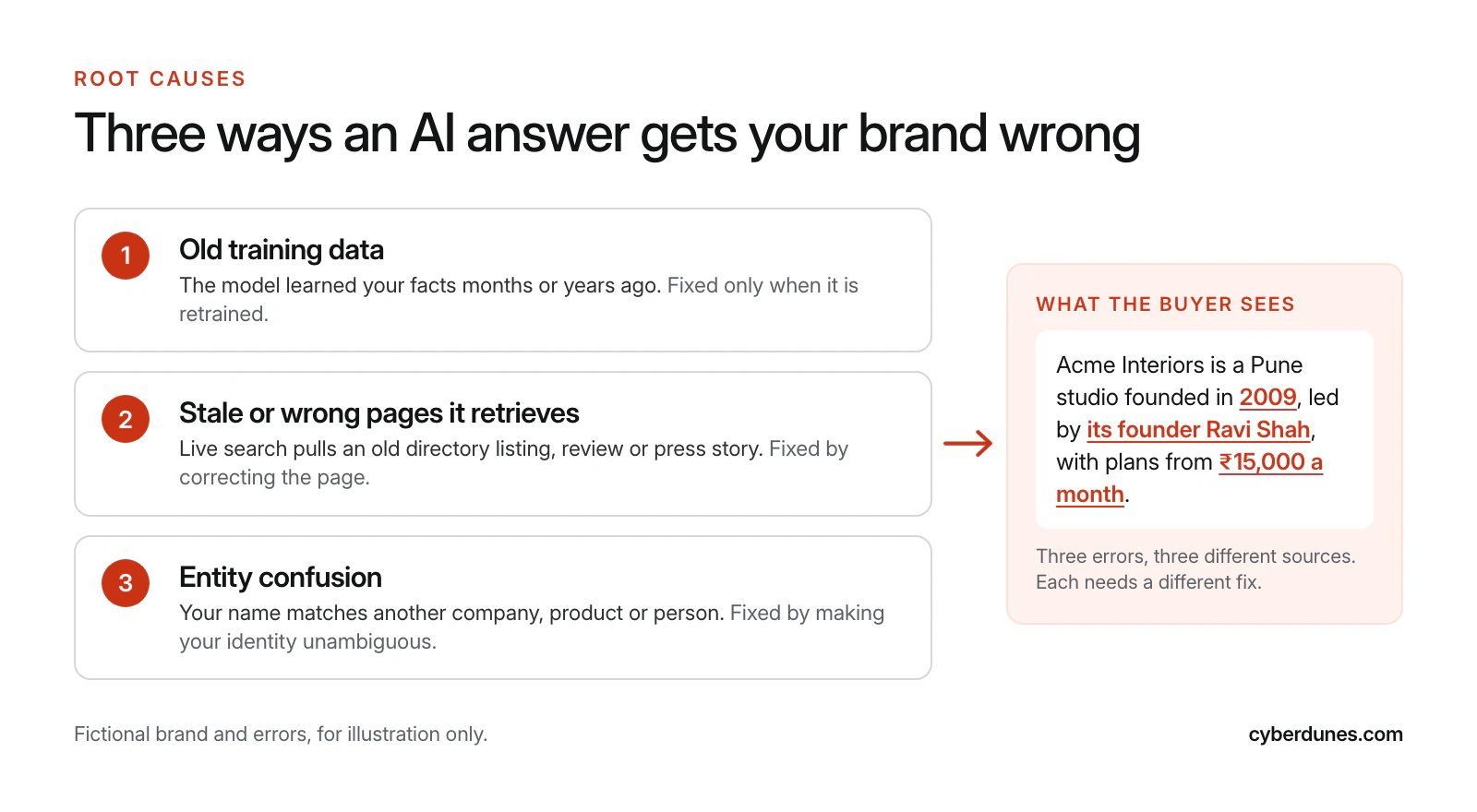
- Most wrong answers trace back to one of three causes: old training data, stale or wrong pages that live search retrieves, or confusion with a similarly named entity.
- Audit with a fixed prompt set: about 30 buyer questions, run three times on each engine, graded against a written brand fact sheet.
- Fix at the source. Your own site, Google Business Profile, directories, review sites, press and, where you qualify, Wikidata carry far more weight than any feedback button.
- Provider feedback exists but promises nothing. OpenAI and Google offer thumbs-down reports, and Google lets verified entities suggest knowledge panel edits.
- Answers that use live search can change within days of a fix; what a model memorized changes only when it is retrained. Monitor monthly.
This guide is for marketing leaders, founders and brand or communications teams who have seen an AI assistant get their business wrong. At Cyberdunes we build Apex®, which tracks prompts, citations and sentiment across AI engines, and we run generative engine optimization (GEO) work for clients, so we see these errors and their sources every week. Everything below sticks to what the providers have documented.
Why Does ChatGPT Say Wrong Things About My Company?
AI assistants get brands wrong because they either remember old facts, read wrong pages, or mix you up with someone else. Each cause needs a different fix, so diagnosis comes first.
1. Old Training Data
Without search, an assistant answers from what it learned in training. OpenAI's help center says its models are "trained on data up to a certain point and responses do not incorporate information about events beyond that, unless tools are used" (OpenAI). If you changed prices, leaders or your name after that point, the model's memory still holds the old version.
Models also guess. A September 2025 paper by Kalai, Nachum, Vempala and Zhang argues that language models hallucinate partly because training and evaluation "reward guessing over acknowledging uncertainty" (arXiv). For a small or mid-sized brand with little coverage, that guess can be a plausible-sounding founding year or price.
2. Stale or Wrong Pages That Live Search Retrieves
When an assistant searches the web, it repeats whatever the retrieved pages say. OpenAI states plainly that ChatGPT "search results and citations can be incomplete, outdated, or incorrect", and that ChatGPT search sometimes sends rewritten queries to third-party search providers (OpenAI). Google's AI features can use "query fan-out" (see our AI search glossary), issuing several related searches across subtopics to build one answer (Google Search Central). More searches mean more chances to pick up an old directory listing, a reseller's price table or a five-year-old news story. Our explainer on how large language models (LLMs) choose sources to cite covers the retrieval step in detail.
3. Entity Confusion
If your name is shared with another company, a product or a place, the assistant can merge facts from both. This is common for generic names ("Apex", "Summit", "Nova") and for brands that rebranded. Google's documentation notes that Organization structured data can help it "disambiguate your organization in search results" (Google Search Central), which tells you how much the search side depends on clear identity signals.
The scale of the problem is real, even for well-documented topics. In a study of more than 3,000 responses from ChatGPT, Copilot, Gemini and Perplexity, 22 public service media organizations found that 45% of news answers had at least one significant issue, and 20% contained major accuracy issues "including hallucinated details and outdated information" (EBU and BBC, October 2025). Your brand has far less coverage than the news.
Why Do Wrong AI Answers Cost You Business?
Buyers increasingly ask AI before they visit your site, and many trust what it says. BrightLocal's 2026 survey of 1,002 US consumers found that use of ChatGPT and other AI tools for local recommendations rose from 6% to 45% in a year, and that 40% of consumers trust AI platforms to provide business recommendations (BrightLocal, February 2026).
A wrong price filters you out of a shortlist. A closed branch sends a customer to an empty address. A competitor's bad reviews attached to your name cost you trust you never lost. Unlike a bad review, you often do not see the answer at all. For B2B firms, the same thing happens earlier in the cycle, when buyers ask AI to shortlist vendors.
How Do You Audit What AI Says About Your Brand?
Run a fixed set of buyer prompts across the main engines, grade every factual claim against a written fact sheet, and record which source each wrong fact came from. Repeat the same set monthly so you see trends, not one-off answers.
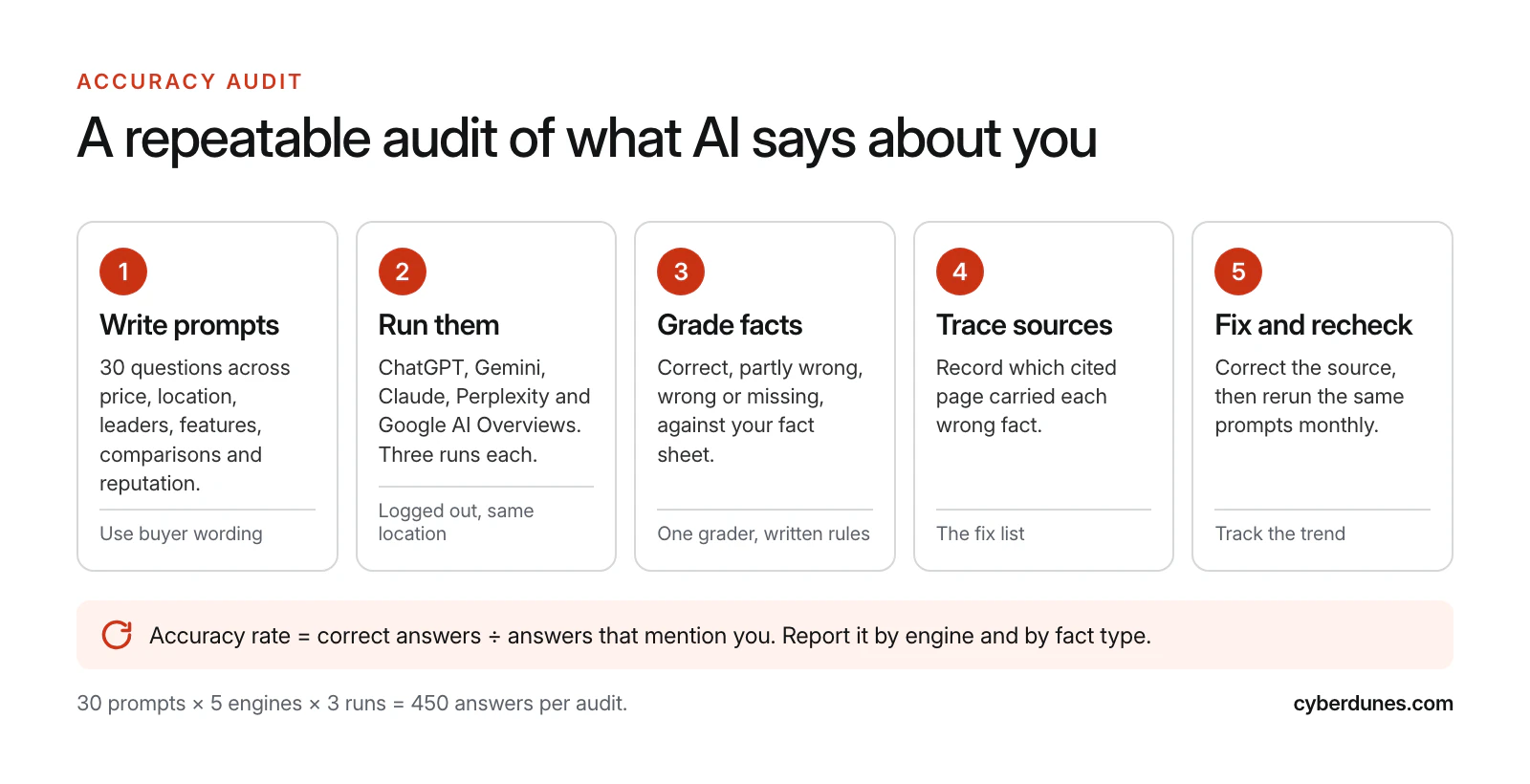
- Write about 30 prompts across six fact types: price and plans, locations and hours, leadership and history, features, comparisons with competitors, and reputation. Use the words buyers use: "Is [brand] open on Sundays?", "Who is the CEO of [brand]?", "[brand] vs [competitor] pricing".
- Run each prompt three times on ChatGPT, Gemini, Claude, Perplexity and Google AI Overviews, logged out where possible and from the same location. That is 450 answers per audit. Answers vary between runs, so one run proves little.
- Grade each claim as correct, partly wrong, wrong or missing, against your brand fact sheet (template below). Use one grader with written rules so results stay comparable.
- Trace the source. For every wrong fact, note the cited page if there is one. No citation usually means the model is answering from memory or guessing.
- Calculate an accuracy rate: correct answers divided by answers that mention you. Report it by engine and by fact type, because a 90% average can hide a 40% score on pricing.
Doing this by hand takes a day per audit. Prompt tracking tools automate the running and logging; see how prompt tracking works in Apex® and our guide to choosing an AI visibility checker.
Which Fix Matches Which Error?
Match the error type to its likely source, then fix it there. The table below is the triage we use; times are our working estimates for answers that rely on live search.
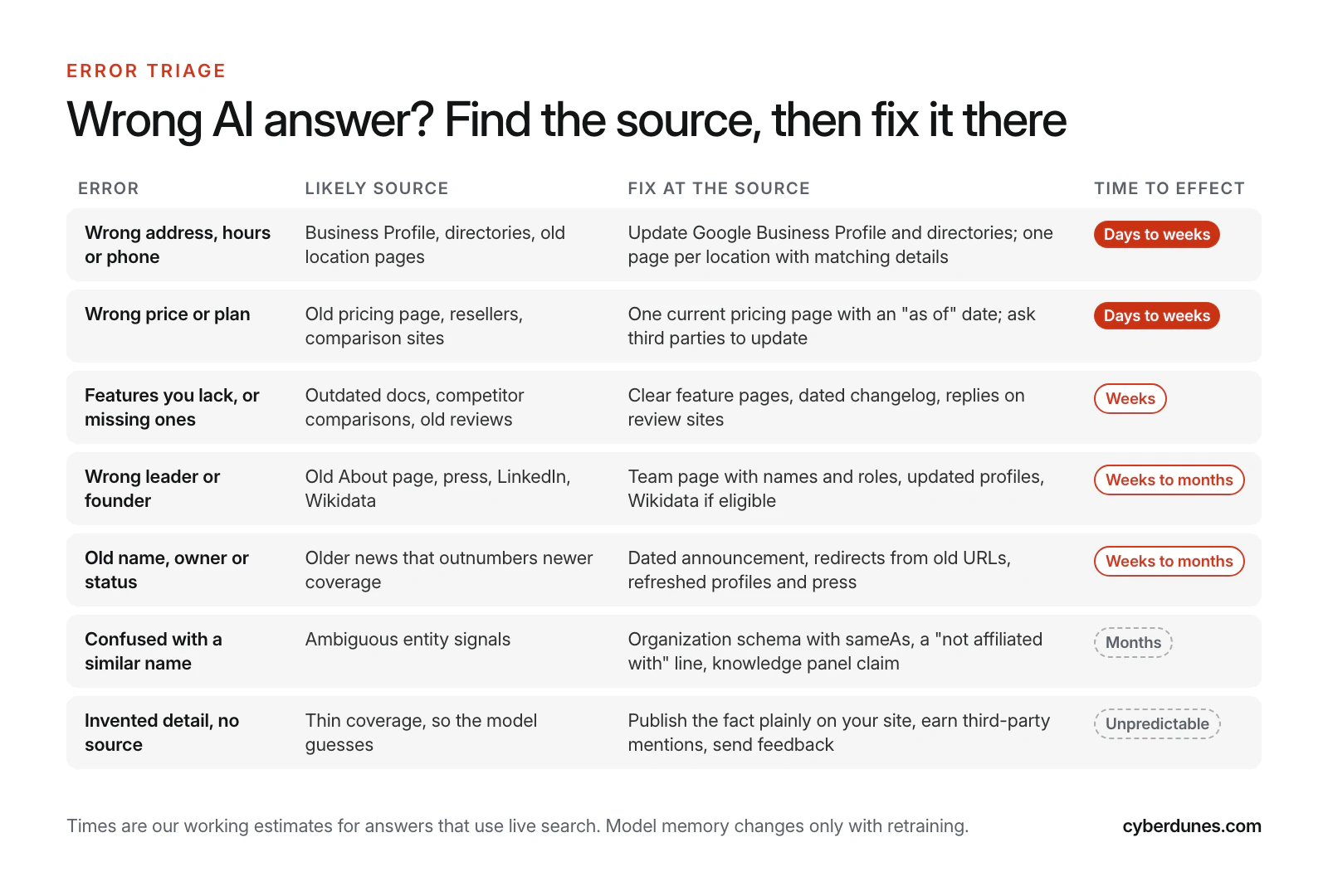
| Error type | Likely source | Fix at the source | Time to effect (our estimate) |
|---|---|---|---|
| Wrong address, hours or phone | Google Business Profile, directories, old location pages | Update your Business Profile and major directories; one page per location with matching details | Days to weeks |
| Wrong price or plan | Old pricing page, resellers, comparison sites | One current pricing page with an "as of" date; ask third parties to update or remove old prices | Days to weeks |
| Features you lack, or missing ones | Outdated docs, competitor comparison pages, old reviews | Clear feature pages that say what is and is not included; a dated changelog; replies on review sites | Weeks |
| Wrong leader or founder | Old About page, press coverage, LinkedIn, Wikidata | Team page with names, titles and start dates; updated LinkedIn; Wikidata edit if eligible | Weeks to months |
| Old name, owner or status | Older news that outnumbers newer coverage | Dated announcement page, redirects from old URLs, refreshed profiles and a press release | Weeks to months |
| Confused with a similar name | Weak or ambiguous entity signals | Organization schema with sameAs links, a "not affiliated with" line on your About page, knowledge panel claim | Months |
| Invented detail with no source | Thin coverage, so the model guesses | State the fact plainly on your site, earn third-party mentions, send provider feedback | Unpredictable |
One timing fact is documented. Google says Business Profile edits "usually take up to 10 minutes to review, but sometimes it can take up to 30 days" (Google Business Profile Help). Everything downstream of that depends on when each engine next retrieves the page.
How Do You Correct AI Information at the Source?
Make the correct fact easy to find, consistent everywhere and clearly yours. Start with what you control, then work outward to the third-party pages that engines trust.
Your Own Website
- One page per fact type. About, team, locations, pricing (or a plain statement that pricing is custom-quoted), and product pages. If your pricing is custom, say so; otherwise assistants fill the gap with numbers from resellers or old pages. We do this ourselves: Apex® plans are custom-quoted, and our pages say so.
- Dates on facts that change. "Prices as of October 2026" helps both people and machines judge freshness.
- Answer-first copy. Put the fact in the first sentence under a clear heading, not in a PDF or an image.
- Structured data that matches the page. Add Organization markup on your home or About page with name, logo, contact details and sameAs links to your official profiles (Google). Google asks that structured data match the visible text (Google).
- Let the right crawlers in. OpenAI says sites that opt out of OAI-SearchBot "will not be shown in ChatGPT search answers", and robots.txt changes take about 24 hours to apply (OpenAI). Our guide to which AI bots to allow or block covers the trade-offs.
Listings, Reviews and Profiles
Google tells site owners to keep "Merchant Center and Business Profile information" up to date as a best practice for its AI features (Google Search Central). Update your Business Profile, Bing Places, Apple Business Connect, industry directories and marketplace listings so name, address, phone and hours match exactly. Multi-location brands should read our guide to multi-location local search engine optimization (SEO) in AI search. On review sites, reply to outdated complaints with the current facts; the reply is often what a retriever quotes.
Wikipedia and Wikidata, Where Eligible
Wikidata accepts an item if it meets at least one criterion, such as referring to a "clearly identifiable conceptual or material entity" supported by "serious and publicly available references" (Wikidata). If your company qualifies, a well-sourced Wikidata item with your official website, founding date and current leadership gives engines a structured reference. Wikipedia is stricter: editors with a conflict of interest are "strongly discouraged from editing affected articles directly" and should propose changes on the talk page, and anyone editing for pay must disclose it (Wikipedia). Do not hire someone to edit your page quietly.
Press and Third-Party Coverage
When old news outnumbers new, publish the change as a dated announcement, send it to the publications that covered the old version, and ask them to add an update note. A single current article from a trusted outlet can outweigh several stale ones in retrieval.
The Brand Fact Sheet Template
A brand fact sheet is one internal document that holds the correct, current version of every fact an AI assistant might state about you. It is your grading key for audits and your source for every page and profile update.
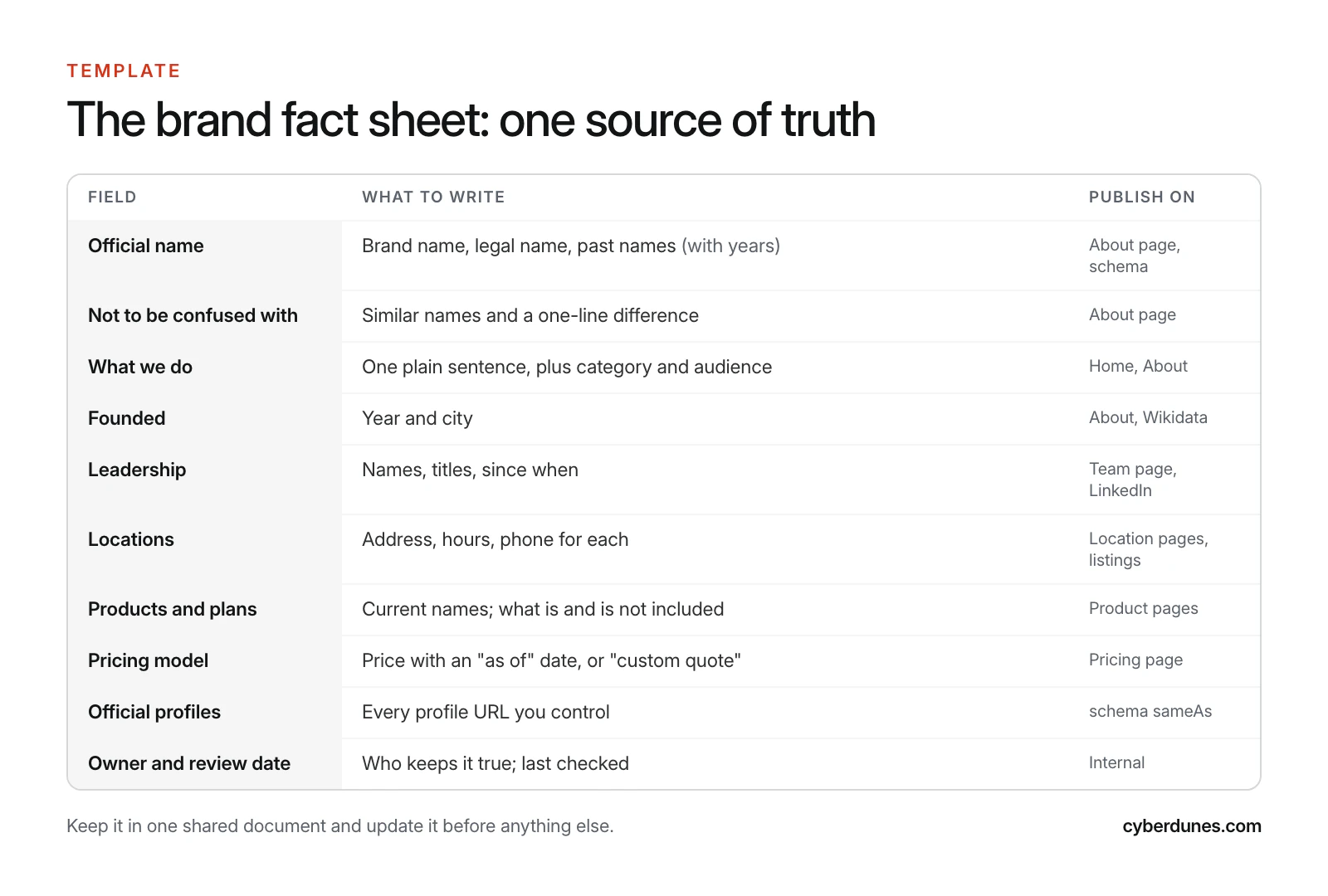
| Field | What to write | Publish on |
|---|---|---|
| Official name | Brand name, legal name, past names with years | About page, Organization schema |
| Not to be confused with | Similar names and a one-line difference | About page |
| What we do | One plain sentence, category and audience | Home page, About page |
| Founded | Year and city | About page, Wikidata if eligible |
| Leadership | Names, titles, since when | Team page, LinkedIn |
| Locations | Address, hours and phone for each | Location pages, Business Profile, directories |
| Products and plans | Current names; what is and is not included | Product pages |
| Pricing model | Price with an "as of" date, or "custom quote" | Pricing or plans page |
| Official profiles | Every profile URL you control | sameAs in Organization schema |
| Owner and review date | Who keeps it true; date last checked | Internal only |
Give the sheet one owner, usually in brand or marketing operations, and review it every quarter and after any change in leadership, pricing, locations or naming. If you also publish an llms.txt file, keep it consistent with the sheet; see how llms.txt works in Apex®.
What Feedback Options Do OpenAI and Google Offer?
Both offer ways to report a wrong answer, and neither promises a correction or a timeline. Use feedback alongside source fixes, never instead of them.
| Provider and product | What you can do | What it does, per the provider |
|---|---|---|
| OpenAI, ChatGPT | Thumbs down under the message, then "Select an issue"; or the content reporting webform | Reported domains and content "may be reviewed by OpenAI's Model Quality team, which may apply filters or other mitigations" (OpenAI) |
| OpenAI, ChatGPT search | Allow OAI-SearchBot; keep your host or content delivery network (CDN) from blocking it | Makes a site eligible for ChatGPT search; "Placement is not guaranteed" (OpenAI) |
| Google, AI Overviews | Thumbs down or the three-dot menu, then report a problem with optional details | The report includes your query and results; Google says AI Overviews "can and will make mistakes" (Google) |
| Google, knowledge panel | Verify as the entity, then "Suggest edits" with supporting public URLs | Google compares feedback "with other public information on the web"; verified feedback is typically reviewed within a few days (Google) |
| Google, Gemini app | Thumbs down ("Bad response") with a reason; "Report legal issue" for legal concerns | The conversation is attached to the feedback (Google) |
| Google, Business Profile | Edit your profile directly | Edits usually reviewed within 10 minutes, sometimes up to 30 days (Google) |
When you report, write the correction, not a complaint: the wrong claim, the correct fact and a public URL that proves it. Save a screenshot, the prompt and the date first, so you can show the change later.
How Do You Monitor Brand Mentions in LLMs Over Time?
Rerun the same prompt set monthly, track accuracy and sentiment by engine, and check after every material change to your business. Trends matter more than single answers, because answers vary from run to run.
- Monthly: the full prompt set; accuracy rate by engine and fact type; new wrong sources added to the fix list.
- After a change (new pricing, new CEO, new location, rebrand): the affected prompts within a week, then again a month later.
- Quarterly: refresh the fact sheet and the prompt set, and add questions from sales calls and support tickets.
- Alerts: any answer that names a competitor's product as yours, or states a safety, legal or pricing claim that is wrong, goes straight to the brand owner.
As more teams hand content work to AI agents, add one more check: make sure your own agents publish from the fact sheet, not from memory. Our guide to AI agents for marketing teams covers the evals that catch this.
How Cyberdunes and Apex® Help
Apex®, the AI-native digital experience platform (DXP), tracks the prompts that matter to your business across ChatGPT, Gemini, Claude, Perplexity and Google AI Overviews, and shows whether each answer cites you, mentions you or leaves you out. Its citation and sentiment insights show which pages AI engines cite and whether answers describe you positively, neutrally or negatively. The fixes then happen in the same platform: Schema.org JSON-LD structured data, metadata, llms.txt, IndexNow and local listings management, so your facts stay consistent across your site and listings.
No platform can guarantee what an AI engine says. What it can do is make the correct facts easy to find and show you when answers change. Start with a free check of how AI engines see your brand today.
Run a Free AI Visibility Check
Sources
- Does ChatGPT Tell the Truth?, OpenAI Help Center, accessed October 2026
- ChatGPT Search, OpenAI Help Center, accessed October 2026
- Reporting Content in ChatGPT and OpenAI Platforms, OpenAI Help Center, accessed October 2026
- Overview of OpenAI Crawlers, OpenAI developer documentation, accessed October 2026
- Why Language Models Hallucinate, Kalai, Nachum, Vempala and Zhang, arXiv, September 2025
- Largest Study of Its Kind Shows AI Assistants Misrepresent News Content 45% of the Time, European Broadcasting Union, October 2025
- Local Consumer Review Survey 2026, BrightLocal, February 2026
- AI Overviews in Google Search, Google Search Help, accessed October 2026
- AI Features and Your Website, Google Search Central, updated December 2025
- Suggest Changes to Your Knowledge Panel, Google Knowledge Panel Help, accessed October 2026
- Organization Structured Data, Google Search Central, updated September 2026
- Understand What Happens to Your Business Profile Edits, Google Business Profile Help, accessed October 2026
- Give Feedback on Gemini Apps, Gemini Apps Help, accessed October 2026
- Wikidata:Notability, Wikidata, accessed October 2026
- Wikipedia:Conflict of Interest, Wikipedia, accessed October 2026