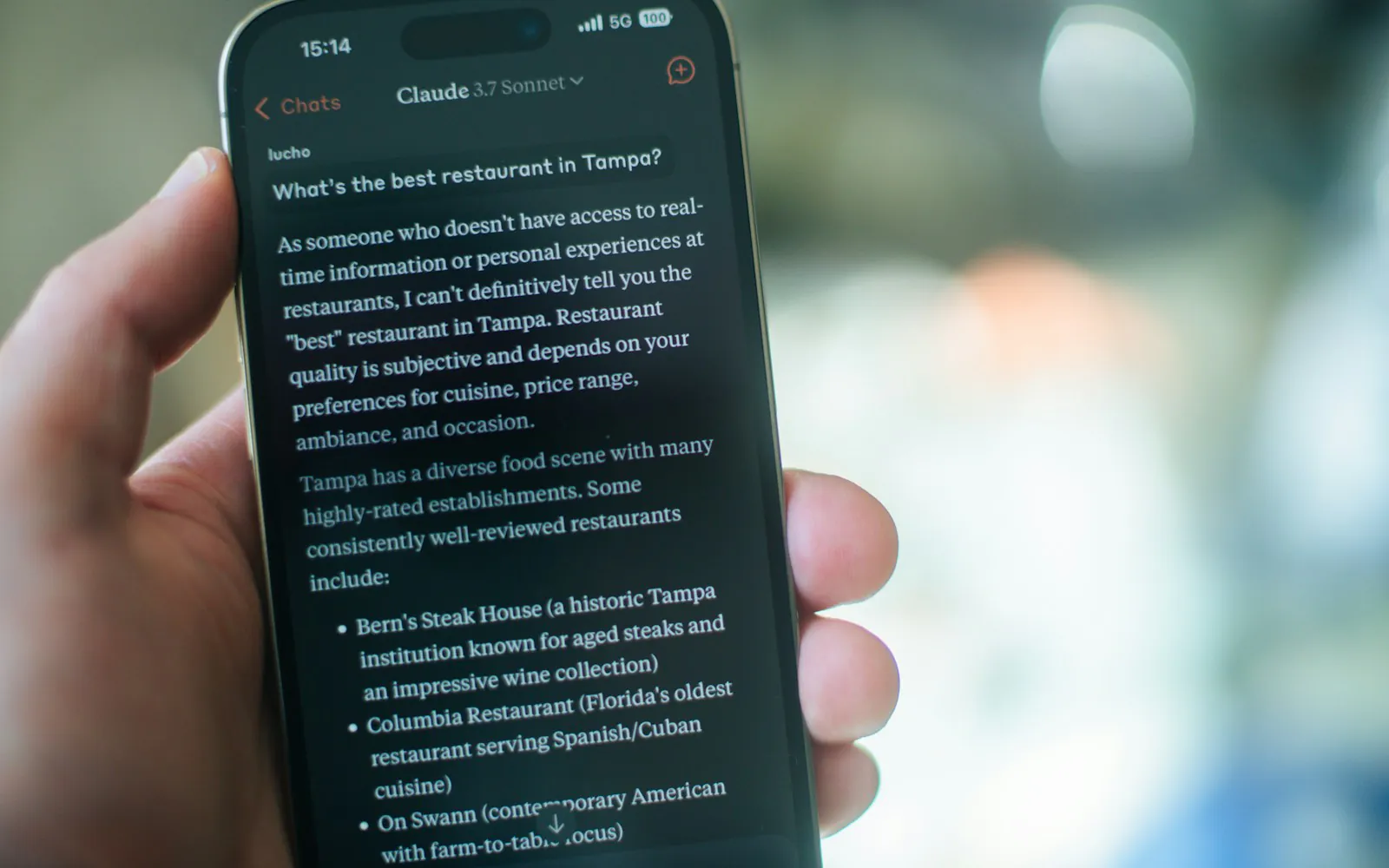
An AI visibility checker is a tool that asks AI assistants like ChatGPT, Gemini, Claude, Perplexity and Google AI Overviews the questions your buyers ask, then reports whether the answers mention your brand, cite your website and describe you accurately. It turns “Does AI know about us?” into numbers you can track and improve.
Key Takeaways
- Buyers now ask AI for recommendations before they search or visit a website. If an AI answer does not name your brand, you are not on the shortlist.
- An AI visibility checker runs real buyer prompts across AI engines and reports your mention rate, citation rate, share of voice, position, sentiment and accuracy.
- AI answers change between runs, so one check is a snapshot. Trust patterns across 20 or more prompts, repeated over weeks.
- Small businesses gain the most from early checks, because local and niche prompts often have only a few credible sources.
- You can run a free AI visibility check with Apex® to see where your brand stands today.
This guide is for business owners, marketing leads and enterprise teams who want to know whether AI search is recommending them, and what to do if it is not. We build Apex®, an AI-native digital experience platform (DXP) that tracks AI visibility, so we will tell you plainly what a checker can and cannot tell you.
What Is an AI Visibility Checker?
An AI visibility checker measures how often, and how well, AI assistants include your brand in their answers. It is to AI search what a rank tracker is to Google: a way to see your position instead of guessing at it.
It looks for two kinds of presence, and the difference matters:
- A mention is when the answer names your brand, product or business. “For a spa stay in North Goa, consider Hotel X” is a mention.
- A citation is when the answer links to a page on your website as a source. Citations send visitors and show that the AI engine trusts your content.
You can be mentioned without being cited (the AI learned about you from reviews or news articles) and cited without being recommended (the AI quoted your blog but suggested a competitor). A good checker reports both.
Why AI Visibility Is the Next Big Thing for Businesses
AI visibility matters because AI assistants have become the place where buying journeys start, and they show a short answer instead of a long list. Being on page one of Google no longer guarantees that buyers will see you.
The scale is hard to ignore:
- ChatGPT reached 900 million weekly users in February 2026, according to OpenAI.
- Google reported in July 2026 that AI Mode has more than 1 billion monthly users and the Gemini app 950 million (Google).
- 45% of US consumers now use ChatGPT or other AI tools for local business recommendations, up from 6% a year earlier (BrightLocal, 2026).
- McKinsey estimates that AI search will influence $750 billion in US consumer spending by 2028 (McKinsey).
At the same time, fewer people click through. In a Pew Research study, Google users clicked a traditional result in 8% of visits when an AI summary appeared, against 15% when it did not, and clicked a link inside the summary in only about 1% of visits (Pew Research Center). Ahrefs found that an AI Overview goes with a 58% lower click-through rate for the top-ranked page (Ahrefs).
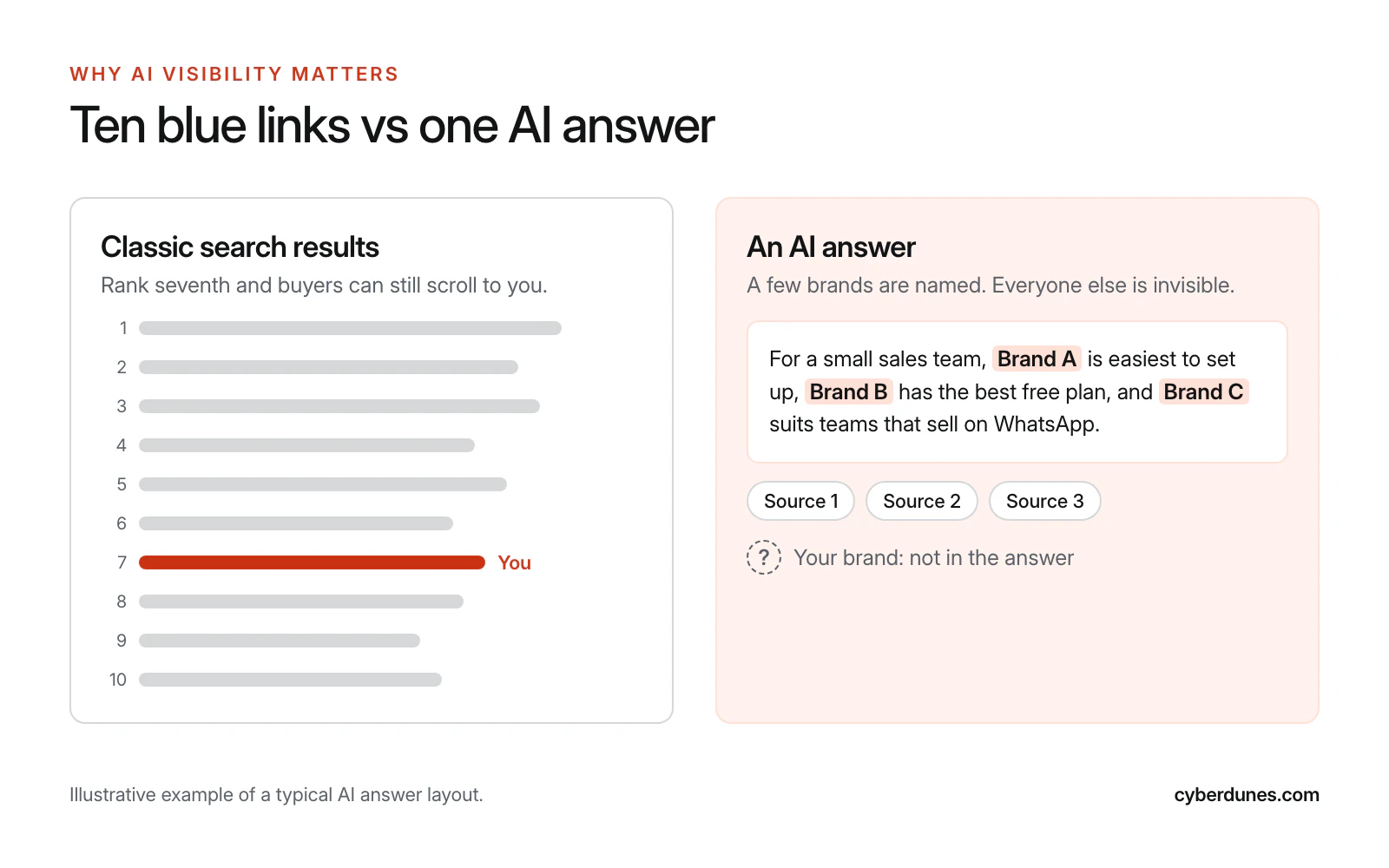
So the value of your brand is shifting toward a new question: when a buyer asks AI, are you in the answer? The visitors who do click through are worth more, too. Semrush estimated that an AI search visitor is worth 4.4 times an average organic visitor, based on conversion rates (Semrush). If you want to win those visits, our guide to converting AI search traffic covers the landing page side.
How Does an AI Visibility Checker Work?
An AI visibility checker works in three steps: it sends a set of buyer prompts to AI engines, reads every answer, and scores your brand’s presence against your competitors.
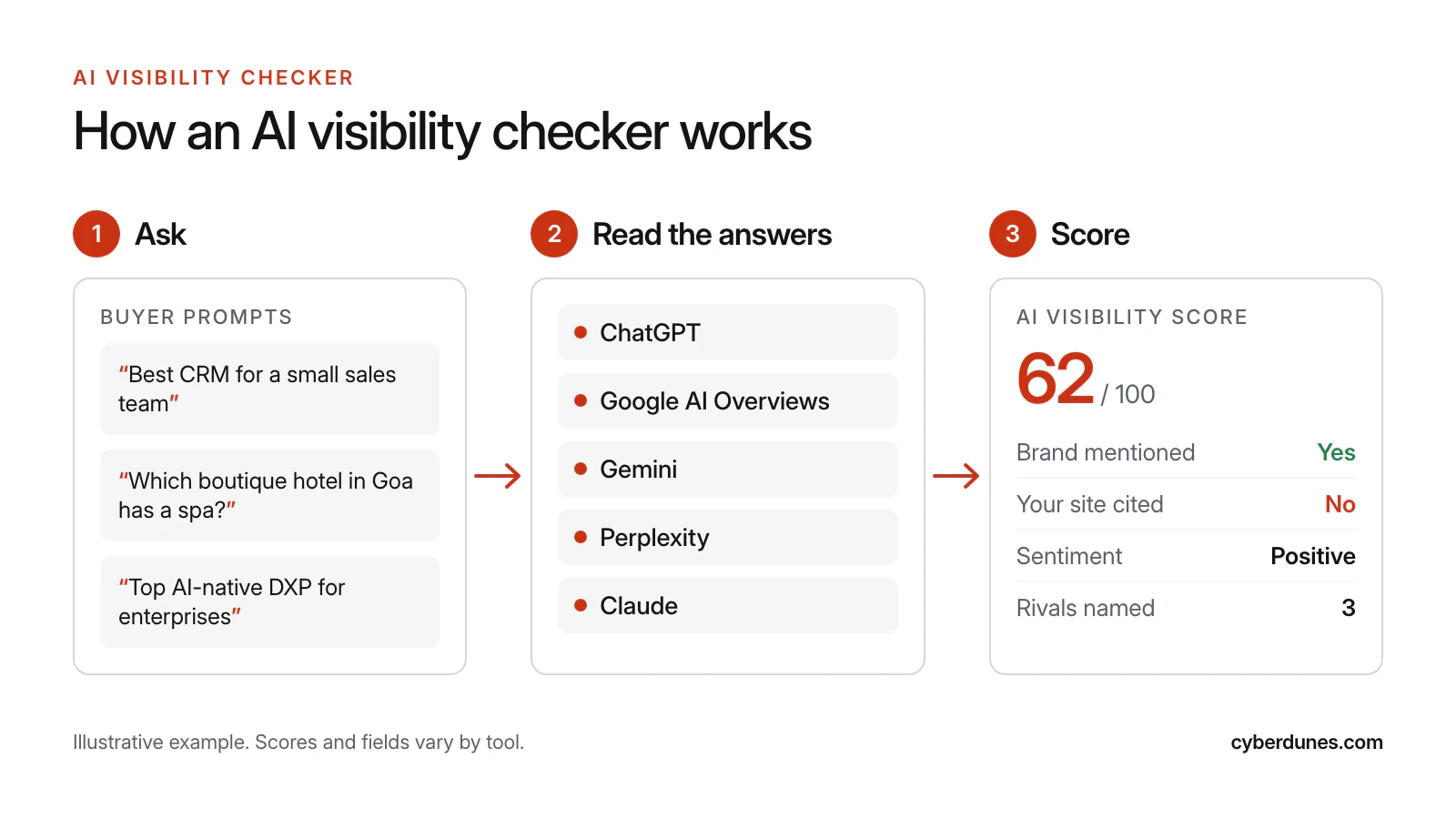
- Ask. The tool runs prompts that real buyers would type, such as “best CRM for a small sales team” or “which boutique hotel in Goa has a spa?”
- Read the answers. It collects the responses from each engine, including the brands named and the sources linked.
- Score. It checks whether you were mentioned or cited, where you appeared, how you were described and which competitors showed up instead.
Not every tool sold as an AI visibility checker does this. There are three kinds, and it helps to know which one you are using:
| Type of checker | What it does | Good for |
|---|---|---|
| Live-query checker | Sends your prompts to the real AI engines and reads the answers | Seeing what buyers actually see |
| Model-estimated checker | Asks one model to predict your visibility | A rough first impression only |
| Technical readiness checker | Tests whether AI crawlers can reach and read your site | Finding blocked bots and missing markup |
A live-query checker is the one that answers the question “Is my brand in the answer?” Technical checks are useful, but they tell you whether you could be cited, not whether you are. If you want the mechanics of how engines pick sources, read how LLMs choose sources to cite.
What Does an AI Visibility Checker Measure?
Most AI visibility checkers report six numbers: mention rate, citation rate, share of voice, position, sentiment and accuracy. Names vary between tools, and some roll them into a single AI visibility score out of 100.
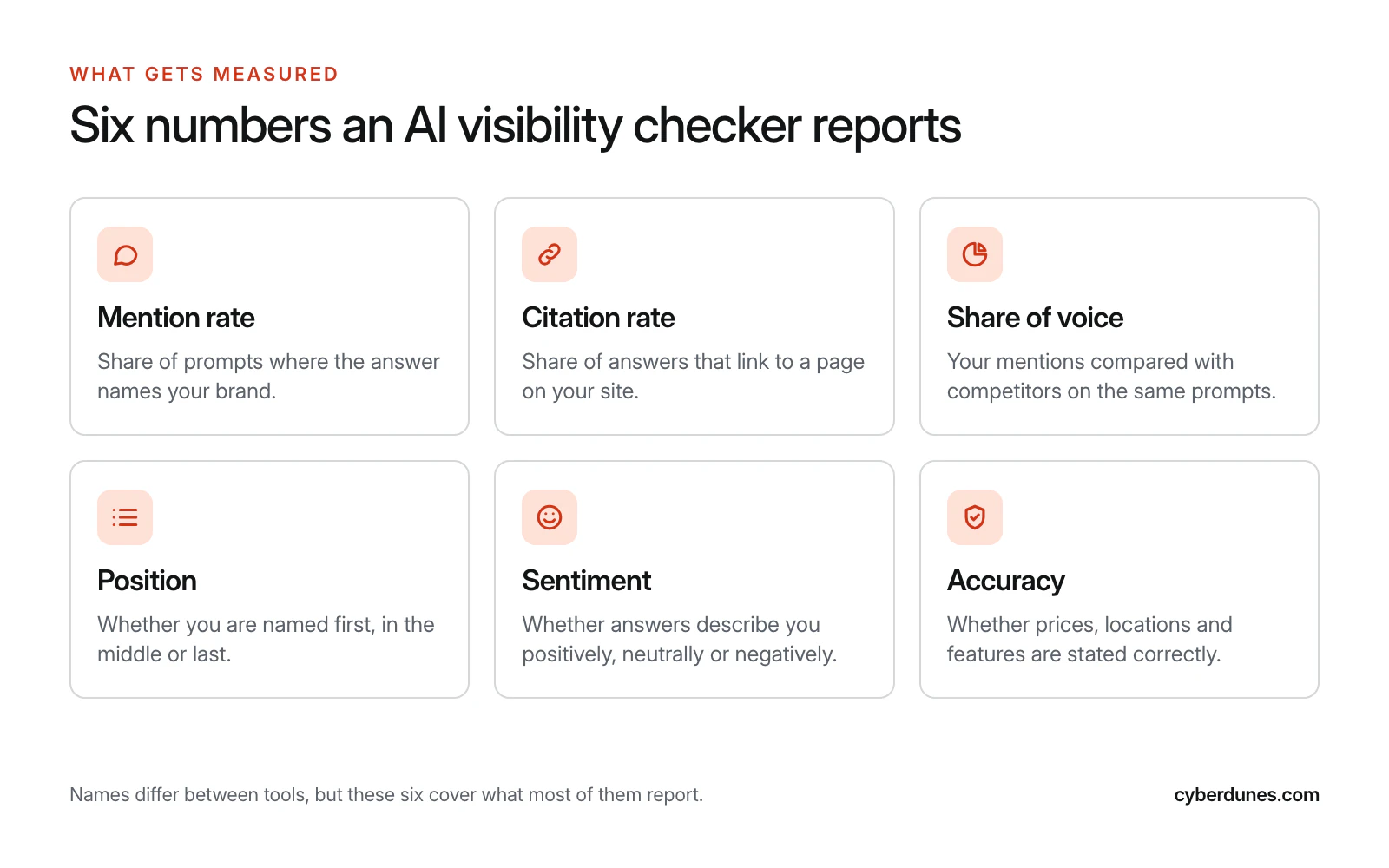
| Metric | What it tells you | What to do if it is low |
|---|---|---|
| Mention rate | The share of prompts where AI names your brand | Publish clear pages for each service, and earn mentions on trusted third-party sites |
| Citation rate | The share of answers that link to your website | Answer questions directly at the top of each page, with specific facts |
| Share of voice | Your mentions compared with competitors on the same prompts | Study the sources that cite competitors and close the gaps |
| Position | Whether you are named first, in the middle or last | Strengthen proof: reviews, case studies, awards and data |
| Sentiment | Whether AI describes you positively, neutrally or negatively | Respond to recurring complaints and refresh outdated content |
| Accuracy | Whether prices, locations and features are stated correctly | Keep facts consistent on your site, listings and profiles |
Treat a single blended score with care. A score of 62 tells you little on its own. The per-prompt and per-engine breakdown tells you what to fix.
What Value Does an AI Visibility Checker Give Your Business?
An AI visibility checker gives you a baseline, a list of gaps and a way to prove that your fixes worked. Without one, you only find out that AI ignores you when leads quietly dry up.
For Small and Medium Businesses
- Find out if AI recommends you locally. Prompts like “best physiotherapist in Bandra” or “hotel near Pune airport with a pool” decide who gets the call.
- Catch wrong facts early. An AI that quotes last year’s prices or an old address sends buyers away.
- Compete above your weight. Niche and local prompts often have few credible sources, so a small business with clear pages can be named ahead of bigger brands.
For Enterprises
- Measure share of voice by product line, market and engine. See where competitors own the answer.
- Protect the brand. Monitor sentiment and accuracy across thousands of prompts, not a few spot checks.
- Connect content to outcomes. Show which pages AI cites, so content teams invest where it moves visibility.
Which Prompts Should an AI Visibility Checker Test?
Test the prompts your buyers actually type at each stage of a decision, not just your brand name. A brand-name prompt shows what AI knows about you. Category and comparison prompts show whether AI recommends you.
Use this prompt library as a starting point. Swap in your own category, city and competitors:
| Prompt type | Example prompt | What it reveals |
|---|---|---|
| Category | “What is the best [category] for [audience]?” | Whether you make the shortlist |
| Local | “Best [service] in [city] for [need]” | Your local AI visibility |
| Problem | “How do I fix [problem your product solves]?” | Whether AI links your content to the problem |
| Comparison | “[Your brand] vs [competitor]: which is better?” | How AI frames your strengths and weaknesses |
| Alternatives | “Alternatives to [competitor]” | Whether you are seen as a contender |
| Brand facts | “What does [your brand] cost, and where is it located?” | Accuracy of prices, locations and features |
| Reputation | “Is [your brand] reliable? What do customers say?” | Sentiment and the reviews AI relies on |
Aim for 20 to 50 prompts that cover these types. Fewer than 20 and one odd answer can swing your score.
How to Run Your First AI Visibility Check
You can run your first AI visibility check in under an hour. Here is the process we use with clients:
- List your buyer questions. Ask your sales or front desk team what customers ask before buying. Turn those into 20 or more prompts using the library above.
- Name three to five competitors. Share of voice only means something next to the brands you lose deals to.
- Run the check across engines. Cover at least ChatGPT, Google AI Overviews, Gemini and Perplexity. Your buyers do not all use the same one.
- Read the answers, not just the score. Note which sources AI cites for prompts where you are missing. Those are the sites to learn from or get featured on.
- Save it as your baseline. Date the results, so you can measure change after every fix.
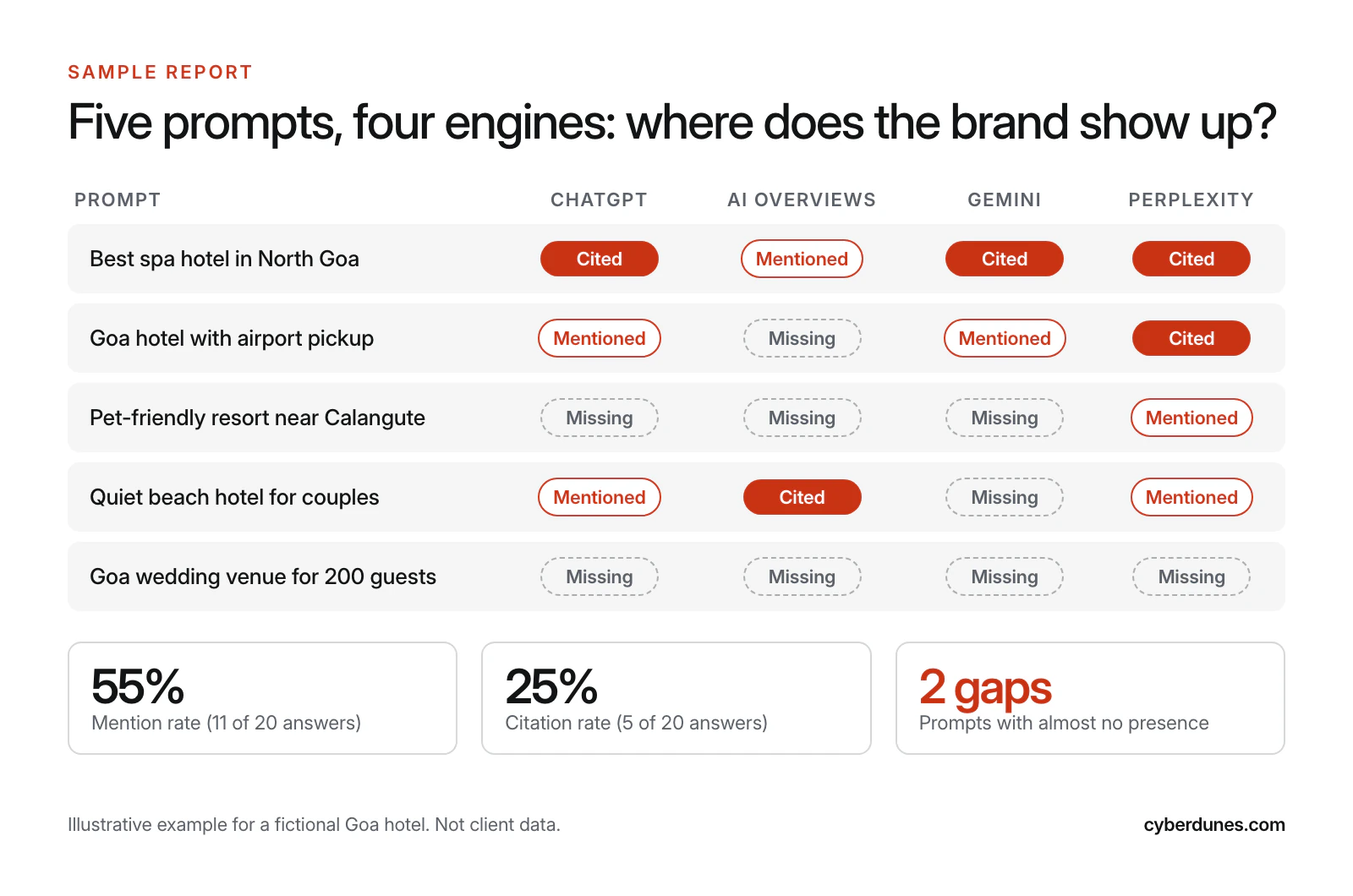
In this illustrative example, the hotel is cited for its core spa prompt but missing for weddings and pet-friendly stays. That is a clear brief: build a weddings page with capacity, packages and photos, and state the pet policy plainly. The report turns vague worry into a to-do list.
The fastest way to get this baseline is a free check with Apex®. Enter your brand and website, and see how AI engines describe you today.
Run your free AI visibility check
How Accurate Are AI Visibility Checkers?
AI visibility checkers are accurate about what an engine said at that moment, but AI answers change from run to run, so one result is never the full picture. In research by SparkToro and Gumshoe, ChatGPT and Google’s AI returned the same list of brands in fewer than 1% of repeated runs of the same prompt (SparkToro).
The same study found that how often a brand appears is more stable than where it appears in the list. That is why mention rate across many prompts is a better health check than your position in one answer. To get numbers you can rely on:
- Run each prompt more than once, and track averages.
- Use the same prompts and engines every time, so changes reflect your work rather than your setup.
- Compare trends over weeks. One week’s dip is noise. A month of decline is a signal.
Be clear about the limits, too. A checker cannot see how many people type each prompt, and answers can be personalized by location, history and account. Treat it as a measure of presence, not a traffic forecast.
How Do You Improve AI Visibility After a Check?
You improve AI visibility by fixing what the check reveals, then checking again with the same prompts. The work is a loop, not a one-off project.
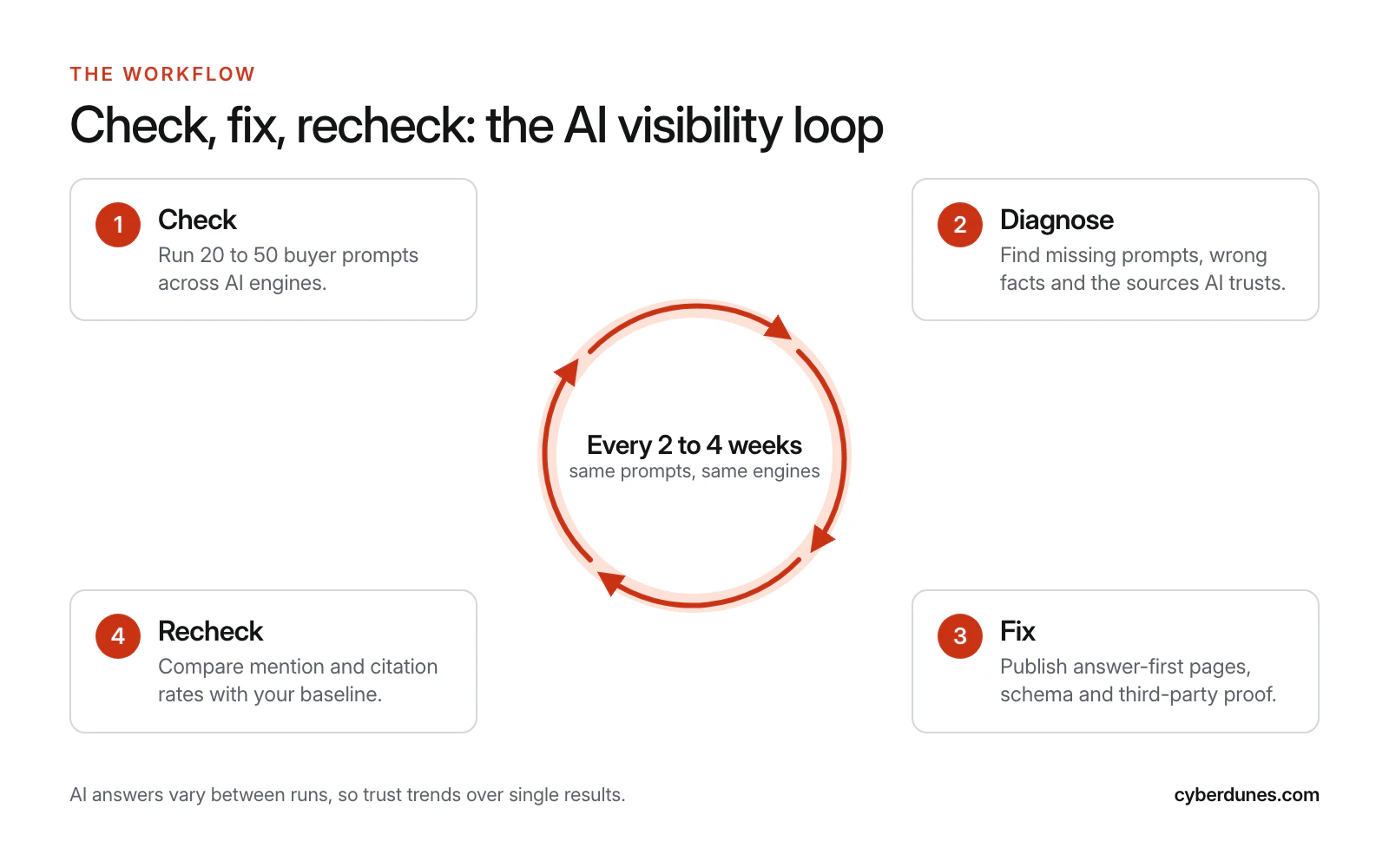
- Make sure AI can read you. Do not block search crawlers such as OAI-SearchBot, PerplexityBot or Googlebot, and keep your main text in the HTML.
- Answer questions first. Open each section with a direct, specific answer. Vague paragraphs are rarely quoted.
- Add facts and proof. Prices, numbers, dates, named clients and linked sources give AI something it can cite. The GEO study found that citations, quotations and statistics made content more visible in AI answers.
- Earn mentions elsewhere. Reviews, directories, press and industry lists shape how AI describes you. Keep your name, address and details consistent.
- Use structured data. Schema.org markup that matches your visible content helps engines read your facts accurately.
Our generative engine optimization checklist turns these into 12 on-site fixes rated by effort and impact.
How to Choose an AI Visibility Checker
Choose an AI visibility checker that queries the engines live, covers the engines your buyers use, and shows answers prompt by prompt. Use these questions to compare tools:
- Is it a live check? Ask whether it sends prompts to the real engines or estimates results with a model.
- Which engines does it cover? At minimum, ChatGPT, Google AI Overviews, Gemini and Perplexity. Claude is a plus.
- Can you choose your own prompts? Generic prompts miss the questions your buyers ask.
- Does it separate mentions from citations? You need both to know what to fix.
- Does it compare competitors and keep history? Without them, you cannot see share of voice or progress.
- Does it help you fix the gaps? A report you cannot act on is a dashboard, not a strategy.
Free checkers are the right place to start, because they show whether you have a problem before you spend anything. Paid trackers make sense once you need daily monitoring, many prompts and competitor history.
Check Your AI Visibility Free With Apex®
Apex® is the AI-native DXP we built at Cyberdunes to get brands cited in AI search. Its free AI visibility checker shows how ChatGPT, Gemini, Claude, Perplexity and Google AI Overviews describe your brand: whether you are cited, mentioned or not found, and whether the answer is positive or neutral.
When you are ready to go further, Apex® tracks your prompts over time, shows which pages AI cites and which to fix first, and lets your team publish answer-first content, schema and llms.txt in the same place. Most visibility tools stop at the report. Apex® closes the loop between what AI says and what you publish. See how it has worked for others in our case studies.
No tool can guarantee that AI will cite you. But you cannot improve what you have not measured, and your competitors may already be measuring. Start with a free check today.
Check your AI visibility free on Apex®
Prefer a hands-on review? Our GEO services team can audit your AI visibility and build the fix plan with you.
Sources
- Scaling AI for Everyone (OpenAI, February 2026)
- Alphabet Q2 2026 Earnings Remarks (Google, July 2026)
- Local Consumer Review Survey 2026 (BrightLocal)
- New Front Door to the Internet: Winning in the Age of AI Search (McKinsey)
- Google Users Are Less Likely to Click on Links When an AI Summary Appears (Pew Research Center)
- AI Overviews Reduce Clicks (Ahrefs, February 2026)
- AI Search and SEO Traffic Study (Semrush)
- AIs Are Highly Inconsistent When Recommending Brands (SparkToro, January 2026)
- GEO: Generative Engine Optimization (Aggarwal et al., arXiv)