
Google agentic checkout lets shoppers buy from eligible merchants inside Google Search, AI Mode and the Gemini app, using the Universal Commerce Protocol (UCP). On October 15, 2026, Google added Universal Cart on top: one cart for products from many stores, with price alerts and Google Pay checkout. It is US-only for now.
Key Takeaways
- Universal Cart went live in the US on October 15, 2026, across Search and the Gemini app. YouTube and Gmail, named in May, were not part of the launch.
- Checkout runs on UCP. The merchant stays the seller of record and handles order confirmations and customer support.
- Indian brands cannot use Universal Cart or UCP checkout yet. They can use AI performance insights in Merchant Center, which shows share of voice in AI Mode and AI Overviews.
- Product data is now the storefront. Feed quality, return policies and promotions decide whether an AI answer can sell your product.
- Use the next 30 days to fix Merchant Center, publish clean return and support details, load promotions and set up tracking for Google-originated orders.
This analysis is for ecommerce heads, direct-to-consumer (D2C) founders and performance marketers in India and other markets who need to decide what to change before the holiday peak. Cyberdunes has built and run commerce websites since 2010, and we read every Google post and help page cited here. Where Google has not confirmed a detail, we say so.
What Did Google Announce on October 15, 2026?
Google launched Universal Cart in the US across Google Search and the Gemini app. It is a single cart for products from different retailers, with checkout powered by UCP.
According to Google's launch post by Suresh Ganapathy, Senior Director of Product Management, the cart does four things:
- Saves items across stores. Shoppers add products while using AI Mode in Search or the Gemini app, and the cart keeps them for later.
- Tracks price and stock. It draws on Google's Shopping Graph, which Google says holds more than 60 billion product listings, and sends alerts on price drops and restocks.
- Suggests savings. It is built on Google Wallet, so it can suggest which card to use based on card perks and show relevant promo codes.
- Checks out. At participating stores, shoppers pay with Google Pay in a few taps. Elsewhere, they transfer items to the merchant's own cart.
Google named Nike, Sephora, Target, Ulta Beauty, Walmart, Wayfair and many Shopify merchants. Search Engine Roundtable, TechCrunch and Pymnts confirmed the US-only rollout the same day.
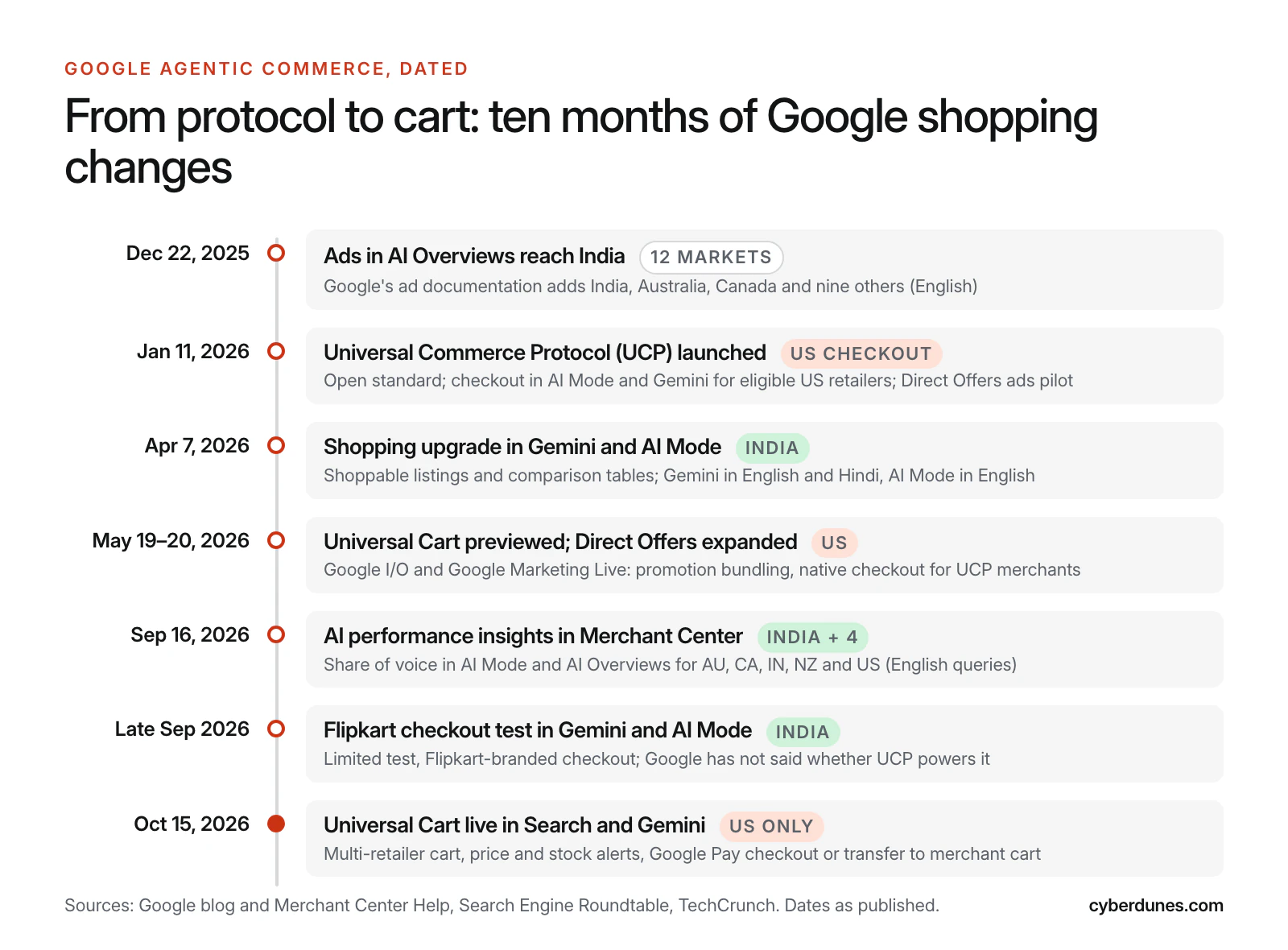
Two things are missing compared with the May 19, 2026 preview. That post said shoppers could add items from Search, Gemini, YouTube or Gmail, and promised price history and compatibility checks. The October post covers only Search and the Gemini app and lists price-drop and restock alerts. The May post also targeted a US rollout "this summer"; it arrived in mid-October.
How Do Universal Cart and Agentic Checkout Work Together?
Universal Cart is the shopper's tool. UCP is the plumbing that lets Google's surfaces, and AI agents in general, talk to a merchant's checkout. Direct Offers and Business Agent are the ad and brand layers on top.
Google launched UCP on January 11, 2026 as "a new open standard for agentic commerce that works across the entire shopping journey." It was co-developed with Shopify, Etsy, Wayfair, Target and Walmart, and endorsed by more than 20 companies including Flipkart, Mastercard, Visa and Stripe. The same post introduced checkout in AI Mode for eligible US retailers, the Direct Offers ads pilot and Business Agent, a branded chat agent in Search.
| Piece | What it does | Who controls it | Status, October 2026 |
|---|---|---|---|
| Universal Cart | Multi-store cart with alerts, card suggestions and promo codes | Shopper, inside Google | Live in the US |
| UCP checkout | "Buy" button on eligible listings in AI Mode and Gemini | Merchant opts in per product | Select US merchants, early access |
| Cart transfer | Sends cart items to the merchant's own site | Merchant, via the UCP integration hub | Rolling out in the US |
| Direct Offers | Exclusive offers shown inside AI Mode answers | Advertiser, via Google Ads | Pilot |
| Business Agent | Brand-voiced chat that answers product questions in Search | Retailer, via Merchant Center | Eligible US retailers |
At Google Marketing Live on May 20, 2026, Google said Direct Offers would surface inside AI Mode responses, added promotion bundling (discounts, giveaways and local coupons) and "native checkout integration for Universal Commerce Protocol (UCP) merchants." It also told advertisers to "build a strong foundation with AI Max for Search."
The merchant keeps the customer relationship on paper. Google's launch post says merchants handle direct order confirmations and customer support and remain the seller of record. In practice, the shopper discovers, compares and pays inside Google. Our guide to preparing a store for AI shopping agents covers that shift in depth.
What Does Agentic Checkout Mean for Retailers and D2C Brands?
The product listing becomes the point of sale. If your feed, price, stock, returns and promotions are not machine-readable and correct, an AI answer cannot recommend or sell the product.
Four consequences matter most:
- Your feed is your shelf. Google's September 16, 2026 update says conversational attributes were used in AI Mode recommendations 50% of the time in lululemon's test, and that following core Merchant Center feed best practices averages a 5% conversion increase the following month.
- Promotions travel without you. The cart shows promo codes and card perks next to your price. A discount that lives only in an email or on-site banner will not appear.
- Return terms sit on Google's checkout screen. Google's UCP developer guide requires return cost, return window and a link to the full policy in Merchant Center, because they appear at checkout.
- Attribution gets harder. Google has not said how cart transfers are labeled in analytics or whether they count as paid or organic. Plan your own tagging before the peak, on top of a sound Google Analytics 4 (GA4) setup.
For D2C brands, the trade-off is reach against control. Google's surfaces bring buyers who are already comparing. You give up some of the on-site experience, cross-sell and first-party data capture that your own checkout provides. Brands with strong repeat purchase may prefer cart transfer over native checkout so the order completes on a site they keep improving through A/B testing.
Native Checkout or Cart Transfer: A Decision Framework
| Criterion | Lean to native checkout on Google | Lean to cart transfer |
|---|---|---|
| Basket type | Single, standard products | Bundles, made-to-order, personalized goods |
| Repeat purchase value | Low; mostly one-off buyers | High; loyalty program drives margin |
| Checkout complexity | Standard shipping, simple returns | Special shipping, installation, gifting |
| Data needs | Order data is enough | You need on-site consent capture and profiling |
| Support capacity | Can handle orders that start elsewhere | Support built around your own order flow |
Several of these are not choices at all. The developer guide excludes subscriptions, installments, personalized goods, refurbished or final-sale items, pre-orders, special shipping, gifting and age-restricted goods from native checkout.
What Does It Mean for Indian Brands?
Universal Cart and UCP checkout are not available in India. Indian brands can act on two things now: AI performance insights in Merchant Center and shopping answers in Gemini and AI Mode.
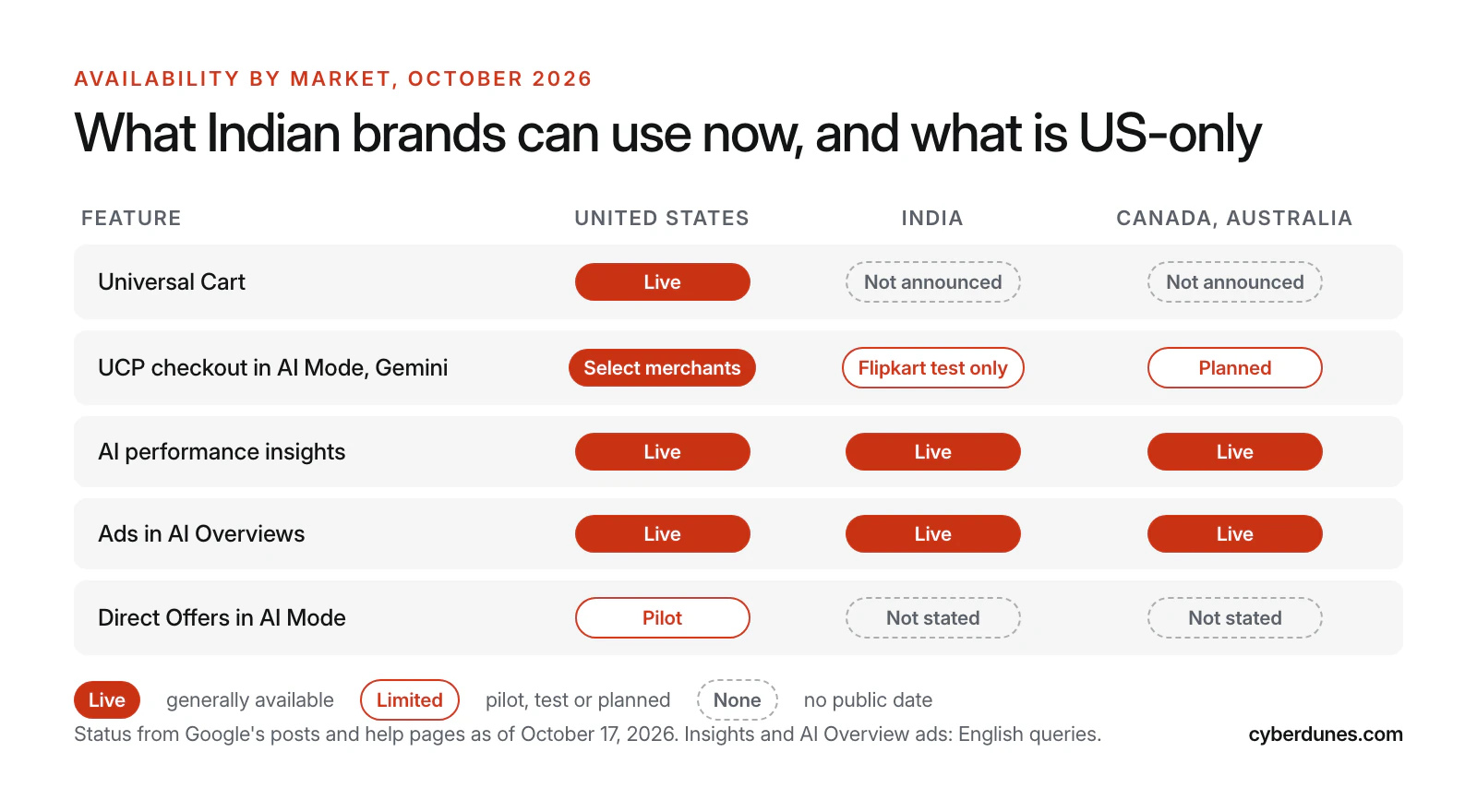
Here is the precise status by feature, as of October 17, 2026:
- Universal Cart: US only. Google has given no international date.
- UCP checkout: Google's Merchant Center help page applies to products eligible in the United States, Canada and Australia, and says checkout is "available for select merchants at this time." The UCP integration hub is rolling out in the US, with Australia and Canada planned. India is not listed.
- AI performance insights: Available to Merchant Center accounts in Australia, Canada, India, New Zealand and the US, for English-language queries. It reports your share of voice against competitors you define in AI Mode and AI Overviews.
- Ads in AI Overviews: Google added India and 10 other markets to its ad documentation in December 2025, per Search Engine Roundtable. Sensitive verticals such as finance and healthcare are excluded.
- Shopping in Gemini and AI Mode: Google's April 7, 2026 India post added shoppable listings and comparison tables. Gemini supports English and Hindi; AI Mode shopping launched in English with Hindi "soon."
There is one signal of what checkout could look like in India. TechCrunch reported on September 26, 2026 that Google is testing a "Buy" button that opens a Flipkart-branded checkout inside Gemini and AI Mode, for smartphones, electronics and mobile accessories. Google told TechCrunch it is "always testing new features." Google has not said whether UCP powers it.
Our read: Indian D2C brands should treat 2026 as a measurement year and early 2027 as the earliest realistic window for checkout inside Google. Large marketplaces may get there first, which raises the bar for brand sites competing in the same AI answer.
What Should You Do in the Next 30 Days?
Fix product data, publish return and support details, load promotions and set up measurement. These steps help in every market, whether or not checkout reaches you this year.
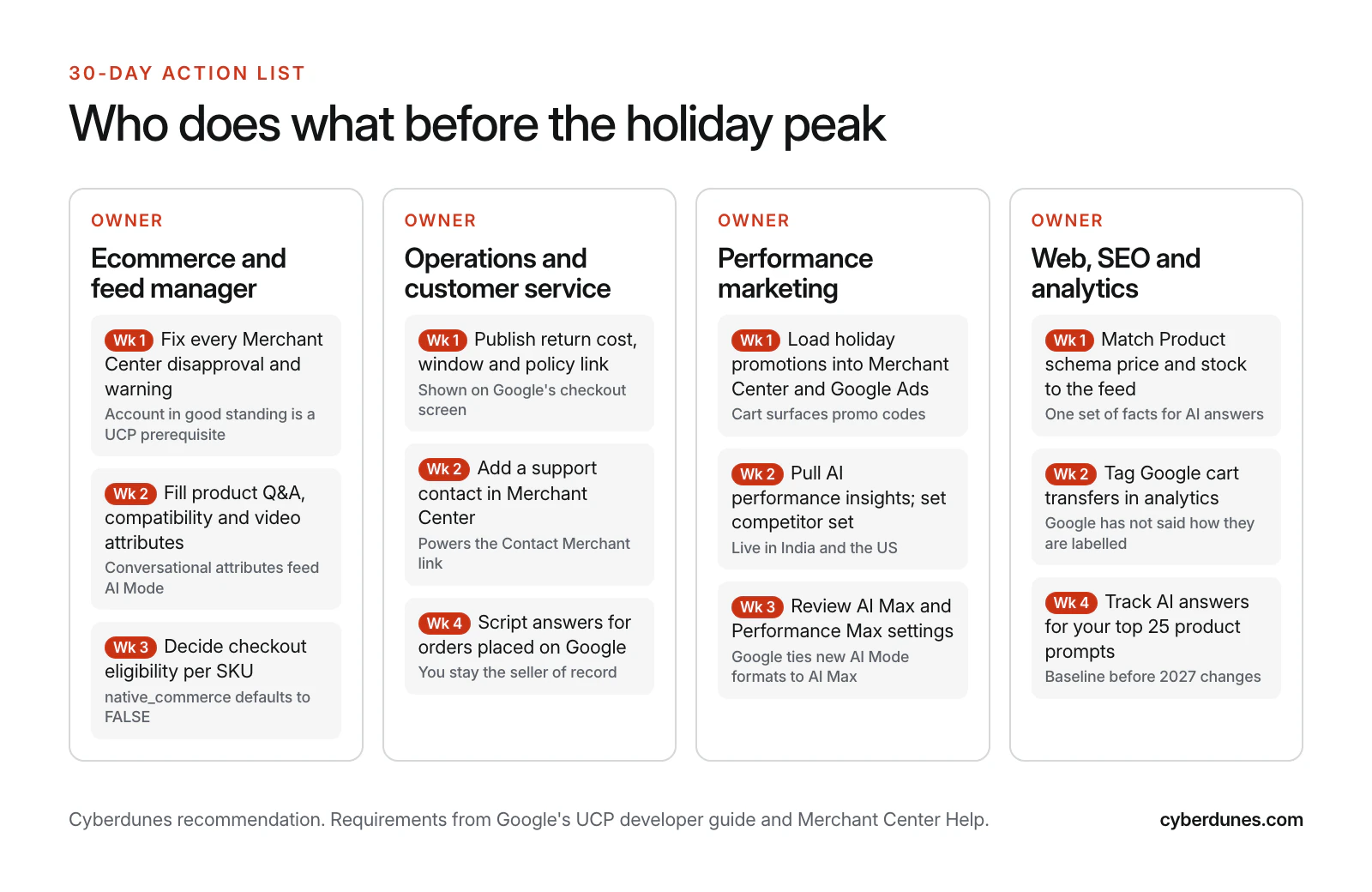
- Week 1: Clean Merchant Center. Resolve every disapproval. Google's developer guide requires an account "in good standing and approved products for free listings" before UCP checkout.
- Week 1: Publish returns. Add return cost, window and a policy link. For advanced accounts, configure them in every sub-account.
- Week 1: Load promotions. Put holiday and festive offers into Merchant Center promotions and Google Ads, not only on your site. Our ecommerce promotion tips still apply; they now need a machine-readable form.
- Week 2: Enrich attributes. Add product Q&A, compatible accessories, substitutes and video links. Google said in January it was adding "dozens of new data attributes" for conversational commerce.
- Week 2: Add a support contact. Merchant Center needs at least one contact method; it powers the "Contact Merchant" link after a Google checkout.
- Week 2: Baseline share of voice. If you sell in India or the US, open AI performance insights and define your competitor set.
- Week 3: Decide eligibility per stock keeping unit (SKU). The
native_commerce(checkout_eligibility)attribute defaults to FALSE. Mark excluded categories FALSE deliberately rather than by accident. - Week 4: Tag Google-originated orders. Add UTM (Urchin Tracking Module) conventions for cart transfers and create a channel group. Our guide to tracking AI referral traffic in GA4 shows the setup.
Defaults and Settings to Review
| Setting | Default or rule | What to check |
|---|---|---|
| Checkout eligibility attribute | FALSE if missing | Set per product, on purpose |
| Return policy | Required for checkout | Cost, window and link match your site |
| Return policy in sub-accounts | Configured per sub-account | No sub-account left blank |
| Customer support contact | At least one method required | Monitored inbox or phone line |
| Google Pay and Wallet Console | Account required; button on your site is not | Payment provider supports the Google Pay API |
| On-page Product schema | Your responsibility | Price, availability and returns match the feed |
The last row is ours, not Google's. AI answers draw on both your feed and your pages, so conflicting prices or return terms create doubt. Consistency across sources is also a core principle of generative engine optimization (GEO). Our guide to getting into Google AI Mode answers explains how pages and feeds work together, and designing sites AI agents can use covers the on-site side.
What Should You Watch in 2027?
Watch for international rollout, the YouTube and Gmail integrations, agent-initiated payments and how Google reports these orders. Each one changes where your budget and data work should go.
- Canada and Australia checkout. Google's September post says UCP capabilities will follow in Australia and Canada "early next year." That is the first test of UCP outside the US.
- YouTube and Gmail. The May post promised both for Universal Cart. Their absence in October is worth tracking, because YouTube is where many Indian shoppers discover products.
- Agent payments. In May, Google said the Agent Payments Protocol (AP2) would let shoppers set brand, product and spending limits so an agent buys only when criteria are met. That is the step from cart to agent.
- India checkout. Watch whether the Flipkart test expands, whether it moves to UCP, and whether brand sites get the same "Buy" button.
- Reporting. Merchants need cart, transfer and order data in Merchant Center and analytics. Google said in September that more analytics are coming to the integration hub.
The common thread for 2027: the brands that win AI shopping answers will be the ones whose facts are consistent everywhere. The same discipline applies to privacy. If you collect data from Indian shoppers, read our analysis of India's DPDP consent manager deadline and the May 2027 obligations alongside this one.
How Cyberdunes Helps Brands Prepare for Agentic Checkout
We build the website side of this work: structured product pages, clean Schema.org JSON-LD, fast templates and integrations with ecommerce and payment systems. Our web development team can audit product templates against your Merchant Center feed and fix mismatches before the peak.
Apex®, the AI-native digital experience platform (DXP), adds the measurement layer. Its prompt tracking shows whether ChatGPT, Gemini, Claude, Perplexity and Google AI Overviews mention or cite your brand for the product questions your buyers ask. It does not guarantee placement; it shows where you stand so you can fix the right pages. Our guide to the AI visibility checker explains each metric.
Run a free AI visibility check
Sources
- An Intelligent New Shopping Cart (Google, October 2026)
- Universal Cart and Agentic Shopping Preview (Google, May 2026)
- New Tech and Tools for Retailers to Succeed in an Agentic Shopping Era (Google, January 2026)
- A New Generation of Ads for the AI Era of Search (Google, May 2026)
- Boost Your Holiday Sales With These Agentic Commerce Updates (Google, September 2026)
- About AI Performance Insights (Google Merchant Center Help, 2026)
- About UCP and UCP-Powered Checkout on Google (Google Merchant Center Help, 2026)
- Prepare Your Merchant Center Account, UCP Guide (Google for Developers, 2026)
- About the UCP Integration Hub in Merchant Center (Google for Developers, 2026)
- New Ways Google Is Using AI to Make Shopping Easier (Google India, April 2026)
- Universal Cart Launches in Google Search (Search Engine Roundtable, October 2026)
- Google Expands Ads in AI Overviews to More Countries (Search Engine Roundtable, December 2025)
- Google's Universal Cart Shopping Tool Launches in the US (TechCrunch, October 2026)
- Google Tests Buying From Flipkart Through Gemini and AI Mode in India (TechCrunch, September 2026)
- Google Launches Intelligent Shopping Cart for Search and Gemini App (PYMNTS, October 2026)