
Zero click searches are searches that end without the searcher clicking any result. The answer sits on the results page, in an AI Overview or in an AI assistant, so the buyer learns what they need without visiting a website. For marketing leaders, this means traffic is no longer a reliable measure of whether buyers found you.
Key Takeaways
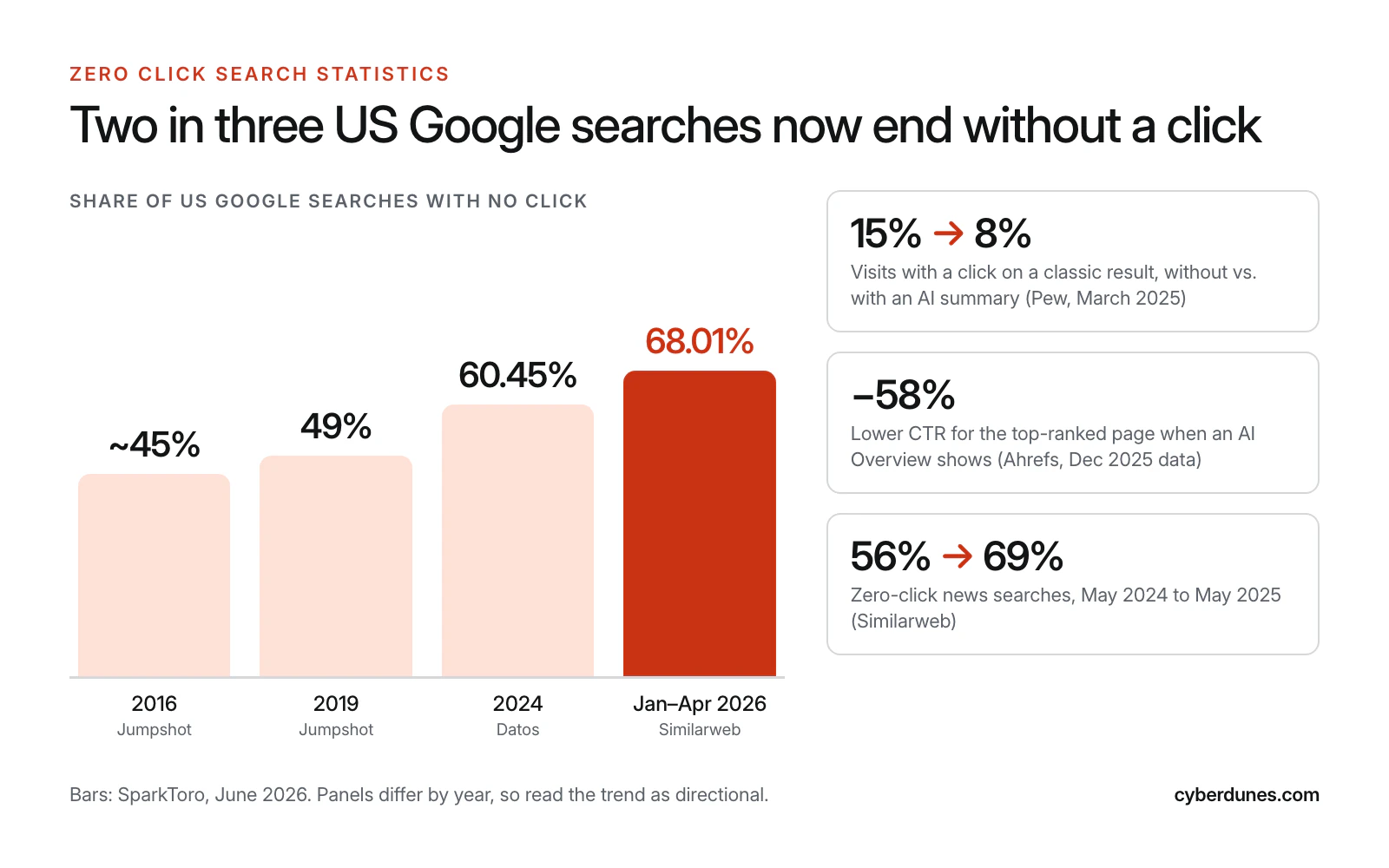
- In the first four months of 2026, 68.01% of US Google searches ended without a click, up from 60.45% in 2024, according to SparkToro's analysis of Similarweb panel data.
- When Google shows an AI summary, users click a classic result in 8% of visits instead of 15% (Pew Research Center).
- Clicks are a lagging signal now. Track visibility in AI answers, branded demand and pipeline influenced, in that order.
- Move budget away from commodity "what is" content and toward answer-first pages, third-party mentions and owned channels such as email and LinkedIn.
- Report to the board in four blocks: what changed, where you stand, what it is worth and what you are changing.
This plan is for CMOs, founders and marketing heads who have watched organic traffic fall while revenue held or grew, and now need to explain why. Cyberdunes has built digital platforms for brands since 2010, and we build Apex®, the AI-native digital experience platform (DXP) that tracks how brands appear in AI answers. Everything below is what we would do with our own budget.
What Are Zero Click Searches?
A zero click search is any search session that ends without a click on a result. SparkToro, which has measured the trend since 2016, defines them as searches that "end without clicking on any of the results presented," including ones where the searcher gives up or types a new query (SparkToro).
Three things cause most of them:
- The answer is on the page. Weather, scores, definitions, conversions and now AI Overviews answer the question before a link is needed.
- The searcher refines. They search again instead of clicking. SparkToro found the share of searches followed by another search rose 7.2 points from 2024 to 2026.
- The answer comes from an AI assistant. The buyer asks ChatGPT, Gemini, Claude, Perplexity or Google AI Overviews and reads a summary that may name you but never sends a visit.
The last point matters most for considered purchases. A zero-click answer can still make your brand the recommendation. It just does not show up in your analytics as a session.
Zero Click Search Statistics: What the 2024 to 2026 Data Shows
The short answer: about two in three Google searches now end without a click, and the share is rising faster than at any time in the last decade. Here is the verified data, with the caveats each source gives.
| Finding | Number | Source and period |
|---|---|---|
| US Google searches ending without a click | 68.01% | SparkToro with Similarweb, January to April 2026 |
| Same measure, two years earlier | 60.45% | SparkToro with Datos, 2024 |
| Change in searches with at least one click of any kind | Down 9.51 points (a 22.9% decline) | SparkToro, 2024 vs. 2026 |
| Searches that went to AI Mode | 0.34% | SparkToro, January to April 2026 |
| Visits with a click on a classic result | 8% with an AI summary, 15% without | Pew Research Center, 900 US adults, March 2025 |
| Visits that ended the browsing session | 26% with an AI summary, 16% without | Pew Research Center, March 2025 |
| Click-through rate for the top-ranked page when an AI Overview shows | 58% lower | Ahrefs, 300,000 keywords, December 2025 vs. December 2023 |
| Zero-click news searches on Google | 56% to 69% | Similarweb, May 2024 to May 2025 |
Two caveats keep this honest. First, SparkToro says its 2016, 2019, 2024 and 2026 numbers come from different panels, so the long-run comparison is "a bit of apples and oranges." Second, AI Mode is not yet the cause: only 0.34% of searches reached it in early 2026. What moved the number is a decade of Google features that answer on the page, plus AI Overviews, which SparkToro says now appear on more than 20% of searches.
The zero click search trends are the same in B2B. Forrester's Buyers' Journey Survey, 2025 found that 94% of business buyers use AI in their buying process, and twice as many named generative AI or conversational search as a more meaningful source than any other, ahead of vendor websites and sales (Forrester, January 2026). Our companion guide on how B2B buyers use AI to build vendor shortlists covers what that does to pipeline.
Why Zero Click Searches Matter for Revenue, Not Just Traffic
Fewer clicks do not mean less demand. They mean demand is being shaped somewhere you cannot see in a traffic report, and the clicks that remain are later in the journey.
SparkToro's June 2026 follow-up puts it plainly: SEO now earns "two different things: being the source AI systems quote, and capturing the high-intent, ready-to-act searches that still convert," such as branded, local and transactional queries (SparkToro). It cites Cyrus Shepard's study of more than 400 winning and losing sites: nearly 84% of winners let users finish a task, against half of the losers.
The influence side is measurable too. In G2's March 2026 survey of 1,076 software buyers, 85% said they think more highly of a vendor when AI includes it in an answer, and 69% chose a different vendor than planned because it was part of a chatbot's recommendation (G2). None of that shows up as a session on your site.
So the business question changes from "How much traffic did we get?" to "Were we in the answer, and did the buyers who saw us come back to buy?"
What Should You Measure Instead of Clicks?
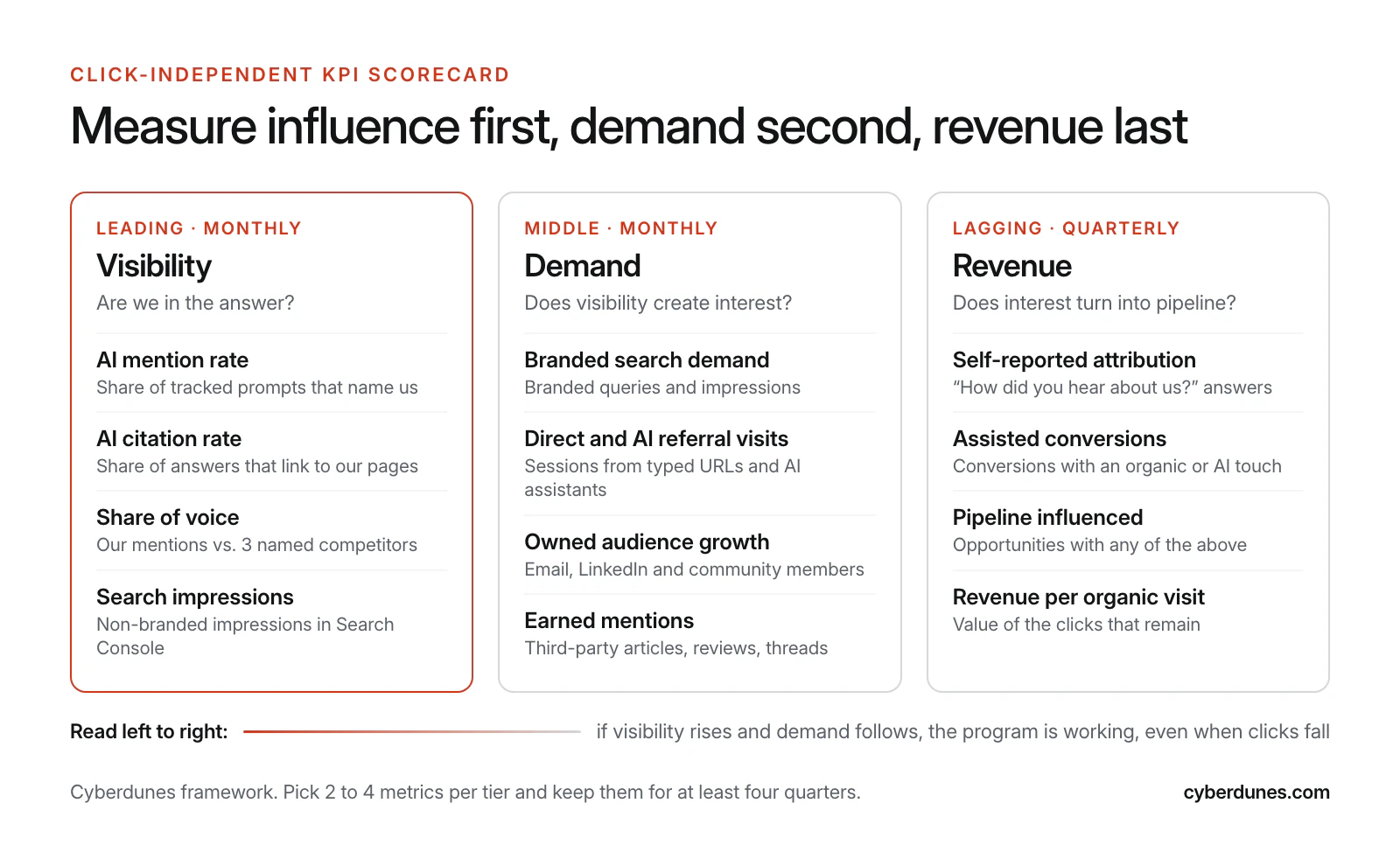
Measure in three tiers: visibility (are we in the answer), demand (does it create interest) and revenue (does interest become pipeline). Clicks stay on the dashboard, but as a diagnostic, not the headline.
| KPI | Tier | Where the data comes from | Cadence | Owner |
|---|---|---|---|---|
| AI mention rate and citation rate on 30 to 50 tracked prompts | Visibility | Prompt tracking across ChatGPT, Gemini, Claude, Perplexity and Google AI Overviews | Monthly | SEO or content lead |
| Share of voice vs. three named competitors | Visibility | Same prompt set | Monthly | SEO or content lead |
| Non-branded search impressions | Visibility | Google Search Console | Monthly | SEO lead |
| Branded search demand | Demand | Branded queries in Search Console, Google Trends | Monthly | Brand lead |
| Direct and AI referral sessions | Demand | GA4 channel groups | Monthly | Analytics lead |
| Owned audience growth | Demand | Email list, LinkedIn followers, community members | Monthly | Social or CRM lead |
| Self-reported attribution | Revenue | "How did you hear about us?" field on forms and in sales calls | Quarterly | Marketing ops |
| Assisted conversions and pipeline influenced | Revenue | CRM, GA4 conversion paths | Quarterly | Marketing ops and sales ops |
Score it simply. Each quarter, mark every KPI +1 if it improved, 0 if flat and −1 if it fell. A healthy zero-click program shows a positive visibility and demand total even while organic clicks decline. If visibility rises but demand stays flat for two quarters, your answers are reaching buyers without persuading them, which is a messaging problem, not a search problem.
Three setup notes. Use an AI visibility checker to set your baseline across engines. Set up GA4 to separate assistant visits from organic search, as in our guide to tracking AI traffic in GA4. And add a free-text "How did you hear about us?" field today, because it is the only source that catches a buyer who read about you in ChatGPT and then typed your URL. SparkToro gives the same advice: replace traffic as a KPI and build a correlation dashboard instead.
How Should You Rebalance Budget for Zero Click Search?
Sort every content and search line item by two questions: does it still earn a click when the buyer searches, and does it shape what AI answers say about you? The answers put each item into one of four boxes.
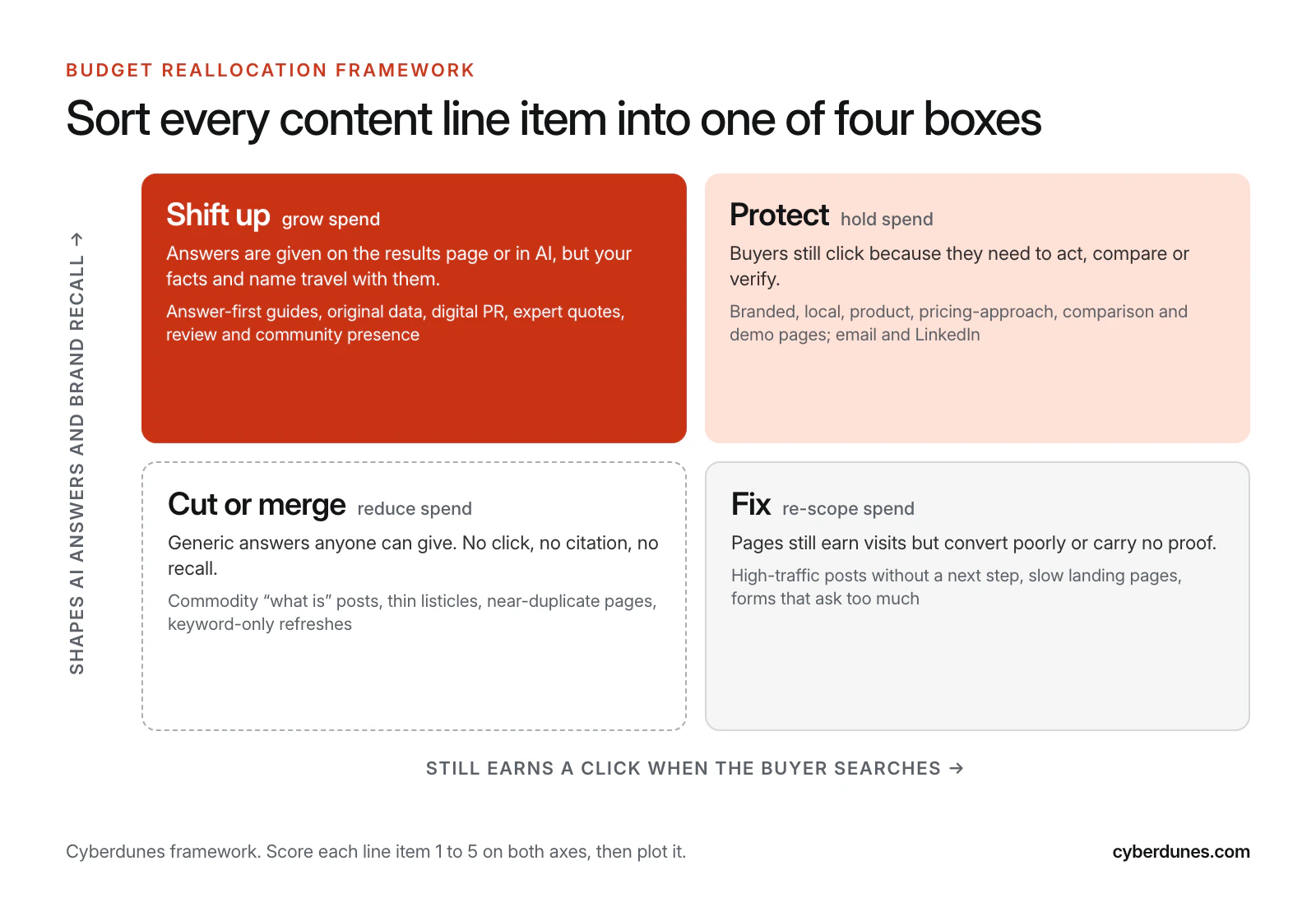
- Shift up (grow spend): content that rarely earns a click but carries your facts into answers. Answer-first guides, original data, expert commentary, digital PR, review and community presence.
- Protect (hold spend): pages where buyers still need to act or verify. Branded, local, product, comparison and demo pages, plus email and LinkedIn.
- Fix (re-scope spend): pages that still get visits but convert poorly. Our guide to conversion rate optimization for AI search traffic covers the seven fixes we apply first.
- Cut or merge (reduce spend): generic answers anyone can give. If an AI Overview can answer it in two lines, a 1,500-word post on it earns neither a click nor a citation.
A Worked Example
Take an illustrative annual content and search budget of ₹60 lakh. This is a fictional split, not client data.
| Line item | Box | Before | After | Change (₹ lakh) |
|---|---|---|---|---|
| Commodity informational blog posts | Cut or merge | 40% | 15% | 24 to 9 |
| Answer-first guides, original data, comparison pages | Shift up | 15% | 25% | 9 to 15 |
| Digital PR, review program, community presence | Shift up | 10% | 20% | 6 to 12 |
| Owned channels: email, LinkedIn, community | Protect | 15% | 20% | 9 to 12 |
| Demand capture: branded, local, conversion work | Protect and fix | 15% | 15% | 9 to 9 |
| Measurement: AI visibility, attribution survey | Enable | 5% | 5% | 3 to 3 |
The total stays at ₹60 lakh. ₹15 lakh moves out of posts that answer generic questions and into work that either earns a mention in AI answers or captures a buyer who is ready to act. That matters because budgets are not growing: Gartner's 2026 CMO Spend Survey put marketing budgets at 7.8% of company revenue, up from 7.7% in 2025, and 56% of CMOs said they lack the budget to deliver their 2026 strategy (Gartner, May 2026). Reallocation, not new money, is the realistic path.
How Do You Create Content That Works Without a Click?
Write pages that AI systems can quote accurately and that a human can act on. In practice, that means the answer in the first two sentences, specifics that only you can supply and a clear next step.
- Lead with the answer. Put a 40 to 60 word direct answer under each question-form heading. This is the passage an AI Overview or assistant is most likely to lift.
- Add what a model cannot recreate. Original numbers, named methods, prices or price drivers, timelines and constraints. Generic advice gets summarized without credit.
- Cover the follow-up questions. AI search expands one query into many related ones. Our guide to query fan-out content strategy shows how to map them.
- Keep facts consistent everywhere. Your name, product names, locations and claims should match across your site, profiles and listings, so the model does not have to choose between versions.
- Give the reader a task to finish. A calculator, a checklist, a demo booking or a comparison table. Shepard's data says task completion is what separates sites that still win clicks.
For the technical side, such as structured data and llms.txt, see our complete guide to generative engine optimization (GEO).
How Do You Earn Third-Party Mentions That LLMs Trust?
Show up on the sites AI engines already cite for your category. Your own site is one source among many, and for many prompts it is not the main one.
Peec AI's analysis of 30 million sources cited by ChatGPT, Google AI Mode, Gemini, Perplexity and AI Overviews in the US found Reddit, YouTube, LinkedIn, Wikipedia and Forbes as the most-cited domains overall, with G2 sixth (Peec AI, 2026). The mix differs by engine, so check which sources appear for your own prompts before you spend.
- Digital PR with data. Publish one original data point a quarter that journalists and analysts can quote. A survey of 200 customers beats ten opinion posts.
- Expert presence in communities. Have named experts answer real questions on LinkedIn and relevant subreddits, with clear disclosure. No astroturfing.
- Reviews. Ask every happy customer, at a set moment after onboarding, for a review on the platforms your buyers use.
- Video. Short explainers on YouTube for the questions your sales team hears most.
We explain the mechanics in how LLMs choose sources to cite.
Why Owned Channels Matter More When Search Sends Fewer Clicks
Owned channels are the audience you can reach without asking a platform for permission. When a search engine keeps two in three searches, a subscriber list is the closest thing to guaranteed reach.
- Email. A useful weekly or fortnightly newsletter turns one-time readers into a repeat audience. If clicks are weak, start with four steps to improve your email click-through rate.
- LinkedIn. For B2B, post from people, not only the company page. A founder or practice head with a clear point of view earns attention that a logo rarely does.
- Community. A customer group, a recurring webinar or a small invite-only roundtable builds the word of mouth that AI answers later reflect.
Treat every zero-click answer as the first touch and every owned channel as the second. The goal of the answer is recall. The goal of the channel is a relationship.
How Do You Report Zero Click Search Impact to a Board?
Lead with revenue, not traffic, and explain the market change in one sentence with one sourced number. Boards accept a falling metric when you show which metric replaced it and why.
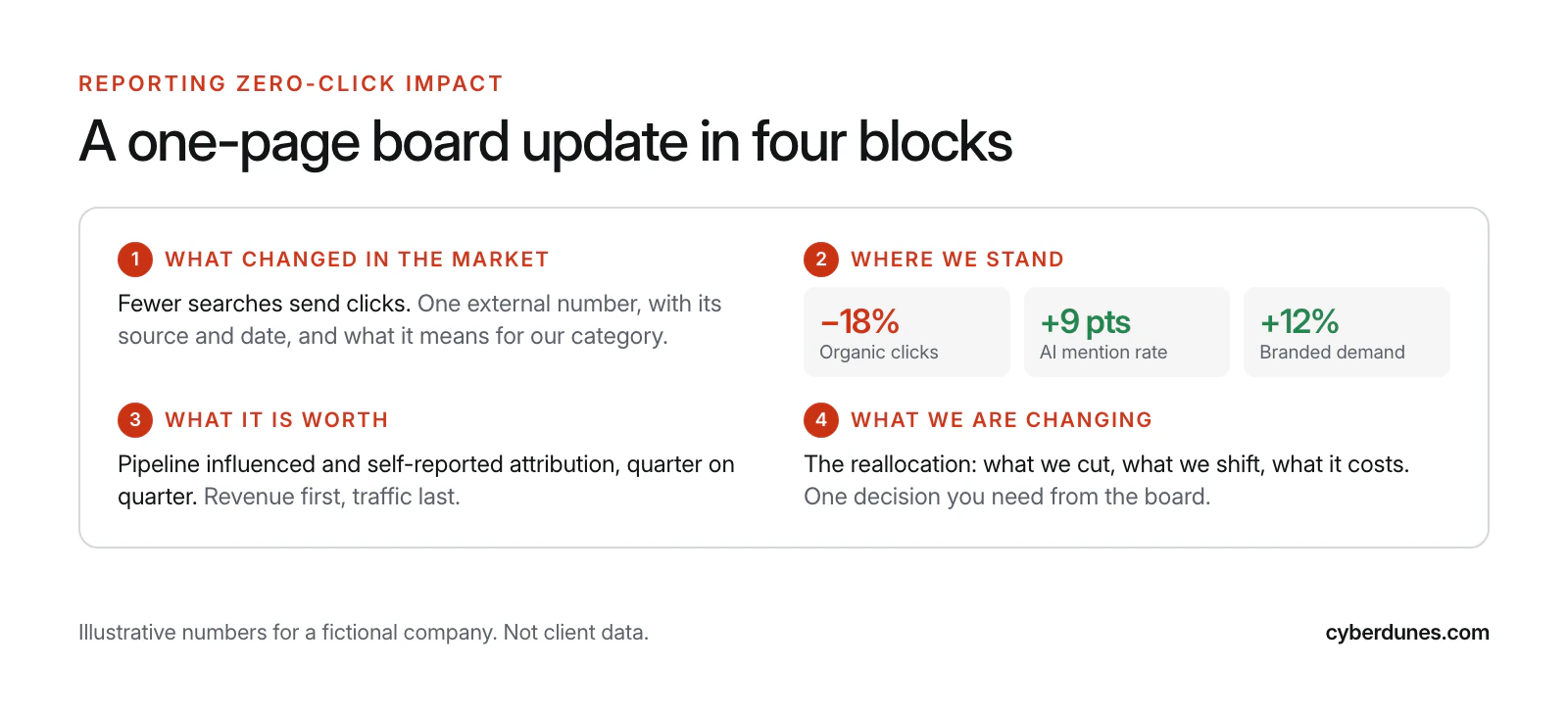
- What changed in the market. "68% of US Google searches now end without a click (SparkToro, June 2026). Our category is no exception."
- Where we stand. Three numbers side by side: organic clicks, AI mention rate and branded demand, each quarter on quarter.
- What it is worth. Pipeline influenced and self-reported attribution. If buyers say "ChatGPT recommended you," quote the count.
- What we are changing. The reallocation table, the cost and the one decision you need from the board.
Keep the same metrics for at least four quarters, so trends mean something. If your board wants a model rather than a dashboard, marketing mix modeling (MMM) estimates channel impact without relying on clicks.
A 90-Day Zero Click Search Optimization Plan
Ninety days is enough to set a baseline, move the first budget and show the board a trend. Here is the sequence we would follow.
| Weeks | Action | Owner | Effort |
|---|---|---|---|
| 1 to 2 | Pick 30 to 50 buyer prompts and record the baseline across ChatGPT, Gemini, Claude, Perplexity and Google AI Overviews | SEO or content lead | 2 to 3 days |
| 1 to 2 | Add "How did you hear about us?" to forms and the sales call script | Marketing ops | Half a day |
| 3 to 4 | Set up GA4 channel groups for AI referrals and a branded query report in Search Console | Analytics lead | 1 day |
| 3 to 5 | Score every content line item on the four-box framework and agree the reallocation | CMO with finance | 2 days |
| 5 to 10 | Rewrite the 10 pages closest to revenue in answer-first format; merge or retire thin posts | Content team | 3 to 4 weeks |
| 5 to 12 | Start a review request program and one data-led PR story | PR and customer success | Ongoing |
| 11 to 12 | Re-run the prompt set, fill in the scorecard and present the one-page board update | CMO | 2 days |
How Cyberdunes and Apex® Help With Zero Click Search
Apex® brings the measurement and the publishing into one place. Its AI visibility features track prompts, citations and sentiment across ChatGPT, Gemini, Claude, Perplexity and Google AI Overviews, so the visibility tier of your scorecard updates without manual checks. See how prompt tracking in Apex® works.
On the content side, Context Intelligence runs site audits and topic research, drafts answer-first pages, repurposes them for LinkedIn and short video, and schedules publishing. Apex® also handles Schema.org JSON-LD, XML sitemaps, IndexNow and llms.txt, and connects to Google Analytics and your CRM through its API layer. It will not guarantee a citation, and no platform honestly can. It makes the work measurable and repeatable.
You can start with a free AI visibility check to see your baseline today.
Sources
- In 2026, Less than One Third of Google Searches Still Send a Click, SparkToro, June 2026
- The Click Is Now Optional. Here's What Isn't., SparkToro, June 2026
- 2024 Zero-Click Search Study, SparkToro, 2024
- Do people click on links in Google AI summaries?, Pew Research Center, July 2025
- Update: AI Overviews Reduce Clicks by 58%, Ahrefs, February 2026
- Generative Engine Optimization: The Complete 2026 Guide, Similarweb, 2026
- B2B Buyers Make Zero-Click Number One, Forrester, January 2026
- In the Answer Economy, Don't Win the Click, Win the Answer, G2, April 2026
- Gartner 2026 CMO Spend Survey, Gartner, May 2026
- Top domains cited by AI search: analysis based on 30M sources, Peec AI, 2026