
B2B buyers use AI to research categories, compare vendors and draft business cases before they ever speak to sales. They ask ChatGPT, Gemini, Copilot or Perplexity for a shortlist, check it against reviews and peers, and reach the first sales call with a favorite already in mind. If AI leaves you out, you rarely get a second chance.
Key Takeaways
- 94% of business buyers use AI in their buying process, and twice as many named generative AI as a more meaningful source than any other, ahead of vendor websites and sales (Forrester, January 2026).
- 51% of software buyers now start research in an AI chatbot more often than in Google, up from 29% a year earlier (G2, April 2026).
- 94% of buying groups rank preferred vendors before first contact, and the winner comes from the Day One shortlist 95% of the time (6sense, 2025).
- AI answers about vendors draw heavily on review sites, communities such as Reddit and LinkedIn, media and your own pages. You control only some of these.
- The fix is a shortlist-prompt audit, honest comparison and alternatives pages, a clear pricing approach, a steady review program and a sales team trained to work with what AI already told the buyer.
This guide is for CMOs, founders, heads of sales and revenue leaders at B2B companies, from SMBs to enterprises. At Cyberdunes we sell an enterprise platform, Apex®, to B2B buying groups ourselves, and we run AI visibility and GEO work for clients. The plan below is the one we use on our own pipeline.
How Do B2B Buyers Use AI in 2026?
B2B buyers use AI at every stage: to define the problem, find vendors, compare them, summarize reviews and build the internal case. The research from 2025 and 2026 agrees on the direction, even where the exact numbers differ.
| Finding | Number | Source |
|---|---|---|
| Business buyers using AI in their buying process | 94% (up from 89%) | Forrester Buyers' Journey Survey, 2025 |
| Buyers using private AI tools provided by their organization | 61% | Forrester, January 2026 |
| Software buyers who start research in an AI chatbot more often than Google | 51% (29% in 2025) | G2, survey of 1,076 buyers, March 2026 |
| Software buyers who rely on AI chatbots at some point in research | 71% | G2, March 2026 |
| Buyers using Deep Research tools for structured software evaluations | 41% | G2, March 2026 |
| Buyers using large language models in the buying process | 94% | 6sense, nearly 4,000 buyers, 2025 |
| Buyers who used GenAI during a recent purchase | 45% | Gartner, 645 buyers, August to September 2025 |
Forrester adds a detail that matters for targeting: business buyers are twice as likely to use ChatGPT and four times as likely to use Microsoft Copilot as consumers. Many of those buyers use private versions behind their company firewall, so you cannot see their research in any analytics tool.
Why Do the Numbers Disagree?
Gartner's 45% and Forrester's 94% measure different things. Gartner asked about GenAI use during one recent purchase. Forrester and 6sense asked about AI use anywhere in the buying process, which includes summarizing reviews or analyzing data. The question wording and the sample decide the number. For planning, the safe reading is this: most buyers use AI somewhere, and a large minority use it to decide who makes the list.
The speed of change is the bigger story. In January 2025, only 7% of the 2,058 buyers TrustRadius surveyed said they used LLMs like ChatGPT in their buying process (TrustRadius, 2025). In G2's survey 14 months later, half of software buyers started their research in a chatbot. Different samples, same direction.
When Does the B2B Vendor Shortlist Form?
Before the buyer talks to you. By the time a seller hears from a prospect, the buying group usually has a ranked shortlist and a favorite.
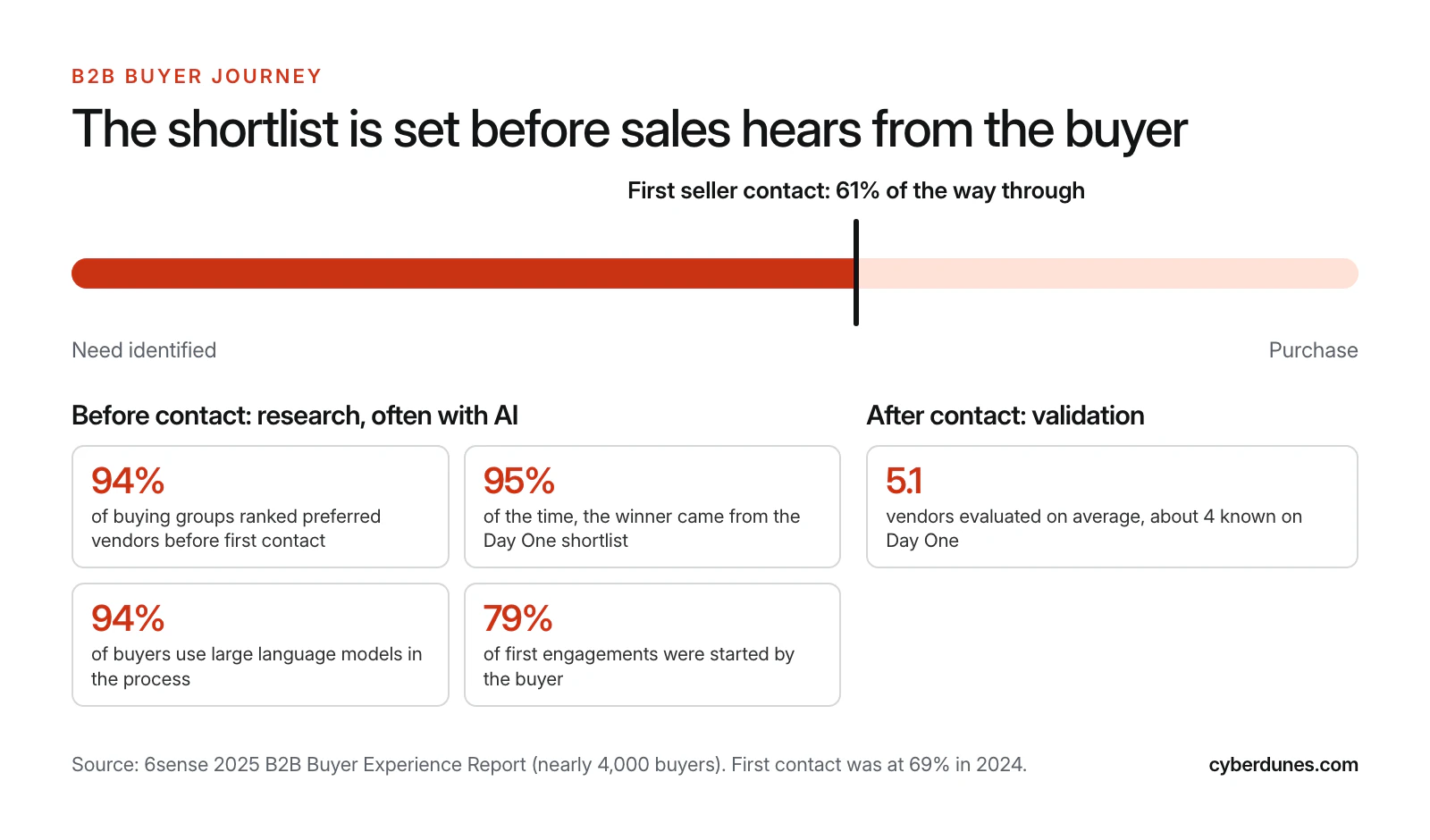
- 94% of buying groups ranked preferred vendors before first contact (6sense, November 2025).
- First contact with a seller came at about 61% of the journey in 2025, earlier than 69% in 2024, but still well past halfway (6sense).
- Buyers evaluated an average of 5.1 vendors and filled about 3.6 shortlist spots on Day One. They chose from that Day One shortlist 95% of the time.
- Buyers started 79% of first engagements with vendors.
- In TrustRadius' sample, the average shortlist held 2.6 products, 82% of buyers had a top product in mind when they made it, and 70% bought that product.
AI is now one of the strongest inputs to that Day One list. G2 found that AI chatbots are the top source influencing buyer shortlists, ahead of review sites, analyst firms and vendor websites. In the same survey, 69% of buyers chose a different vendor than planned because a chatbot recommended it, and one in three bought from a vendor they had never heard of before. That last number is the opportunity for challengers.
The demand side of this shift, where buyers get answers without visiting a site, is covered in our marketing plan for zero click searches.
What Do AI Vendor Shortlist Prompts Look Like?
Shortlist prompts are long, specific and full of constraints. Buyers describe their company size, industry, region, existing tools and budget, then ask for a list, a comparison or a warning.
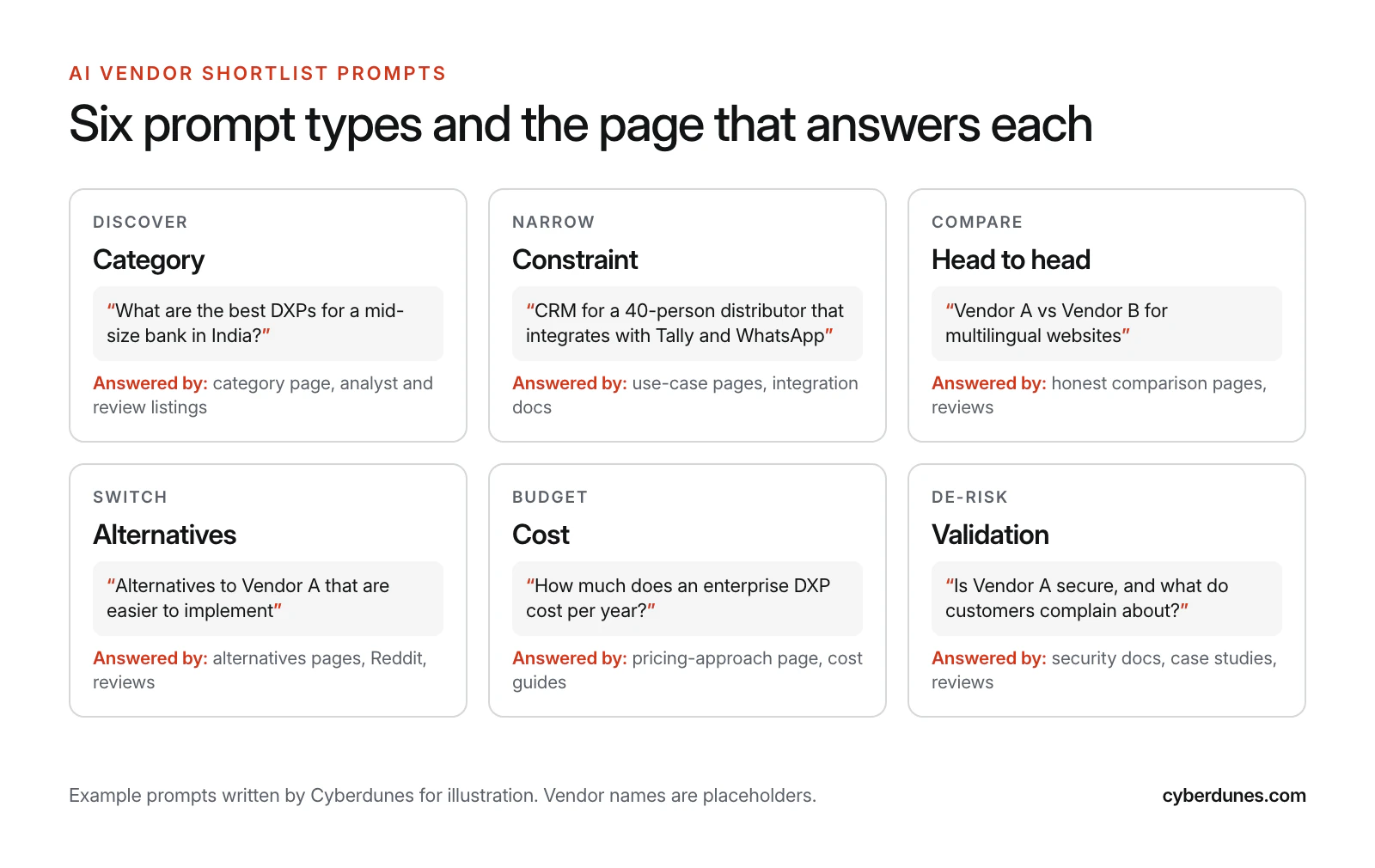
Different members of the buying group ask different questions. Forrester's 2026 State of Business Buying report found the typical decision involves 13 internal stakeholders and nine external influencers (Forrester, January 2026). Map your prompts to the roles that matter in your deals:
| Role | Example prompt | What they need to see |
|---|---|---|
| Business owner or CMO | "Which DXP helps a 200-person insurer launch campaign pages without IT tickets?" | Outcomes, time to value, named use cases |
| CIO or IT lead | "Does Vendor A integrate with Salesforce and support single sign-on?" | Integration docs, security and hosting details |
| Finance | "What is the total cost of ownership of an enterprise DXP over three years?" | Pricing model, cost drivers, implementation effort |
| Procurement | "What are common contract risks with SaaS vendors in India?" | Terms, data handling, references |
| End users | "Is Vendor A easy for marketers to use? What do reviewers complain about?" | Reviews, demos, training material |
Procurement deserves special attention: Forrester found procurement professionals are decision-makers in 53% of business buying cycles and engage from the start. AI search breaks one prompt into many sub-questions, so cover the follow-ups as well. Our guide to query fan-out shows how.
Which Sources Does AI Use to Recommend B2B Vendors?
AI engines blend your website with review platforms, communities, media and reference sites. For many shortlist prompts, third-party sources carry more weight than your own pages.
Peec AI analyzed 30 million sources cited by ChatGPT, Google AI Mode, Gemini, Perplexity and AI Overviews in the US. The most-cited domains overall were Reddit, YouTube, LinkedIn, Wikipedia and Forbes, with G2 sixth and TechRadar tenth. G2 appeared in Perplexity's top five, and review platforms such as G2 and Clutch were among the top 100 cited domains (Peec AI, 2026).
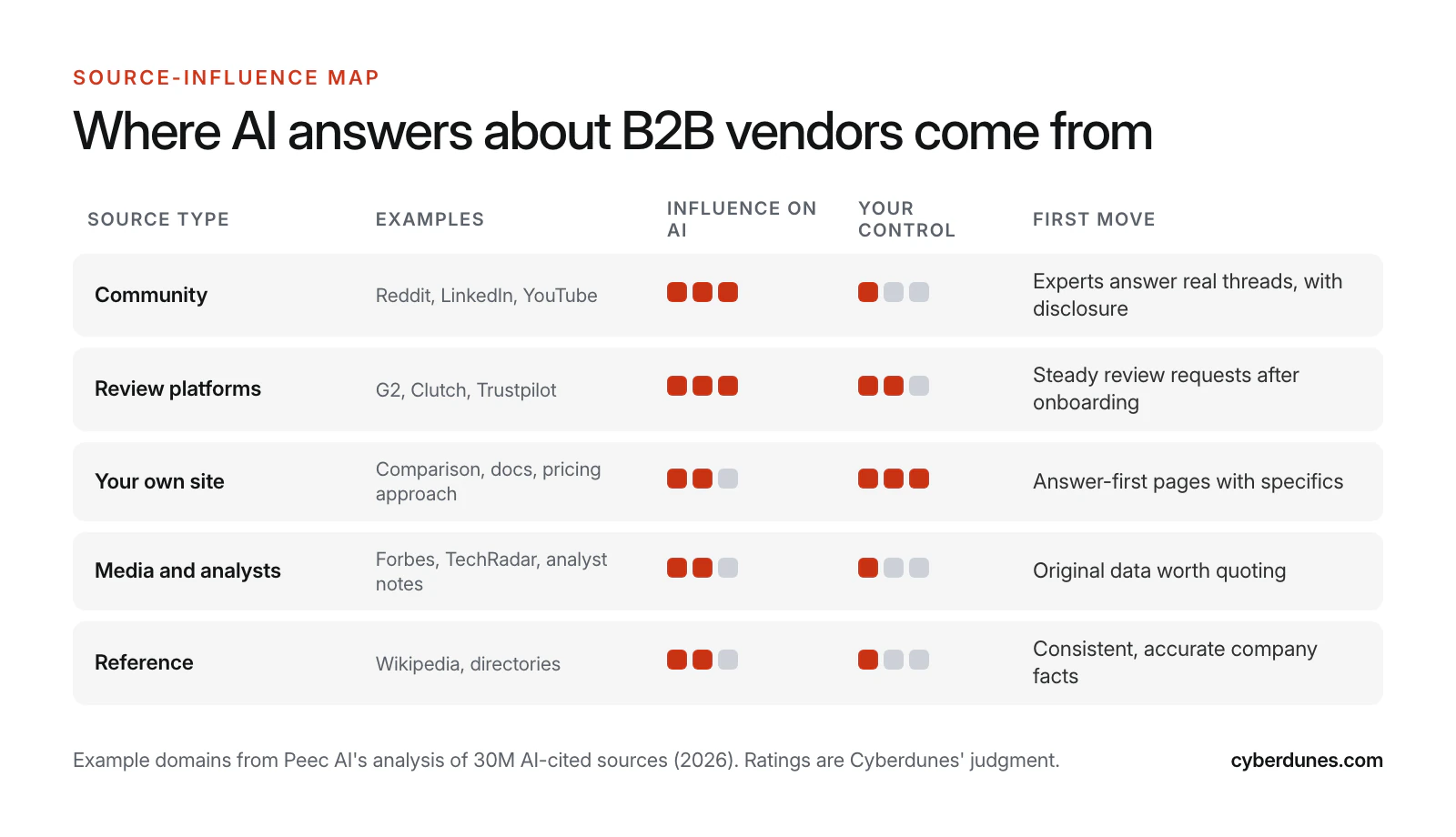
Buyers check what AI tells them. In TrustRadius' survey, 90% of buyers said they click through to the sources cited in AI Overviews to fact-check, and 52% used vendor websites as a source in their journey. 6sense reported that LLM use "has not changed their reliance on vendor content or third-party experts." So your own pages still matter twice: as a source for the model and as the place a skeptical buyer goes to verify.
For the mechanics of source selection, read how LLMs choose sources to cite.
How to Run a Shortlist-Prompt Audit
A shortlist-prompt audit tells you, prompt by prompt, whether AI puts you on the list, describes you correctly and which source it trusts instead of you. It takes about two days the first time.
- Write 30 prompts. Five for each of the six prompt types above, written the way your buyers talk. Use real phrases from sales calls and RFPs.
- Add constraints. Include company size, industry, region and the tools you integrate with. Shortlist prompts are rarely generic.
- Run them in ChatGPT, Gemini, Claude, Perplexity and Google AI Overviews. Use a clean session. Run each prompt twice, because answers vary.
- Score each answer 0 to 3. 3 means shortlisted and described accurately, 2 shortlisted with gaps or errors, 1 mentioned but not recommended, 0 missing.
- Record the top cited source and the competitor named first. This tells you what to fix: your page, a review profile, a community thread or a third-party article.
- Total the score and repeat monthly. Track the score per prompt type, not only the overall number.
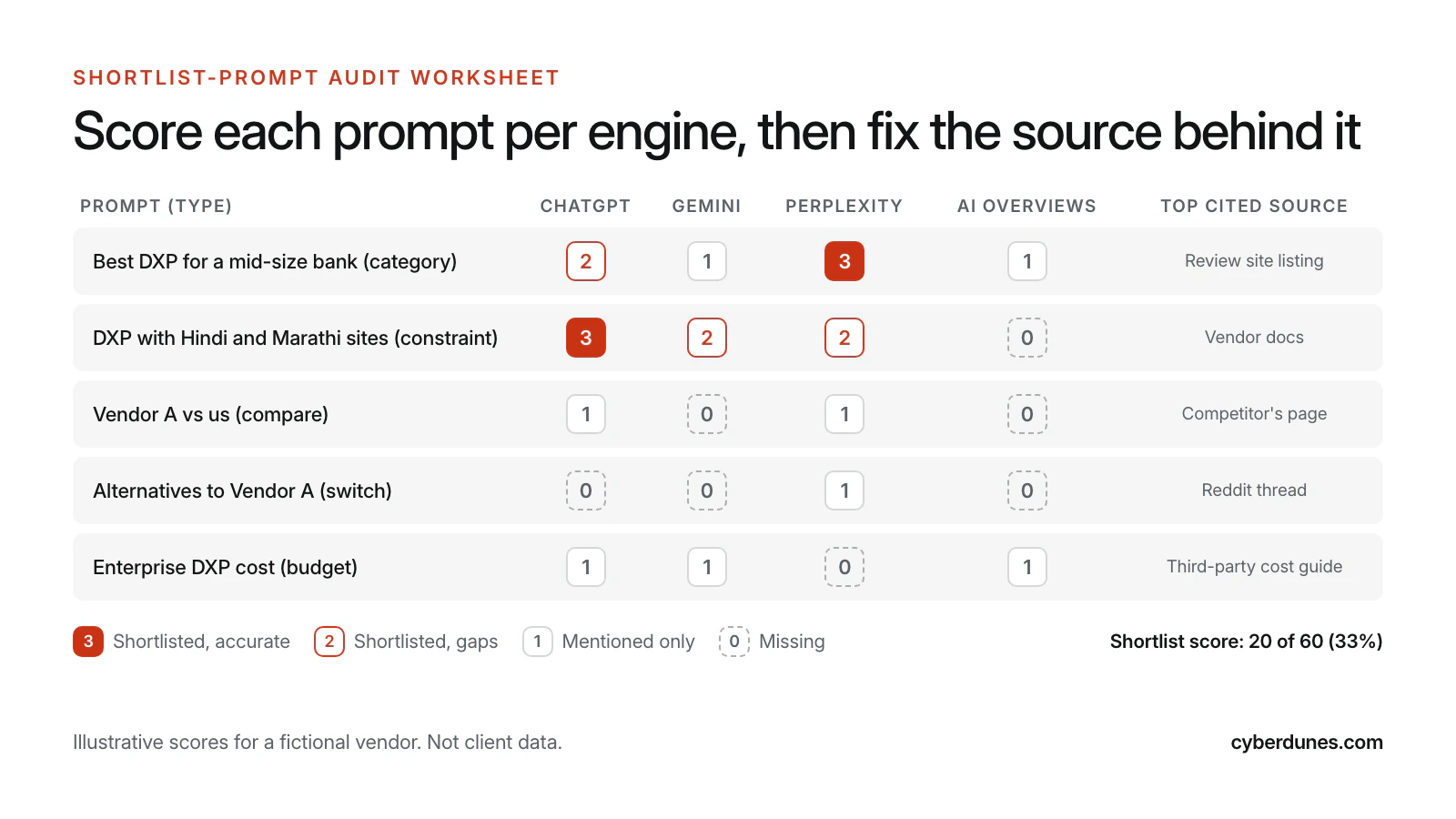
Read the example above the way we would. This fictional vendor scores 20 of 60, or 33%. It does well when buyers ask about a capability it documents (multilingual sites), but it almost disappears on comparison and alternatives prompts, where a competitor's page and a Reddit thread set the narrative. The next three pages it should build are obvious.
Wrong facts are a separate failure. If AI shortlists you but states the wrong integrations or an old product name, fix it with the process in how to fix wrong AI answers about your brand. To automate the audit, Apex® prompt tracking runs the same prompts on a schedule and reports citations and sentiment.
What Should You Build to Get on AI Shortlists?
Build the pages and proof that answer the prompts you are missing. In our experience, four assets close most gaps.
Comparison and Alternatives Pages
Publish honest "Us vs. Competitor" and "Alternatives to Competitor" pages. State who each product suits, including when the competitor is the better fit. Use a criteria table: deployment model, integrations, languages, support hours, implementation time and contract terms. Pages that only praise you read as ads, and buyers who fact-check will notice.
A Transparent Pricing Approach
Cost prompts get answered whether or not you publish anything. If you say nothing, AI fills the gap with a third-party guess. You do not have to publish a price list to be transparent. Explain how pricing works:
- The model: per seat, per usage, tiered plans or custom quotes.
- What drives cost: sites, users, traffic, integrations, support level.
- What is included and what costs extra, such as migration or training.
- If you quote per deal, say so plainly and list the inputs you need for a quote.
A Steady Review Program
Review platforms rank high in AI citations, and G2 found that review sites are the only source besides AI chatbots that gains influence deeper into the funnel. Ask for reviews at a fixed moment, for example 60 days after go-live, on the platforms your buyers use. Never buy or script reviews; our explainer on astroturfing covers the legal and trust risks.
Documentation and Proof
Validation prompts ask about security, integrations and results. Keep public pages for each: integration documentation, security and hosting details, implementation timelines and case studies with real numbers. Trials help too. Forrester found more than 60% of business buyers use a trial, and 78% of buyers making purchases of $10 million or more run one first.
If you want a partner for this work, our GEO and page speed services cover the audit, the page builds and the technical fixes.
How Should Sales Handle AI-Informed Buyers?
Treat every first call as a validation conversation. The buyer arrives with an AI-built view of the market, and your seller's job is to confirm, correct and add what the model could not know.
Gartner's survey of 645 B2B buyers found 69% prefer to validate AI-generated insights with sales reps, even though 67% prefer a rep-free experience overall. Buyers were split on trust: 51% said they were more likely to encounter misleading information from GenAI, and 49% from a sales rep (Gartner, May 2026). Forrester's press release makes the same point: answer engines often deliver incomplete or unreliable information, so buyers seek validation from trusted sources.
- Ask what AI told them. Add "Which tools or sources did you use to build your shortlist?" to discovery. Log the answer in the CRM.
- Arm sellers with the audit. Share the latest prompt audit, with the top three wrong or missing claims and the correct facts.
- Build a correction sheet. One page per competitor comparison that AI gets wrong, with sources a buyer can check.
- Send proof, not decks. Case studies, security documents and a trial plan travel inside the buying group better than slides.
- Feed it back. Every new objection is a prompt to add to the audit and a page to write.
This sits alongside, not instead of, your pipeline engine. Our seven lead generation strategies still apply. They now start one step earlier, in the AI answer.
A 30/60/90-Day Plan for AI Vendor Shortlists
Ninety days is enough to measure where you stand, ship the first fixes and see whether the shortlist score moves.
| Phase | Actions | Owner |
|---|---|---|
| Days 1 to 30: Measure | Write 30 shortlist prompts with sales; run the first audit across five engines; add the "which sources did you use" question to discovery; list review platforms and current review counts | Product marketing with sales |
| Days 31 to 60: Build | Publish two comparison pages and one alternatives page; publish a pricing approach page; launch the review request at 60 days after go-live; update integration and security pages | Content, customer success, product |
| Days 61 to 90: Reinforce | Brief sellers with the audit and correction sheets; pitch one data-led story to trade media; answer real buyer questions on LinkedIn and relevant communities; re-run the audit and compare scores | Sales enablement, PR, CMO |
For the wider launch plan these pages sit in, see our step-by-step go-to-market strategy guide.
How Cyberdunes and Apex® Help B2B Teams Get Shortlisted
Apex®, the AI-native digital experience platform (DXP), gives B2B teams one place to measure and improve how AI describes them. Its AI visibility features track prompts, citations and sentiment across ChatGPT, Gemini, Claude, Perplexity and Google AI Overviews, so the shortlist-prompt audit runs on a schedule instead of in a spreadsheet.
The same platform publishes the pages the audit asks for: comparison, documentation and case study pages with Schema.org JSON-LD, XML sitemaps, IndexNow and llms.txt handled for you. Context Intelligence drafts answer-first pages and repurposes them for LinkedIn, and integrations connect results to your CRM. No platform can guarantee a place on an AI shortlist. Apex® makes the work visible and repeatable.
Start with a free AI visibility check, or read our guide to what an AI visibility checker measures.
Sources
- B2B Buyers Make Zero-Click Number One, Forrester, January 2026
- Forrester's 2026 Buyer Insights: GenAI Is Upending B2B Buying As Leaders Face Mounting Pressure To Justify Every Dollar Spent, Forrester, January 2026
- In the Answer Economy, Don't Win the Click, Win the Answer, G2, April 2026
- The B2B Buyer Experience Report for 2025, 6sense, 2025
- The Timeline for Influencing B2B Buyers Is Shrinking, 6sense, November 2025
- Bridging the Trust Gap: B2B Tech Buying in the Age of AI, TrustRadius, 2025
- Gartner Survey Finds 69% of B2B Buyers Turn to Sales Reps to Validate AI-Generated Insights, Gartner via Business Wire, May 2026
- Top domains cited by AI search: analysis based on 30M sources, Peec AI, 2026