
Skip to content

Product Management

Go-To-Market Strategy: A Step-By-Step Guide

Entering a new market without a plan wastes money. This step-by-step guide shows you how to build a go-to-market (GTM) strategy, from objectives and positioning to channels and launch metrics.

Hands with markers sketching a web page wireframe on a whiteboard with video module and description notesGo-To-Market Strategy: A Step-By-Step Guide

A go-to-market (GTM) strategy is your plan for taking a product into a market: who you sell to, why they will buy, how you will reach them and how you will know it is working. Whether you are launching a new product or taking an existing one into a new region or segment, a GTM plan keeps the team from spending money on guesses. Work through these steps in order.

1. Set Clear Go-To-Market Objectives

Start with one question: why are you entering this market? Then turn the answer into specific, measurable goals, such as a number of paying customers, a revenue target or a share of a defined segment within a set time.

Every later step should support these objectives. Clear goals keep the plan focused and give you a way to decide when to push harder and when to stop.

2. Analyze Your Target Market

Look for a market with real demand and room for a new option. There is no point supplying a market that does not want what you sell, so check the evidence before you commit: search demand, competitor traction, customer interviews and early sign-ups.

Check the economic conditions of the market as well, along with regulation, pricing norms and how buyers in that market usually purchase. They will shape your sales.
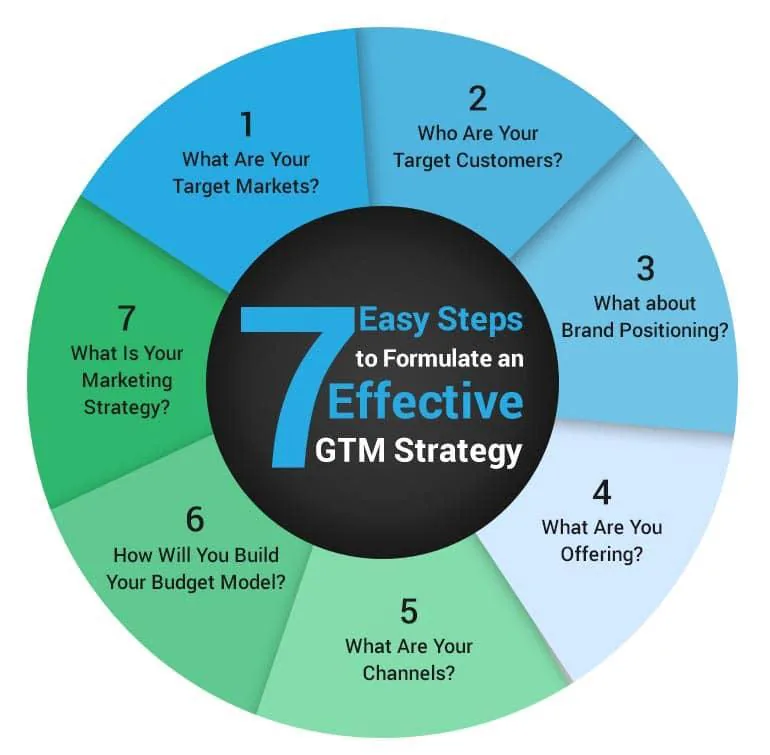
Wheel diagram of 7 steps to an effective GTM strategy, from target markets and customers to channels, budget and marketing

3. Define Your Ideal Customer

Describe the buyer you are building for: their role, the problem they feel most, what they use today and who signs off on the purchase. In business-to-business (B2B) sales, the user and the buyer are often different people, so describe both.

Validate the description with real conversations. Ten interviews with likely buyers will tell you more than a week of desk research.

4. Study Your Competitors

Your competitors show you where the opportunities and the traps are. Use their websites, pricing pages, reviews and job listings, plus market research tools, to answer questions such as:

  • Which segments do they serve best, and which do they neglect?
  • How do they price and package their product?
  • What do their customers complain about in reviews?

The answers tell you where to compete and what to avoid. Learning from their mistakes already puts you a step ahead.

5. Write Your Positioning and Pricing

Positioning answers three questions in plain language:

  • Who is the product for?
  • What problem does it solve better than the alternatives?
  • Why should buyers believe you?

Set pricing alongside positioning, because price signals who the product is for. Decide on a model (subscription, usage-based, one-time or tiered) and test it with prospects before launch.

6. Choose Your Channels

Pick the few channels where your buyers already look for solutions: search, partners, direct sales, marketplaces, communities or events. Buyers increasingly ask AI assistants such as ChatGPT, Gemini, Claude, Perplexity and Google AI Overviews for product recommendations, so make sure your website explains your product clearly enough to be cited. Our guide to how LLMs choose sources to cite explains what that takes.

Start narrow. Two channels done well beat six done badly.

7. Use Research Partners Where It Helps

Market research firms can add depth when you are entering an unfamiliar region or industry. Choose carefully, because the quality of your decisions depends on the quality of their research. Ask how they recruit respondents and what sample sizes they use, and compare several firms before you decide.

8. Launch, Measure and Adjust

Agree on a few launch metrics before you start, such as qualified leads, conversion to paid, customer acquisition cost and early retention. Review them weekly in the first months. Use sales data and buyer feedback to improve the product, the message and the channel mix.

Build Your Own Go-To-Market Strategy

Entering a new market takes effort, time and money, so know the market well before you commit. Set your goals, follow the steps above and plan before you dive in. If you want experienced help shaping the plan, our product management consultants work with teams on GTM. To see how AI now supports launch planning, read how AI is changing the product management lifecycle.


FAQs

Questions, Answered

Can’t find what you’re looking for? Our team is happy to help.

What is a go-to-market strategy?

A go-to-market (GTM) strategy is the plan for taking a product into a market: who you sell to, why they will buy, how you will reach them and how you will know it is working. It applies to new product launches and to taking an existing product into a new region or segment.

What are the steps to build a go-to-market strategy?

The steps are: set clear objectives, analyze the target market, define the ideal customer, study competitors, write positioning and pricing, choose channels, use research partners where helpful, then launch, measure and adjust. Working through them in order keeps the team from spending money on guesses.

How do I set go-to-market objectives?

Start by asking why you are entering the market, then turn the answer into specific, measurable goals, such as a number of paying customers, a revenue target or a share of a defined segment within a set time. Every later step in the GTM plan should support those objectives.

How do I know if a target market has real demand?

Check the evidence before committing: search demand, competitor traction, customer interviews and early sign-ups. Also review the market's economic conditions, regulation, pricing norms and how buyers usually purchase, since all of these shape how a product will sell.

How do I define my ideal customer?

Describe the buyer's role, the problem they feel most, what they use today and who signs off on the purchase. In B2B sales the user and the buyer are often different people, so describe both, then validate the profile with real conversations; ten interviews often teach more than a week of desk research.

What should I learn from competitors before launching?

Competitor research should reveal which segments rivals serve best and which they neglect, how they price and package their products and what their customers complain about in reviews. Websites, pricing pages, reviews, job listings and market research tools all provide useful evidence.

What questions should product positioning answer?

Positioning should answer three questions in plain language: who the product is for, what problem it solves better than the alternatives and why buyers should believe you. Clear answers make it easier to write marketing messages and train sales teams.

How do I choose a pricing model for a launch?

Set pricing alongside positioning, because price signals who the product is for. Choose a model such as subscription, usage-based, one-time or tiered pricing, and test it with prospects before launch rather than guessing after the product is live.

How many marketing channels should a launch use?

Start narrow with the few channels where buyers already look for solutions, such as search, partners, direct sales, marketplaces, communities or events. Two channels done well usually beat six done badly. Since buyers also ask AI assistants for recommendations, make sure your website explains the product clearly enough to be cited.

Which metrics should I track after a product launch?

Agree on a few launch metrics in advance, such as qualified leads, conversion to paid, customer acquisition cost and early retention. Review them weekly in the first months and use sales data and buyer feedback to adjust the product, message and channel mix.

Should I hire a market research firm for a GTM plan?

A market research firm can add depth when entering an unfamiliar region or industry. Choose carefully: ask how they recruit respondents and what sample sizes they use, and compare several firms, because the quality of your decisions depends on the quality of their research.

Put It Into Practice

Want Help Putting These Ideas to Work in Your Business?