
Outcome-based pricing is a pricing model in which the buyer pays only when the product delivers a defined, verified result, such as a customer issue resolved without a human, rather than paying for seats, logins or usage. For AI agents, it ties the vendor's revenue directly to whether the AI actually did the work.
Key Takeaways
- AI agents break the link between users and value, so seat pricing fits them poorly. Gartner said in July 2026 that agentic AI "breaks the link between user growth and revenue growth" for many software vendors.
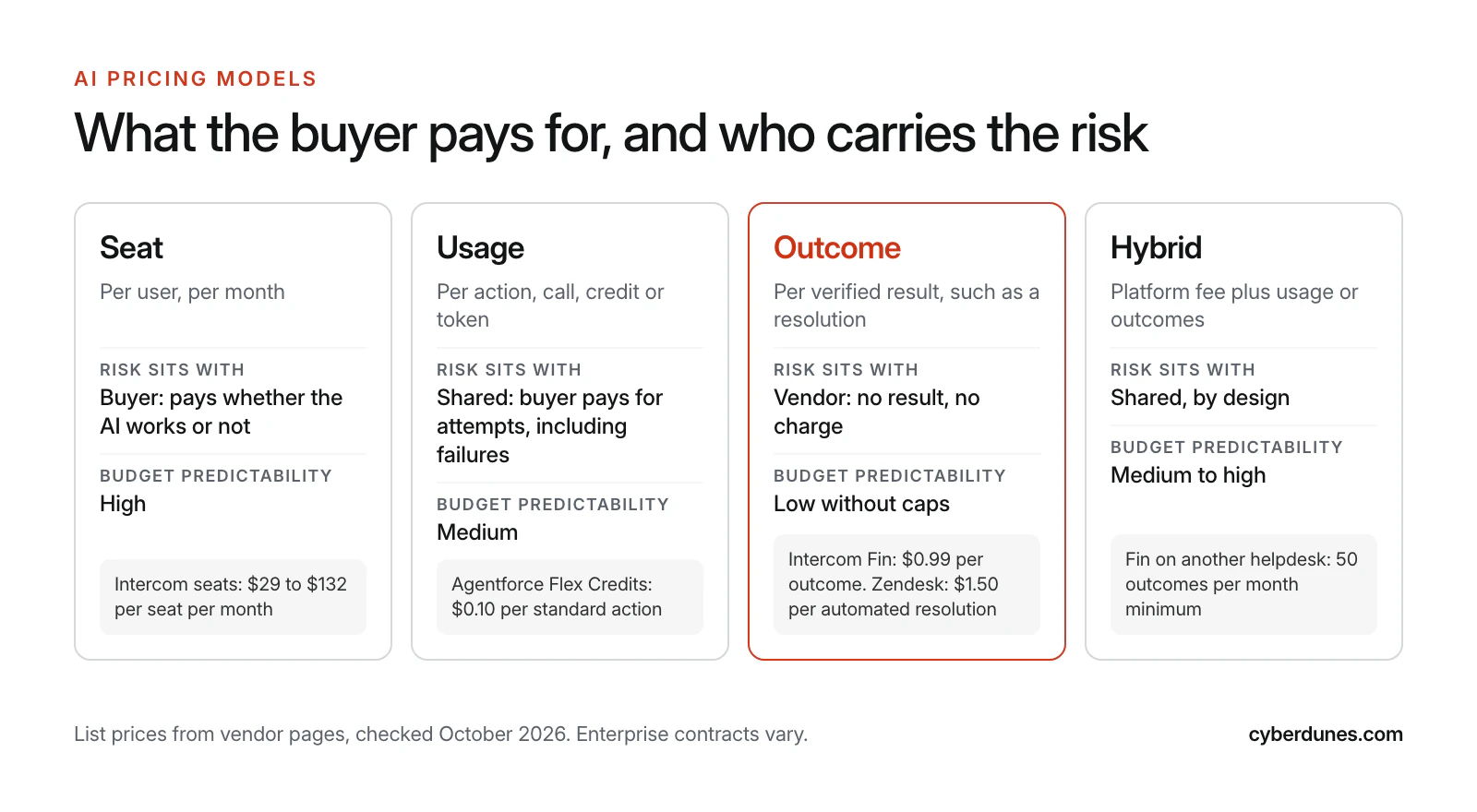
- Live examples already exist: Intercom Fin charges $0.99 per outcome, Zendesk charges $1.50 per automated resolution, and Salesforce added Flex Credits at $0.10 per action to Agentforce's original $2-per-conversation price.
- Outcome pricing works only when the AI acts autonomously and the result can be attributed and verified in logs. Where attribution is disputed, usage or hybrid pricing is safer.
- Vendors carry the cost of failed attempts. In our illustrative example, the same $1.20 price swings from a 75% margin to a loss when resolution rates fall and agents get more complex.
- Buyers should insist on a written outcome definition, log access, caps and a dispute process before signing.
This guide is for founders and product leaders pricing an AI product, and for CXOs buying one. At Cyberdunes we advise product teams on pricing and packaging through our product management services, and every vendor figure below was checked on the vendor's own page in October 2026.
Why Are AI Products Moving From Seats to Usage and Outcome Pricing?
AI agents do work that people used to do, so the number of seats can shrink as the value grows. A pricing model that charges per human user penalizes the vendor for the product succeeding.
Gartner put numbers on this shift in 2026:
- In July 2026, Gartner estimated up to $234 billion of enterprise application spending is exposed to "agentic arbitrage" by 2030, roughly 20% of enterprise application SaaS spending. Managing VP George Brocklehurst said agentic systems "deliver outcomes directly" and this "breaks the link between user growth and revenue growth for many enterprise software vendors." Gartner advised incumbents to "move from interface-based value to outcome-based value."
- In April 2026, Gartner predicted that by 2028 "over half of all enterprises will stop paying for assistive intelligence (such as copilots and smart advisors) and instead will favor platforms that commit to workflow results."
There is a cost reason too. Unlike classic software, every AI task consumes compute, and that cost does not reliably fall. Gartner predicted in January 2026 that by 2030 the cost per resolution for generative AI in customer service "will exceed $3," higher than many offshore human agents. When cost varies per task, a flat seat price leaves either the vendor or the buyer exposed.
What Are Real Examples of Outcome-Based Pricing for AI Agents?
The clearest examples come from customer service, where a resolved conversation is easy to count. Here is what four vendors publish as of October 2026.
| Vendor | Billable unit | Published price | Notable terms |
|---|---|---|---|
| Intercom Fin | Outcome: resolutions, procedure handoffs, disqualifications, self-serve routings, qualifications | $0.99 per outcome; qualifications $9.99 each | "Only charged for one outcome per conversation"; 50 outcomes per month minimum when used with another helpdesk |
| Zendesk AI agents | Automated resolution | $1.50 per automated resolution | An LLM verifies each conversation; only "Verified resolution" draws from the allowance |
| Salesforce Agentforce | Action (Flex Credits), conversation, or user | $500 per 100,000 Flex Credits, 20 credits per action; or $2 per conversation | Flex Credits and Conversations "will not be supported in the same org" |
| Sierra | Pre-agreed business outcome | Not published | Unresolved or escalated conversations: "in most cases, there's no charge" |
A few details matter more than the headline price.
- Zendesk was early. It announced outcome-based pricing in August 2024, saying customers "will only incur costs for issues that are resolved autonomously by AI," with "a starter usage level included at no additional cost."
- Salesforce moved toward usage, not away from value. Agentforce launched at $2 per conversation regardless of complexity. In May 2025, Salesforce introduced Flex Credits at $0.10 per action, arguing that "AI agents should be priced on the value they deliver, not unrealized potential." Interactions with no actions carry no charge.
- Sierra sets criteria up front. Its December 2024 post lists outcomes such as "a resolved support conversation, a saved cancellation, an upsell, a cross-sell," promises "clear, agreed-upon criteria for each outcome upfront," and offers blended pricing where outcomes do not fit, such as greeter-style routing.
Seats have not disappeared. Intercom still lists seats from $29 to $132 per seat per month alongside Fin's per-outcome price, and Salesforce sells Agentforce add-ons at $125 per user per month. Most real pricing today is hybrid.
When Does Outcome-Based Pricing Work, and When Does It Fail?
Outcome pricing works when the AI completes the task on its own, the result is visible in system logs, and outcomes are frequent and similar. It fails when several people or systems share credit, when results take months to show, or when the buyer needs a fixed budget.
Sierra, one of its loudest advocates, is blunt about the limits. In June 2026 it wrote that outcome pricing "only works where the software is highly autonomous and highly attributable," that "if the outcome can't be cleanly attributed to the software, you'll get into an endless debate," and that it is "more complex than seat-based or consumption pricing" in operations, contracts and accounting. Zendesk's own May 2026 guide lists the same risks: outcome definition, attribution, pricing the unit correctly, longer negotiations and less predictable revenue.
| Condition | Outcome pricing works | Outcome pricing fails |
|---|---|---|
| Autonomy | AI finishes the task end to end | AI drafts, a person decides and finishes |
| Attribution | One system clearly caused the result | Marketing, sales and AI all claim the same deal |
| Measurability | Result recorded in logs within hours or days | Result shows up months later, if ever |
| Volume | Thousands of similar, repeatable tasks | A few large, one-off projects |
| Buyer budget | Variable spend is acceptable with caps | Finance needs a fixed annual number |
| Vendor cost | Cost per attempt is stable and known | Cost per attempt swings with task complexity |
Which AI Pricing Model Should You Choose?
Choose outcome pricing only when autonomy, verifiability and volume are all high; choose a hybrid when any one of them is uncertain. Use the matrix below with your product team and finance lead in the same room.
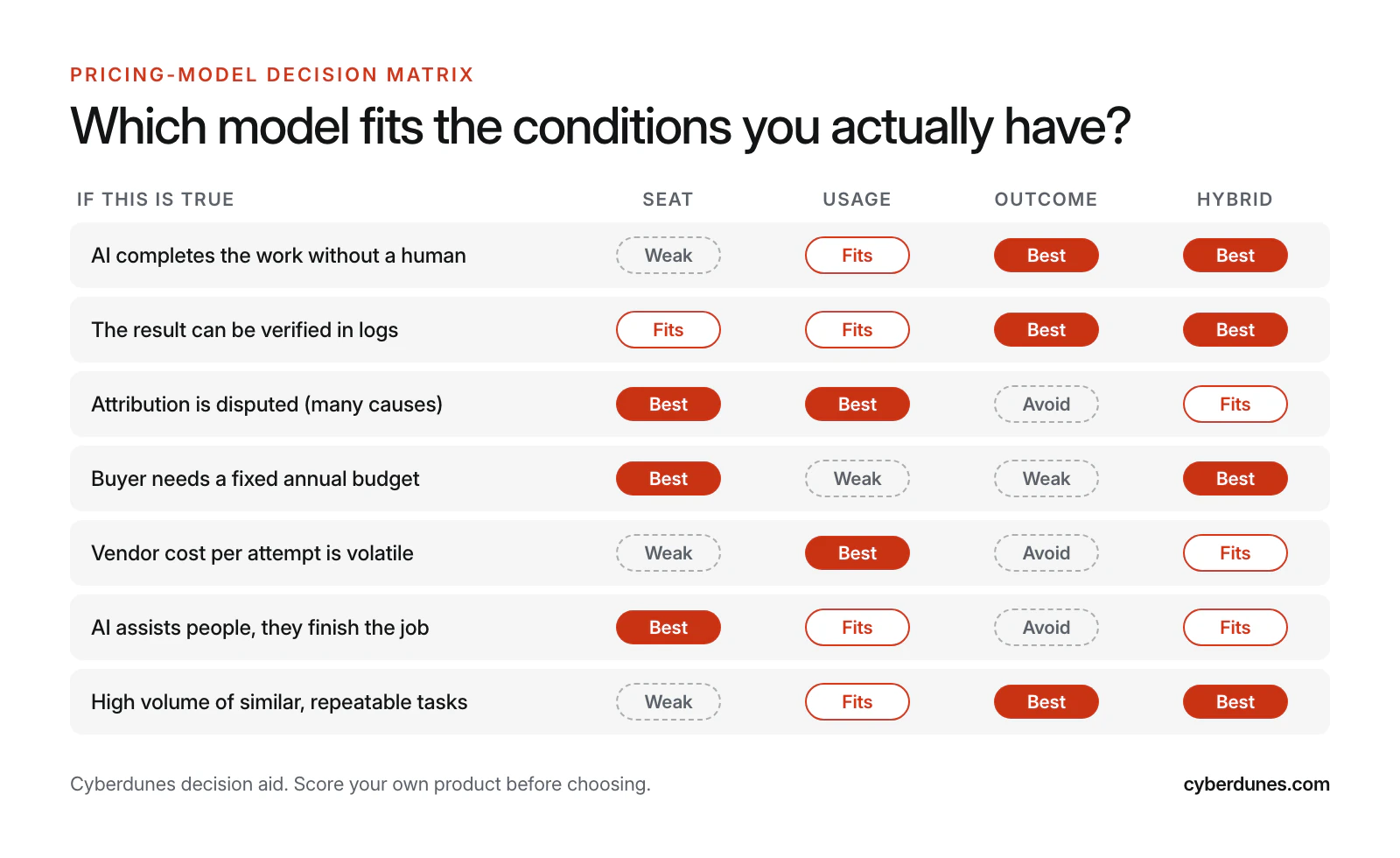
How to use it: mark each row true or false for your product. If every "outcome: best" row is true and no "outcome: avoid" row is true, outcome pricing is a real option. If even one "avoid" row is true, start with a hybrid and move more of the price onto outcomes as your measurement improves. If AI assists people who still finish the work, price by seat or usage and describe value in outcome terms in your sales story instead of on the invoice. Our guide to go-to-market strategy covers how pricing fits positioning and channels.
How Do You Define a Billable Outcome?
A billable outcome needs five written elements: the trigger event, the waiting window, the verification method, the exclusions and dedupe rules, and the audit and dispute process. Leave out any one and you are pricing an argument.
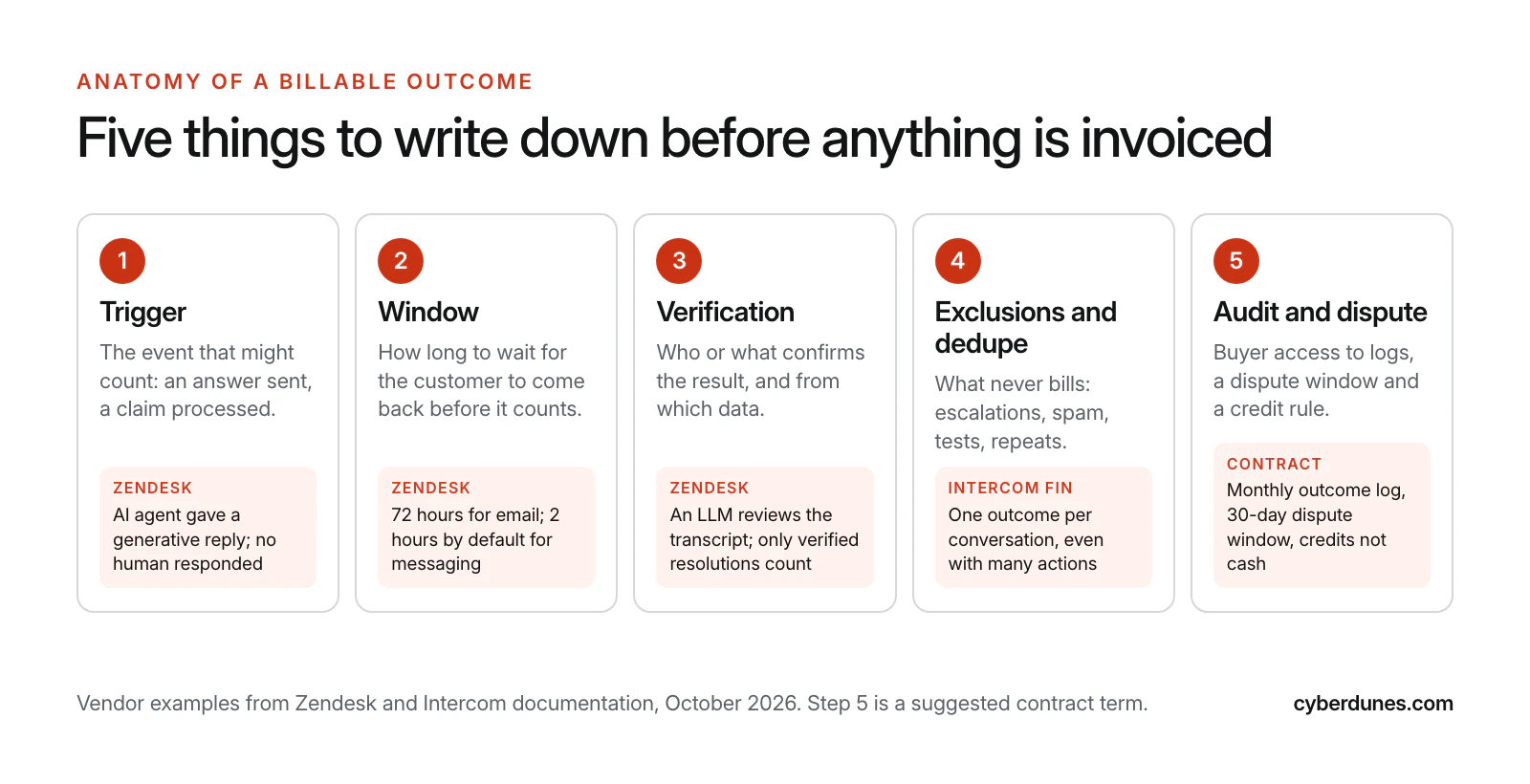
- Trigger. The event that might count. Zendesk counts an email or web form resolution when the AI agent gave a generative reply, the user gave positive or no feedback, no human agent responded and AI evaluation confirmed the reply was relevant.
- Window. How long to wait before counting. Zendesk waits for 72 hours of inactivity on email and 2 hours by default on messaging.
- Verification. Who confirms the result. Zendesk runs an LLM check on the transcript: "Assisted escalation" and "Contained resolution" do not count against the allowance; only "Verified resolution" does.
- Exclusions and dedupe. What never bills. Intercom Fin bills one outcome per conversation, "even if Fin takes multiple actions," and conversations passed to your team without an outcome are not billed.
- Audit and dispute. How the buyer checks the invoice. We suggest a monthly outcome log with conversation IDs, a 30-day dispute window and credits rather than refunds.
Notice that verification is itself an AI evaluation problem. The same discipline we describe in how to build AI evals applies: a written rubric, a test set and periodic human spot checks of the verifier.
What Does Outcome Pricing Do to Vendor Margins?
Outcome pricing shifts the cost of failed attempts to the vendor, so margins depend on resolution rate and cost per attempt, not just price. This illustrative example shows how fast a healthy price can turn unprofitable.
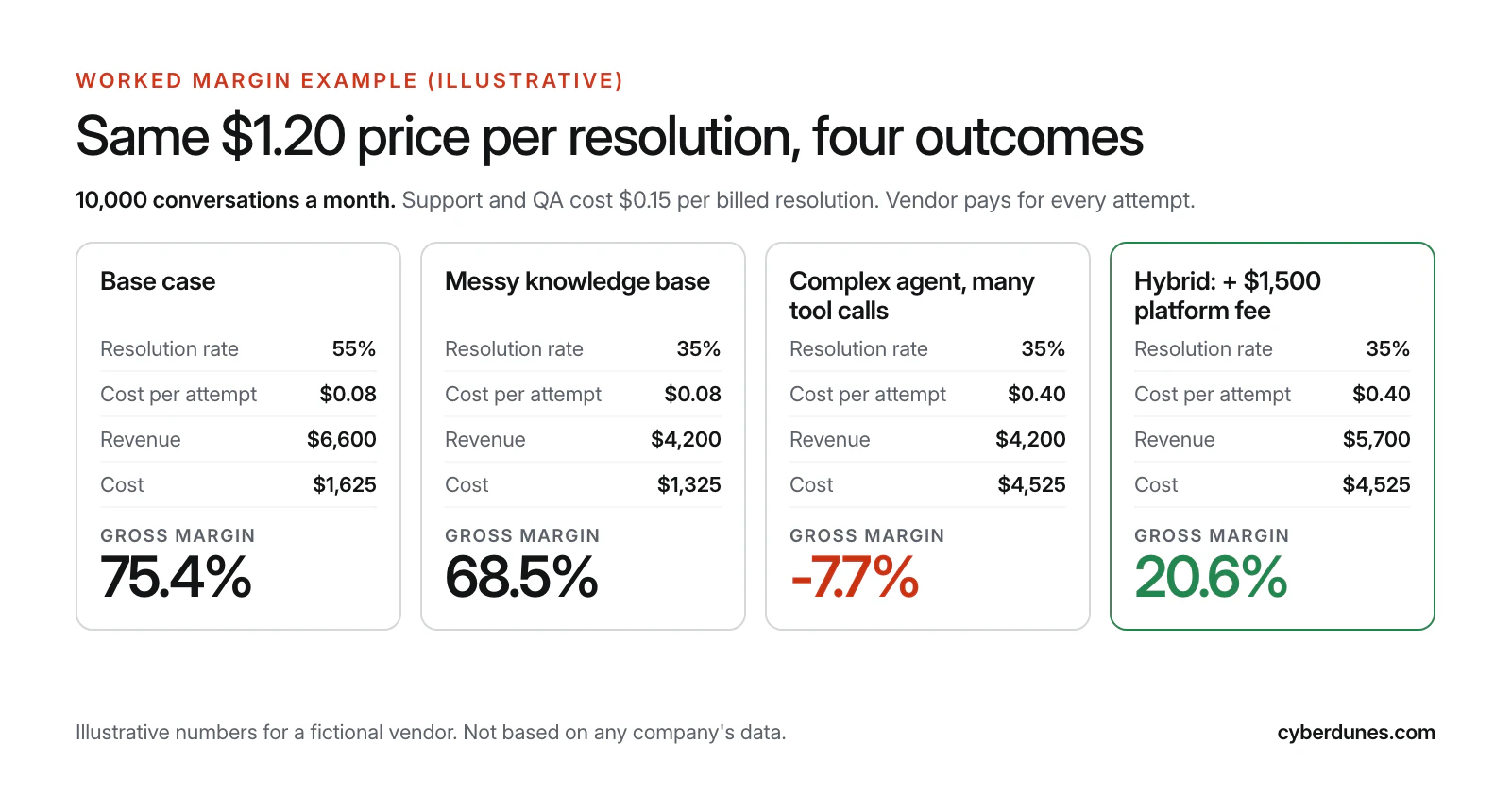
Assumptions for a fictional vendor: 10,000 conversations a month, a price of $1.20 per resolution, and $0.15 of support and quality review per billed resolution. The vendor pays model and infrastructure cost on every attempt, resolved or not.
| Scenario | Resolution rate | Cost per attempt | Revenue | Cost | Gross margin |
|---|---|---|---|---|---|
| Base case | 55% | $0.08 | 5,500 x $1.20 = $6,600 | $800 + $825 = $1,625 | 75.4% |
| Messy knowledge base | 35% | $0.08 | $4,200 | $800 + $525 = $1,325 | 68.5% |
| Complex agent, many tool calls | 35% | $0.40 | $4,200 | $4,000 + $525 = $4,525 | -7.7% |
| Hybrid: add $1,500 platform fee | 35% | $0.40 | $5,700 | $4,525 | 20.6% |
Three lessons for anyone setting the price:
- Resolution rate is a pricing input. Each customer's data quality changes your margin. Price new customers after a measured pilot, not before.
- Agent complexity is the silent killer. Multi-step agents that call many tools can multiply cost per attempt, which is the trend Gartner flags with "increasingly complex use cases that consume more tokens."
- A floor protects both sides. A platform fee or minimum commitment covers fixed cost; Fin's 50-outcome monthly minimum on other helpdesks is one published example.
From the buyer's side, run the same math against your current cost. If a human-handled ticket costs you $4 (an illustrative figure; use your own), 3,500 AI resolutions replace $14,000 of human work for $5,700 even in the hybrid scenario. The deal is good for the buyer; the question is whether it is sustainable for the vendor. The cost-per-successful-task method in our AI product roadmap guide is the starting point for this calculation.
How Do Hybrid AI Pricing Models Work?
A hybrid model combines a predictable base, such as a platform fee or seats, with a variable charge tied to usage or outcomes, plus caps and floors. It gives the buyer a budget they can plan and the vendor a floor that covers fixed cost.
Common structures we see in the market and in our own advice:
- Platform fee plus outcomes. A monthly fee covers setup, integrations and support; outcomes are billed on top.
- Included allowance plus overage. Zendesk includes a starter level of automated resolutions in its Suite and Support plans and bills beyond it.
- Seats plus outcomes. Human agents keep seats; the AI agent bills per outcome. Intercom's published pricing works this way.
- Committed credits. The buyer prepays a credit pool that any AI use draws down, as with Salesforce Flex Credits, which Salesforce says lets companies "shift IT spend from one area to another."
- Blended by task type. Sierra prices routing or greeter conversations by volume and complex conversations by outcome.
If you are consolidating AI tools across a marketing or service stack, these structures add up quickly. Our martech stack audit guide shows how to inventory per-seat, per-credit and per-outcome contracts side by side.
What Contract Guardrails Should Outcome-Based Deals Include?
Every outcome-based contract needs a definition annex, verification and audit rights, caps and floors, exclusions, a dispute process and a repricing clause for model cost changes. Without these, the first invoice becomes a negotiation.
| Guardrail | What it says | Protects |
|---|---|---|
| Outcome definition annex | Trigger, window, verification method, exclusions, one per conversation | Both |
| Baseline | Pre-AI resolution rate and volume, measured before go-live | Buyer |
| Log access and audit right | Monthly outcome log with IDs; right to sample transcripts | Buyer |
| Monthly cap | Maximum billable outcomes or spend, with an alert at 80% | Buyer |
| Minimum commitment | Platform fee or minimum outcomes covering fixed cost | Vendor |
| Exclusions | Spam, test traffic, duplicates and abusive sessions never bill | Buyer |
| Dispute process | 30-day window, sample-based review, credits on the next invoice | Both |
| Repricing trigger | Review if verified resolution rate moves by more than an agreed band | Both |
What Should CXOs Ask AI Vendors About Outcome Pricing?
Ask how the outcome is defined, who verifies it, what you pay when the AI fails, and how your budget is capped. These ten questions separate genuine outcome pricing from relabeled usage pricing.
- What exact event makes an outcome billable, and how long is the waiting window?
- Who verifies the outcome: your system, ours or an independent check? Can we see the rubric?
- Do we pay anything for escalations, failed attempts or conversations with no outcome?
- Can one conversation or case ever bill more than once?
- What is our resolution rate in a pilot on our own data, and what was the baseline?
- Can we export a monthly log of every billed outcome with IDs and transcripts?
- What monthly cap and alert thresholds can we set?
- What minimum commitment or platform fee applies, and what does it include?
- How do prices change if your model or infrastructure costs change?
- If we leave, do we keep our data, test sets and conversation history?
Most of these questions also apply to platform purchases generally; our guide to DXP costs and questions to ask covers the rest of the buying checklist.
Buyers increasingly ask AI assistants to shortlist vendors before calling sales, which makes clear, published pricing terms a competitive advantage. See our guide on how B2B buyers use AI to shortlist vendors.
How Cyberdunes Helps Teams Price AI Products
Cyberdunes helps product leaders design pricing that matches how their AI creates value. Our product management team runs the decision matrix with your leaders, models margins under realistic resolution rates and drafts the outcome definition annex. Our post on product strategy consulting explains how pricing fits a wider strategy engagement, and the AIPM bootcamp teaches product managers AI unit economics and evals.
Talk to us about pricing your AI product
Sources
- Fin Pricing (Intercom, accessed October 2026)
- Intercom Pricing (Intercom, accessed October 2026)
- Zendesk First in CX Industry to Offer Outcome-Based Pricing for AI Agents (Zendesk, August 2024)
- Understanding Outcome-Based Pricing: A Results-Driven Framework (Zendesk, May 2026)
- About Automated Resolutions for AI Agents (Zendesk Help Center, accessed October 2026)
- About Automated Resolution Tiers (Zendesk Help Center, accessed October 2026)
- Agentforce Pricing (Salesforce, accessed October 2026)
- Flexible Pricing Is a Full Circle Moment for Salesforce (Salesforce, May 2025)
- Outcome-Based Pricing for AI Agents (Sierra, December 2024)
- Outcomemaxxing (Sierra, June 2026)
- Gartner Says $234 Billion in Enterprise Application Software Spend Is at Risk from Agentic AI (Gartner, July 2026)
- Gartner Expects Most Enterprises to Abandon Assistive AI for Outcome-Focused Workflow by 2028 (Gartner, April 2026)
- Gartner Predicts GenAI Cost Per Resolution for Customer Service Will Exceed Offshore Human Agent Costs by 2030 (Gartner, January 2026)