
Product management offers many different roles, shaped by industry, company size and product type. If you are exploring product manager jobs, knowing the types of product managers and the skills each needs helps you plan your career. This guide covers the current job market, 12 common roles, the typical career path and how to choose the right one for you.
The Product Manager Job Market in 2026
After a sharp slowdown in 2023, demand for product managers has recovered. Lenny’s Newsletter, using job data from TrueUp, counted more than 7,300 open product manager roles at tech companies globally in March 2026. That was 75% above the low of early 2023, up nearly 20% since the start of the year, and the most open PM roles since 2022. The same analysis described demand for AI product managers as “similarly exploding” (Lenny’s Newsletter, March 2026).
Two patterns stand out across tech hiring more broadly. Indeed Hiring Lab found that 71% of the increase in US software development job postings between May 2025 and May 2026 came from senior roles, and 37% from jobs that mention AI in their title (Indeed Hiring Lab, July 2026). For product managers, that suggests experience and AI skills are where competition is easiest to win. Entry-level roles remain harder to land, so building practical, demonstrable skills matters.
Types of Product Managers
Product management roles vary with the organization’s focus, product complexity and market demands. Here are the most common types of product managers, their main responsibilities and the skills they need.
1. Generalist Product Manager
Role: A generalist product manager oversees the entire product lifecycle, from concept to launch. They handle market research, product strategy, development coordination and post-launch analysis.
Skills Needed:
- Strong communication and leadership
- End-to-end product lifecycle knowledge
- Cross-functional team collaboration
- Strategic thinking and problem-solving
This role suits people who enjoy variety and want a broad understanding of product management.
2. Associate Product Manager (APM)
Role: An entry-level role that supports senior product managers with research and data gathering while learning core product management skills.
Skills Needed:
- Curiosity and eagerness to learn
- Basic data analysis
- Communication and teamwork
- Time management
APMs build the foundation they need to move into more senior PM roles.
3. Technical Product Manager (TPM)
Role: TPMs manage products with a strong technical component. They act as the bridge between engineering teams and business stakeholders, check technical feasibility and align product plans with technical constraints.
Skills Needed:
- Technical knowledge (software architecture, APIs, security standards)
- Ability to explain technical jargon to non-technical stakeholders
- Project management and prioritization
- Understanding of engineering processes and tools
This role is ideal for people with a technical background or a strong interest in technology.
4. Data and Insights PM
Role: Uses data to drive product decisions, working closely with data scientists and analysts to collect, analyze and govern data.
Skills Needed:
- Advanced data analysis and interpretation
- Data governance and privacy knowledge
- Familiarity with analytics tools
- Strategic thinking based on data insights
This role is critical in data-driven companies, especially those building analytics or AI products.
5. Strategic Product Manager
Role: Defines the long-term vision and strategy of a product and aligns roadmaps with market trends and customer needs.
Skills Needed:
- Market research and competitive analysis
- Visionary thinking and goal setting
- Continuous product discovery
- Strong stakeholder management
Strategic PMs guide a product’s future and keep it aligned with business objectives.
6. Growth Product Manager
Role: Grows product metrics such as user acquisition, retention and revenue through experiments and data analysis.
Skills Needed:
- Data-driven decision-making
- User behavior analysis
- Knowledge of growth hacking techniques
- Customer feedback integration
Growth PMs do well in fast-paced teams where scaling the product is the priority.
7. Product Launch Manager
Role: Plans and runs product launches, coordinating with marketing, sales and customer success teams so customers adopt the product.
Skills Needed:
- Project management and coordination
- Go-to-market strategy development
- Cross-team collaboration
- Performance tracking and feedback analysis
This role is vital in companies with frequent releases or complex product portfolios.
8. Product Marketing Manager
Role: Owns product positioning, messaging and market differentiation, and drives go-to-market campaigns and customer engagement.
Skills Needed:
- Market segmentation and buyer persona development.
- Messaging and storytelling using design thinking.
- Competitive analysis.
- Campaign management.
This role suits people who enjoy branding and customer communication.
9. UX (User Experience) Product Manager
Role: Focuses on easy, intuitive user experiences, working closely with design and research teams to improve usability.
Skills Needed:
- User research and usability testing
- Design thinking
- Empathy and a customer-centric mindset
- Collaboration with design and engineering
UX PMs make sure the product is intuitive and meets user expectations.
10. Enterprise and B2B PM
Role: Manages products for business customers, often with complex sales cycles and customization needs.
Skills Needed:
- Understanding of enterprise sales and customer needs
- Relationship management
- Product customization and scalability
- Strategic planning
Enterprise PMs need a blend of technical and business skills.
11. Internal Product Manager
Role: Manages products used inside the organization, such as internal tools and platforms.
Skills Needed:
- Stakeholder management within the company
- Process optimization
- Change management
- Technical understanding of internal systems
Internal PMs improve operational efficiency and employee productivity.
12. Startup Product Manager
Role: Works in a fast-paced startup, often wearing many hats and driving product development with limited resources.
Skills Needed:
- Agility and adaptability
- Broad skills across product, marketing and operations
- Entrepreneurial mindset
- Strong problem-solving skills
Startup PMs do well with uncertainty and rapid iteration.
A Fast-Growing Specialty: AI Product Manager
AI product managers work on products or features powered by machine learning or generative AI. On top of core PM skills, they define what a good AI output looks like, run evaluations, manage data and model choices with engineers, and handle risks such as inaccurate answers, bias and privacy. Many come from the technical, data or growth roles above. Our guide on how to build AI evals shows one of the core skills in practice.
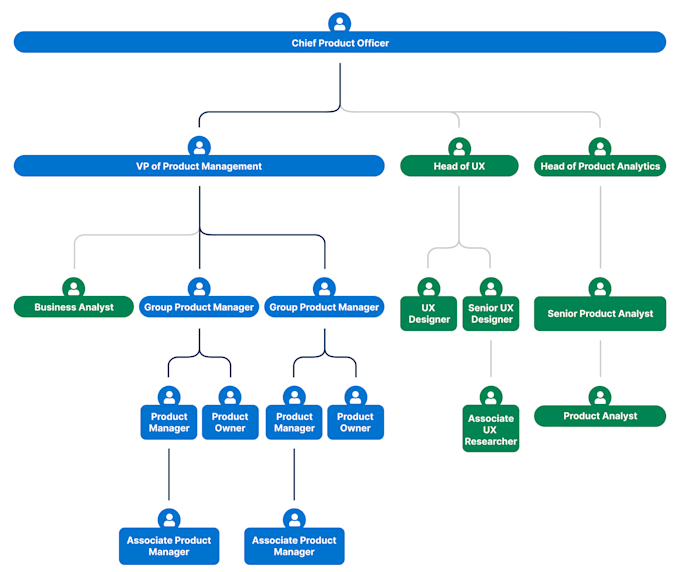
Career Progression in Product Management
Product manager jobs typically progress from entry-level to executive roles:
- Associate Product Manager (APM): Learning and supporting product teams.
- Product Manager: Taking ownership of product features and strategy.
- Senior Product Manager: Leading product vision and mentoring junior PMs.
- Product Lead / Group Product Manager: Managing teams of PMs and product portfolios.
- Director of Product Management: Overseeing multiple product lines and aligning them with company strategy.
- VP of Product Management / Chief Product Officer: Setting the overall product vision and leading the product organization.
Essential Skills to Become a Successful Product Manager
Every product manager job needs a mix of hard and soft skills.
Hard Skills
- Technical Knowledge: Understanding product architecture, development processes and relevant technologies helps you work with engineering teams and make informed decisions.
- Data Analysis: Interpreting product metrics, user data and financial information to guide product strategy.
- Project Management: Organizing tasks, managing timelines and coordinating cross-functional teams to deliver on schedule.
- Market Research: Running competitive analysis and customer research to inform product decisions.
Soft Skills
- Communication: Clear, concise communication with stakeholders, teams and customers keeps everyone aligned.
- Leadership: Inspiring teams, resolving conflicts and driving the product vision forward.
- Empathy: Understanding user needs and pain points to build user-centric products.
- Adaptability: Handling changing market conditions and evolving product requirements.
How to Choose the Right Product Manager Role for You
The right product manager job depends on your interests, background and career goals:
- If you enjoy technical challenges and have an engineering background, consider becoming a Technical Product Manager.
- If you are data-driven and love analytics, a Data and Insights PM or Growth Product Manager role might suit you.
- If you enjoy market positioning and storytelling, Product Marketing Manager is a great fit.
- If you prefer strategic thinking and long-term planning, look into Strategic Product Manager roles.
- If you enjoy working with data and new technology, an AI product manager role builds on technical and data PM skills.
- Startups need versatile PMs who thrive in changing conditions, while large enterprises offer specialized roles.
Find the Best Product Manager Jobs
Product manager jobs cover a wide range of specializations, and each needs its own blend of skills. Knowing these roles helps you make informed career decisions and stand out in a competitive field. Whether you want to be a generalist or specialize in technical, growth or marketing work, the right skills will move your career forward.
Build both hard and soft skills, and match your strengths to the right product management role. If you want structured training, our AI product management masterclass covers the skills that modern PM roles demand, and the AIPM Bootcamp is designed for people moving into AI product roles.