
A composable DXP is a digital experience platform you assemble from separate, specialized services, such as a headless CMS, commerce engine, search, customer data platform (CDP) and digital asset management (DAM), joined through APIs instead of bought as one product. You get freedom to choose every part, and you take on the integration, upgrades and data model yourself.
Key Takeaways
- Composable, suite and AI-native all-in-one platforms are all valid in 2027. The right one depends on your team, not on which architecture is fashionable.
- Software licenses are the smaller part of the bill. Integration, people and upgrades usually decide the three-year cost, so model them before you compare quotes.
- Composable pays off for large enterprises with a funded platform team and experiences that packaged products cannot deliver.
- For most small and mid-market teams, composable is overkill. One platform with one content model reaches value sooner and is easier to govern.
- AI agents need one clean content model and data layer they can reach through APIs or the Model Context Protocol (MCP). Plan for that whichever architecture you pick.
This guide is for CMOs, CTOs and digital leads who have to sign off a platform decision that will outlast their current agency contract. We build Apex®, the AI-native digital experience platform (DXP), and our client work spans banking, hospitality, real estate and wellness. That makes us an interested party, so we show our working: a weighted decision matrix and a total cost of ownership (TCO) worksheet you can fill in with your own numbers, including the cases where composable is the better answer.
What Is a Composable DXP?
A composable DXP is an architecture, not a product. You pick independent services for each capability and connect them through APIs, so each part can be replaced without rebuilding the rest. If you are new to the category, our explainer on what a DXP is and when you need one covers the basics.
Composable stacks usually follow MACH principles. MACH stands for microservices, API-first, cloud-native and headless, and the MACH Alliance that promotes it was formed in 2020 (ITPro, December 2025). In practice that means:
- Headless: content is stored without a fixed front end, and your developers build the website or app that displays it.
- API-first: every service exposes its functions through APIs, which is how the parts talk to each other.
- Packaged business capabilities (PBCs): Gartner's term for discrete, independently deployable components such as a cart, a search index or a personalization engine.
Analysts treat composability as the direction of travel. Gartner's January 2025 Magic Quadrant for Digital Experience Platforms made "a composable architecture for modular and API-first approaches" a mandatory feature for inclusion, and predicted that by 2026 at least 70% of organizations would be mandated to acquire composable DXP technology rather than monolithic suites, up from 50% in 2023 (Gartner, January 2025). Gartner credits that growth both to established suite vendors breaking their products into modules and to headless CMS vendors expanding, so "composable DXP technology" does not only mean a stack you assemble yourself.
Composable vs Suite vs AI-Native All-In-One: How Do They Differ?
The three options differ in who owns the seams between capabilities. In a composable stack you own them. In a suite the vendor owns most of them but sells many modules. In an AI-native all-in-one platform, one vendor owns one content and data model end to end.
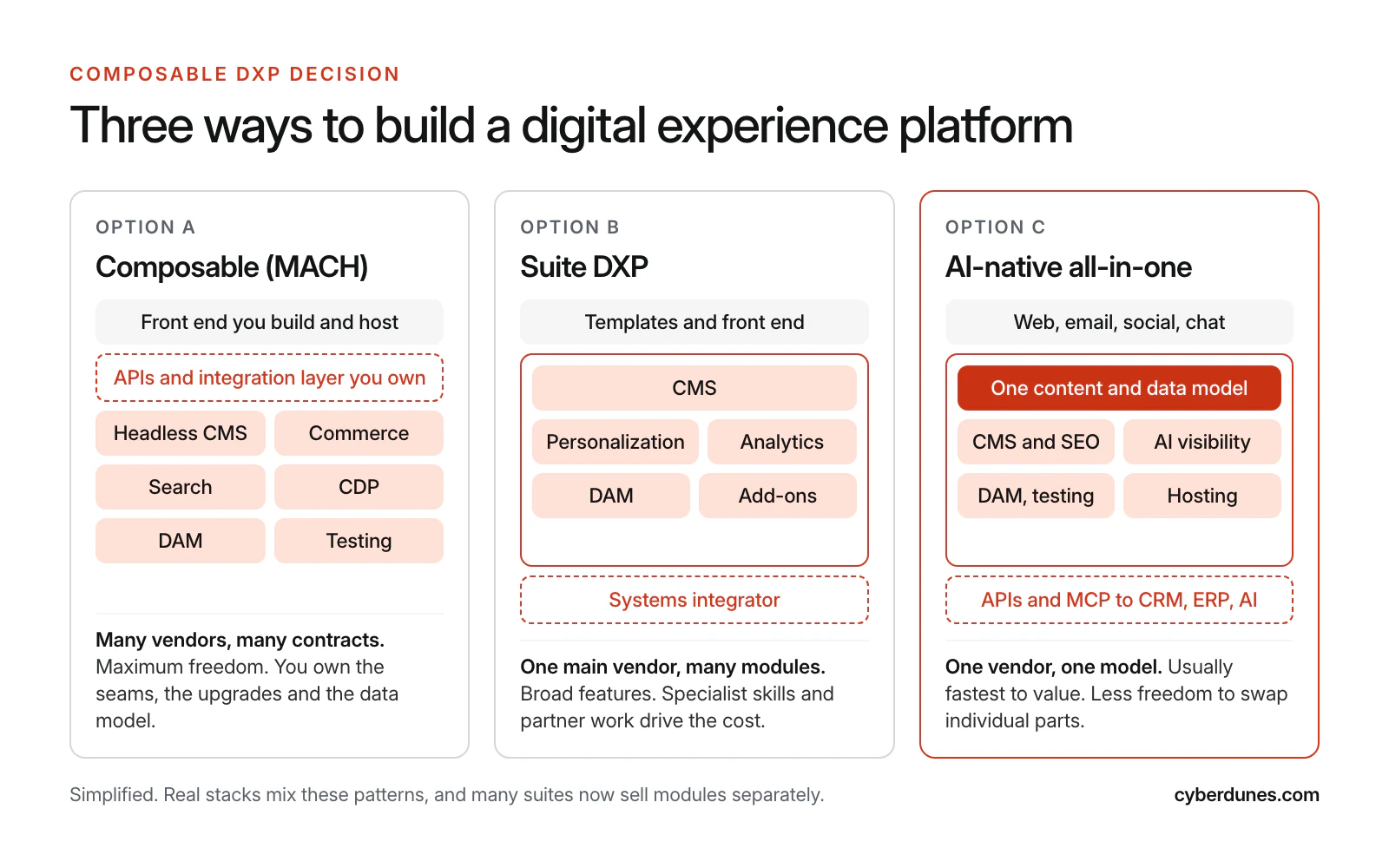
| Factor | Composable (MACH) | Suite DXP | AI-native all-in-one |
|---|---|---|---|
| Vendors to manage | Many, often five or more | One main vendor plus add-ons | One |
| Front end | You build and host it | Templates, customized by partners | Included, configured by your team |
| Content and data model | You design and maintain it across services | Vendor's model, extended per module | One shared model |
| Skills needed | Platform engineers, DevOps, architects | Certified specialists or a systems integrator | Marketers, a platform owner, light developer help |
| Freedom to swap parts | Highest | Low to medium | Low to medium |
| Upgrades | Many small ones, each can break an integration | Fewer, larger version upgrades | Handled by the vendor |
| Best fit | Large enterprises with unique experiences | Enterprises standardized on one vendor | SMBs, mid-market and lean enterprise teams |
Forrester's November 2025 DXP Wave announcement put the market shift bluntly: "If your digital experience platform is still a collection of parts, don't just add more features" (Forrester, November 2025). The point is not that composable is wrong. It is that more parts only help if someone can orchestrate them.
What Drives the Total Cost of Ownership?
Four things drive DXP cost more than the license: integration work, the team you need to run the platform, the number of vendors and the cost of upgrades. A composable stack moves money from licenses into all four.
- Integration: every connection between services is software you build, test and maintain. In the MACH Alliance's February 2026 survey of enterprise technology leaders, 37% cited integration complexity as a primary concern (MACH Alliance, February 2026).
- Team skills: in the Alliance's 2025 research, 23% of organizations named internal skills gaps as an issue to address, and 28% reported a lack of systems to manage composable systems (MACH Alliance, January 2025).
- Vendor count: each vendor adds a contract, a security review, a renewal and an account team. The same 2025 research found 26% of respondents wanted more ready-made solutions.
- Upgrades: Gartner notes a market shift to software as a service, reflecting buyers' wish "to avoid the complexities, operational demands and expense of self-hosting and performing software upgrades" (Gartner, January 2025).
Keep the source in mind: the MACH Alliance is an industry body whose members sell composable technology, and its own research still lists these costs. Composable vendors say the same. Uniform, a composable platform vendor, argues that license fees "only account for roughly a quarter of the whole financial commitment over three to five years" (Uniform, May 2026). Treat that as a vendor estimate, not a benchmark.
A TCO Worksheet You Can Copy
The worksheet below compares the three options over three years for a fictional mid-market company with one brand, three sites and two languages. The numbers are illustrative, not vendor quotes and not Apex® pricing. Use the structure, then replace every number with your own.
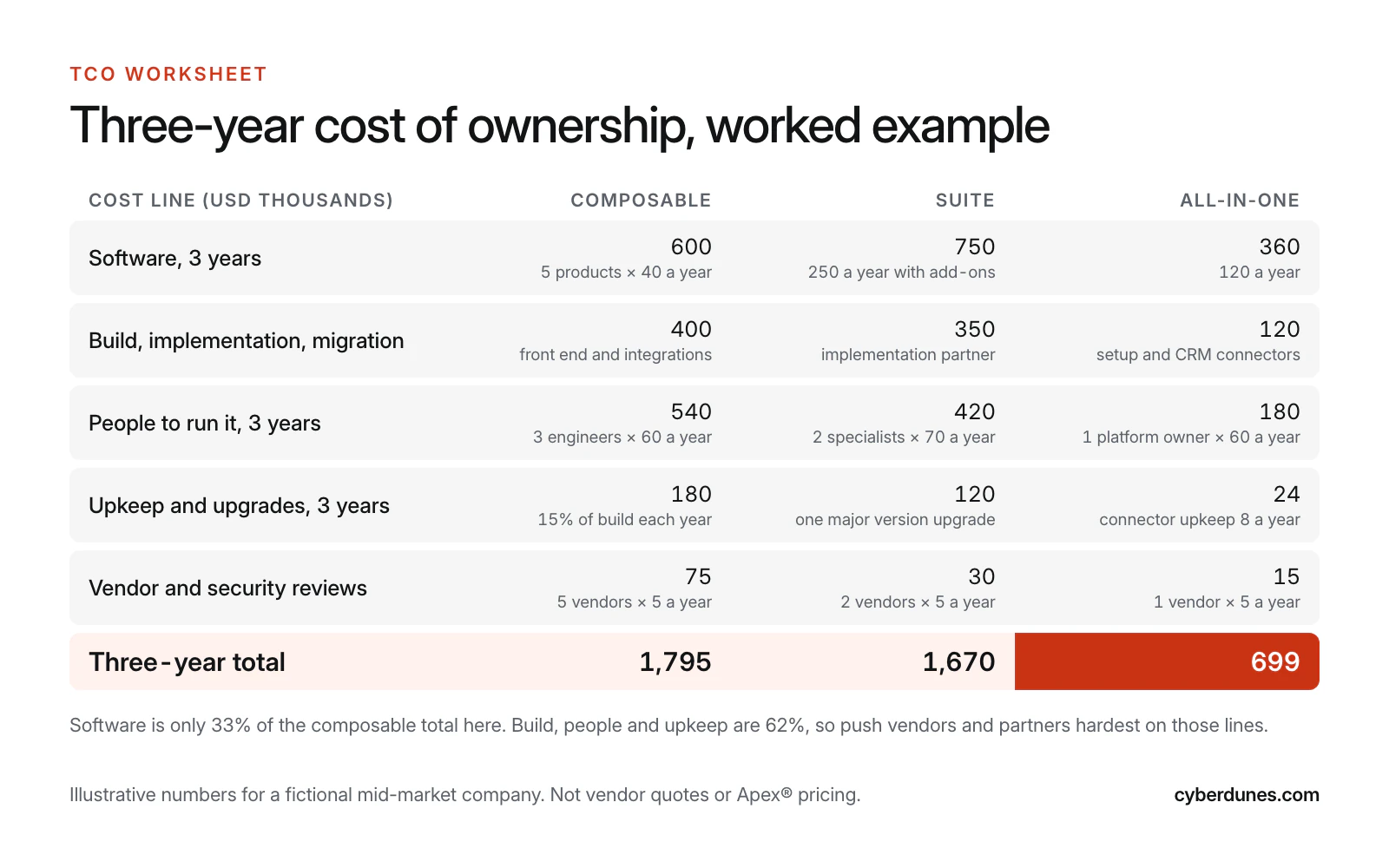
Two lessons hold even when your numbers differ. First, the all-in-one column is cheaper here mainly because of people, not software: one platform owner instead of three engineers. If an all-in-one quote needs the same team, the gap closes. Second, the composable premium buys something real, the freedom to build experiences no packaged product offers. The question is whether that freedom earns more than it costs. To fill in the worksheet:
- List every tool your digital team pays for today. Our martech stack audit guide shows how to find overlap.
- Ask each vendor for a three-year quote that includes add-ons, environments and support tiers.
- Ask implementation partners for a fixed-scope estimate of the build and every integration.
- Price the people: engineers, specialists or a platform owner, at your real loaded cost.
- Add yearly upkeep at a fixed share of the build, plus vendor and security reviews per vendor.
If you are a smaller business, our guide to DXP costs for small businesses lists the questions to put to every vendor.
How Fast Does Each Option Deliver Value?
Time to value is how long it takes before marketing ships something measurably better than before. It is the line most business cases underestimate, because a composable build delivers platform before it delivers campaigns.
- Composable: your team designs the content model, builds the front end and wires each service before marketing gets a usable editor. The first quarters go to foundations.
- Suite: templates shorten the front end work, but configuration, partner onboarding and training take time. Gartner cautions that, for at least one major suite, success "depends on finding the right partner" and partner dependence "can add complexity and cost" (Gartner, January 2025).
- All-in-one: the editor, SEO tooling, hosting and analytics exist on day one, so the work is migration and configuration. The trade-off is that you accept the vendor's way of doing things.
Ask every vendor the same question: what will my team publish in week six that it cannot publish today?
Governance: Who Owns the Seams?
Governance gets harder with every vendor you add. Each service has its own roles, permissions, audit log and data processing terms, and each integration is a place where data can leak or drift.
In a composable stack, someone must own four things that a single platform handles for you:
- The shared content model: one definition of a product, a location or an author across the CMS, search and commerce.
- Identity and access: who can publish, approve and export in each service, kept in step when people join or leave.
- Data flows: which personal data moves between services, where it is stored and which vendor processes it.
- Change control: testing every vendor's release against your integrations before it reaches production.
This is solvable with a platform team. Without one, these jobs fall to whoever is nearest, usually the web manager.
Is Your Architecture Ready for AI Agents?
AI readiness now matters as much as page speed did a decade ago. Assistants and agents can only work with your content if they can reach one clean, consistent model of it, through APIs or through MCP, the open standard for connecting AI assistants to tools and data.
Composable advocates argue that modular stacks are better prepared. The MACH Alliance's 2026 Enterprise Technology Report, a survey of 600 senior technology decision-makers at organizations with 5,000 or more employees or $500M or more in revenue, found 78% of fully composable organizations achieve measurable AI return on investment (ROI), against 13% of those in early planning (MACH Alliance, 2026). That is a correlation among large enterprises surveyed by an advocacy body, not proof that composable causes AI success. Mature organizations tend to do many things well.
Forrester's view is more balanced. Its August 2026 analysis says composability "remains valuable because agentic systems depend on the APIs, integrations, and services" that composable architectures expose, but advises reserving custom builds for work competitors "cannot easily acquire, replicate, or generate" (Forrester, August 2026). Its 2025 Wave post adds: "Your upside won't come from engineering your own agent platform" (Forrester, November 2025).
Gartner frames the risk from the other side, predicting that by 2027, 40% of organizations will fail to deliver impactful digital customer experience due to a lack of AI-driven intelligent content coordination and content operations strategy (Gartner, January 2025). Whatever you build, check these four things:
- Is there one content model an assistant can query, or five that disagree?
- Can an assistant reach content through MCP or documented APIs, with read and write scopes kept separate?
- Are structured data and metadata generated from the same source as the page, so AI engines see consistent facts?
- Can you test AI features before release? Our guide to building AI evals without code shows how.
For the marketing side of this, see our guides to MCP for marketing teams and an operating model for AI agents in marketing.
The Weighted Decision Matrix
A weighted matrix turns a debate about architecture into a debate about priorities, which is the debate you should be having. The same three options produce different winners for different companies.
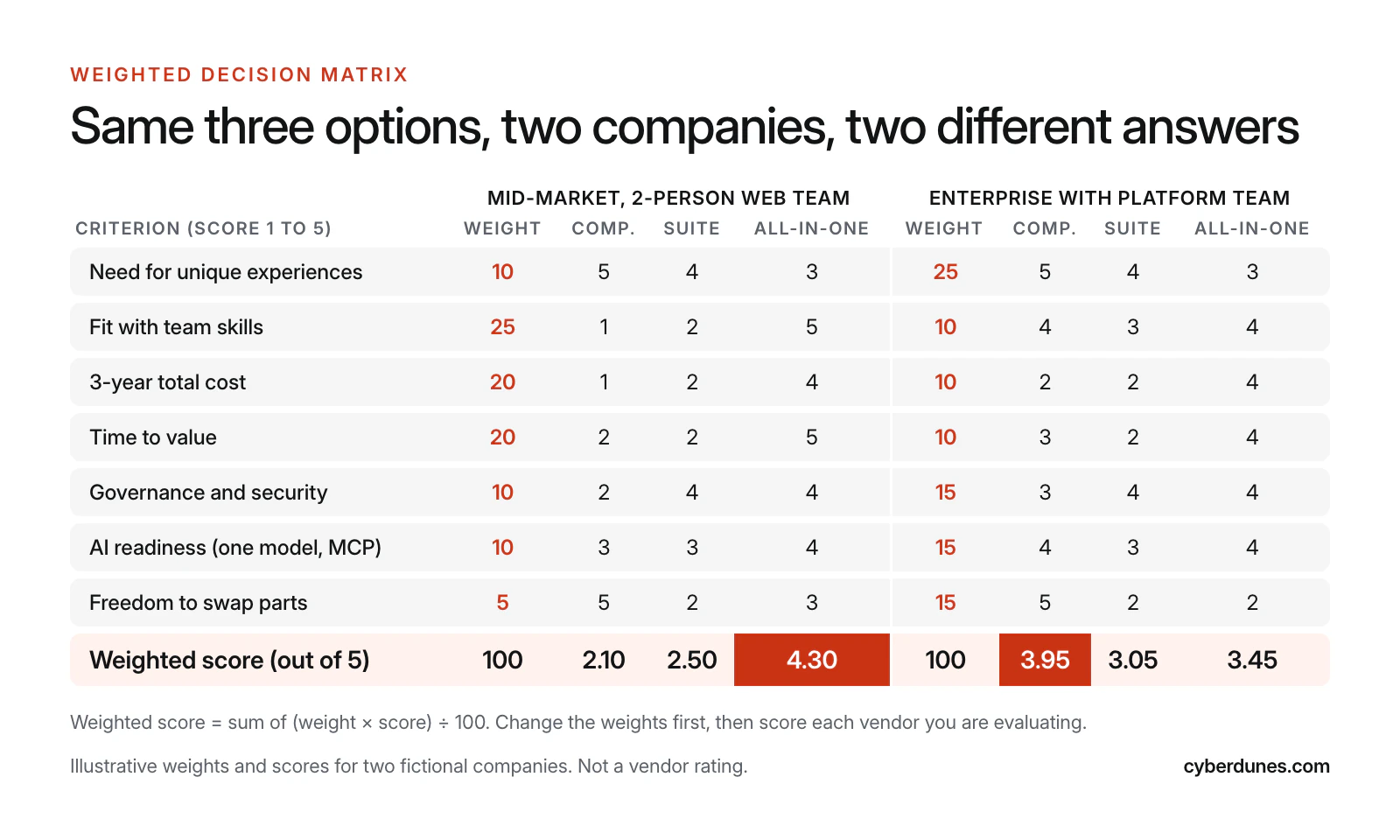
In this illustrative example, the mid-market team weights team fit, cost and time to value at 65 of 100 points, and the all-in-one platform wins with 4.30 out of 5. The enterprise weights unique experiences, AI readiness and freedom to swap parts more heavily, and composable wins with 3.95. To run it yourself:
- Agree the weights with finance, IT and marketing before anyone sees a vendor demo.
- Score each shortlisted vendor from 1 to 5 on each criterion, with evidence for every score.
- Multiply each score by its weight, add the results and divide by 100.
- If two options finish within 0.3 points, run a paid proof of concept on your hardest page type.
When Is Composable Right, and When Is It Overkill?
Composable is right when you have both the need and the team. It is overkill when you have neither, which describes most small and mid-market businesses.
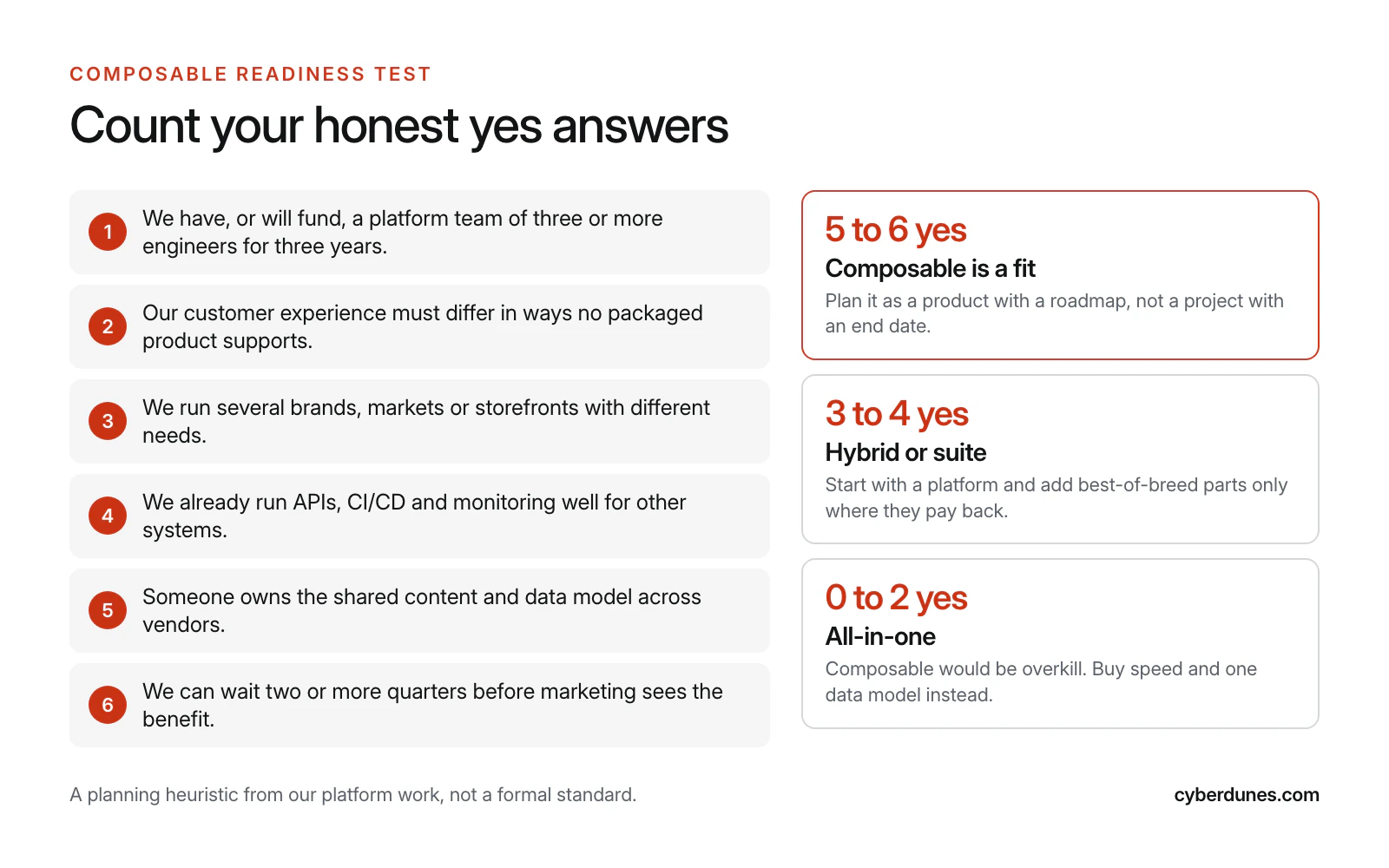
Composable fits large enterprises with several brands or markets, a funded platform team and customer experiences that are part of the product, such as a bank's onboarding journey or a retailer's custom configurator. Our enterprise DXP guide covers how to shortlist vendors at that scale.
Composable is overkill when the web team is two or three people, when the website's job is to publish, rank, get cited by AI engines and convert, and when nobody will own integrations after launch. For these teams, every hour spent on plumbing is an hour not spent on content and conversion.
The middle path is common: start with one platform for content, SEO and AI visibility, connect your CRM and commerce through APIs, and add a specialist service only where it clearly pays back.
A 90-Day Plan to Make the Decision
Most platform decisions take too long because the team compares features before agreeing on goals. This sequence keeps the decision to one quarter.
- Days 1 to 15, baseline (owner: digital lead): list current tools and costs, record publishing speed, and note the three experiences you cannot deliver today.
- Days 16 to 30, priorities (owner: CMO with CTO and finance): run the readiness test, agree the matrix weights and set a three-year budget range.
- Days 31 to 60, market (owner: platform or IT lead): shortlist one or two vendors per architecture, collect three-year quotes and partner estimates, and fill in the TCO worksheet.
- Days 61 to 80, proof (owner: web manager): rebuild your hardest page type on the top two options and time the editor workflow with real marketers.
- Days 81 to 90, decision (owner: steering group): score the matrix with evidence, write down the assumptions that would change the answer, and sign.
Book a DXP Architecture Review
How Cyberdunes and Apex® Help
Apex® is the all-in-one, AI-native option in this guide. It brings a WYSIWYG editor with an AI writing assistant, publishing to web, email, social and chatbots, technical SEO, AI visibility tracking across ChatGPT, Gemini, Claude, Perplexity and Google AI Overviews, digital asset management, A/B testing and AWS hosting into one platform. It connects to CRM, ERP, marketing automation, analytics, ecommerce and payment systems through its API layer, and AI assistants can work with Apex® content through Mcp.
What Apex® does not give you is unlimited freedom to swap individual parts. If your readiness test comes back with five or six yes answers, we will say so. If it comes back with two or fewer, Apex® plans are custom-quoted to your scope, from Basic to Enterprise.
Sources
- Magic Quadrant for Digital Experience Platforms, Gartner (reprint), January 2025
- 2026 Enterprise Technology Report: AI From Pilot to Production, MACH Alliance, 2026
- MACH Alliance Research: 6X More Organizations Achieve AI ROI With a Composable Foundation, MACH Alliance, February 2026
- 2025 MACH Alliance Global Annual Research Quick Guide, MACH Alliance, January 2025
- Announcing The Forrester Wave: Digital Experience Platforms, Q4 2025, Forrester, November 2025
- Meet Digital Experience Tech's New Interface: Agentic AI Systems Of Action, Forrester, August 2026
- What is MACH architecture?, ITPro, December 2025
- Beyond the license: uncovering true DXP total cost of ownership, Uniform, May 2026