How do LLMs choose sources to cite? In short, they pull from pages that a search system can crawl, index and match to the question, then favor passages that state a clear answer with specific facts. There’s no secret switch. It’s mostly strong SEO plus pages written so a machine can lift one paragraph without losing the meaning.
Key Takeaways
- LLMs cite pages in two ways: from what they learned in training, and from live search retrieval. Live retrieval is the part you can influence quickly.
- Google says no special markup or files are needed for AI Overviews. A page must be indexed and eligible to show with a snippet.
- Pages that answer a question in the first sentence, with specific facts and clear headings, are easiest to quote.
- GEO is mostly good SEO plus clearer writing. Nobody can guarantee a citation, so be wary of anyone who does.
- Start with the 10-point checklist: crawl access, direct answers, dates, schema that matches visible text, and named authors.
In this article
- How do LLMs choose sources to cite from web content?
- What makes a page easy for AI to quote?
- Does schema and technical SEO still matter?
- Is GEO different from SEO?
- A 10-point checklist for how LLMs choose sources to cite
- What’s still unproven?
- What should you skip?
- Where to start this week
This guide is for owners and marketing leads who’d rather fix their own site than decode agency jargon. We’ll cover how AI search works in plain terms, what makes a page quotable, a 10-point checklist, and what we think is a waste of time.
How do LLMs choose sources to cite from web content?
An LLM uses web content in two different ways: what it absorbed during training, and what it fetches live when you ask a question. Citations almost always come from the second route.
A large language model learns to predict likely language from huge amounts of text. That training is a snapshot. It can shape what the model “knows” about your brand, but it doesn’t come with neat footnotes, and you can’t edit it after the fact.
The citations you see in ChatGPT search, Perplexity and Google’s AI Overviews come from retrieval. First, the system turns your question into one or more searches. Then it pulls candidate pages from a search index, reads the relevant passages, writes an answer and links the pages it leaned on. If your page isn’t in the index, it can’t be a candidate. Simple as that.
What’s known about how LLMs choose sources to cite
- Google: its documentation on AI features and your website says a page must be indexed and eligible to show in Search with a snippet to appear as a supporting link in AI Overviews or AI Mode. There are no extra technical requirements.
- Other engines: ChatGPT and Perplexity use their own crawlers and search partners, and each publishes bot names you can allow or block in robots.txt. Check each vendor’s current bot documentation, because those details change.
What’s guessed
Exactly how each engine ranks candidate passages isn’t public. So anyone who tells you the precise weighting is guessing, or selling something.
What makes a page easy for AI to quote?
A quotable page answers the question in its first sentence, backs it with specific facts, and uses headings that match how people phrase the question. The model is looking for a passage it can reuse with confidence.

Think about how a retrieval system reads your page: in chunks. A paragraph that opens “It depends on a number of factors” gives it nothing. A paragraph that opens “A basic business website typically takes 4 to 6 weeks to build” gives it a sentence it can cite. The second one is also better for humans, which is the point.
- Direct answers up top. Put the answer in the first one or two sentences under each heading, then explain.
- Specific facts. Numbers, names, prices, dates, steps. Vague claims get skipped.
- Question-style headings. “How much does X cost?” beats “Pricing considerations.”
- Visible dates. Show when you published and last updated the page, and mean it. Stale pages lose to fresh ones on time-sensitive topics.
- Self-contained paragraphs. Each one should make sense if someone quotes it alone. Avoid “as mentioned above.”
A before and after rewrite
This is an illustrative example we wrote to show the pattern, not a client result. Say a hotel’s page answers “Do you allow early check-in?”
Before: “We pride ourselves on flexibility and want every guest’s stay to begin on the right foot. Our team works hard to accommodate a variety of needs, so please get in touch and we’ll see what we can do.”
After: “Early check-in is available from 11 a.m. for a flat fee of $25, subject to room availability. Standard check-in is at 3 p.m. To guarantee an early room, book it at least 48 hours before arrival by emailing the front desk.”
The first version has no fact an AI could use. The second has a time, a price, a condition and an action. (Swap in your real policy, of course. Never publish details you can’t honor.)
Does schema and technical SEO still matter?
Yes. Technical SEO decides whether your page is eligible at all, and schema helps search engines understand it, but Google says no special schema is needed for AI features.
Google’s guide to optimizing for generative AI features says structured data isn’t required for generative AI search and that there’s no special markup to add. Still, it recommends structured data as part of normal SEO, as long as it matches the visible text on the page. Also, Google has been retiring some rich result types, so check its current supported list before investing in a specific schema.
So does schema markup help with AI Overviews directly? Nobody outside the search companies can prove it. We treat it as cheap hygiene: it helps classic search, it clarifies your content, and it costs little once you’ve templated it.
The technical basics that do matter
- Crawlability: robots.txt isn’t blocking the pages or the bots you want. Your sitemap lists the pages and internal links point to them.
- Indexability: no stray noindex tags, no duplicate or canonical mix-ups.
- Text in HTML: important content shouldn’t hide in images, PDFs or scripts that don’t render.
- Speed and page experience: slow, jumpy pages hurt rankings, and rankings feed retrieval.
- Accessibility: clean heading order, alt text and readable structure help people and machines parse the page the same way.
This is where a platform earns its keep. On a hand-built or patched-together site, these basics drift: for example, someone adds a noindex during a redesign and forgets it. In Apex, our AI-powered digital experience platform, we built in technical SEO and accessibility, so sitemaps, metadata fields, heading structure and structured data are part of how pages go live rather than a checklist someone has to remember. We made that design choice because these problems repeat on almost every site we audit. You can see how it plays out in our case studies.
Is GEO different from SEO?
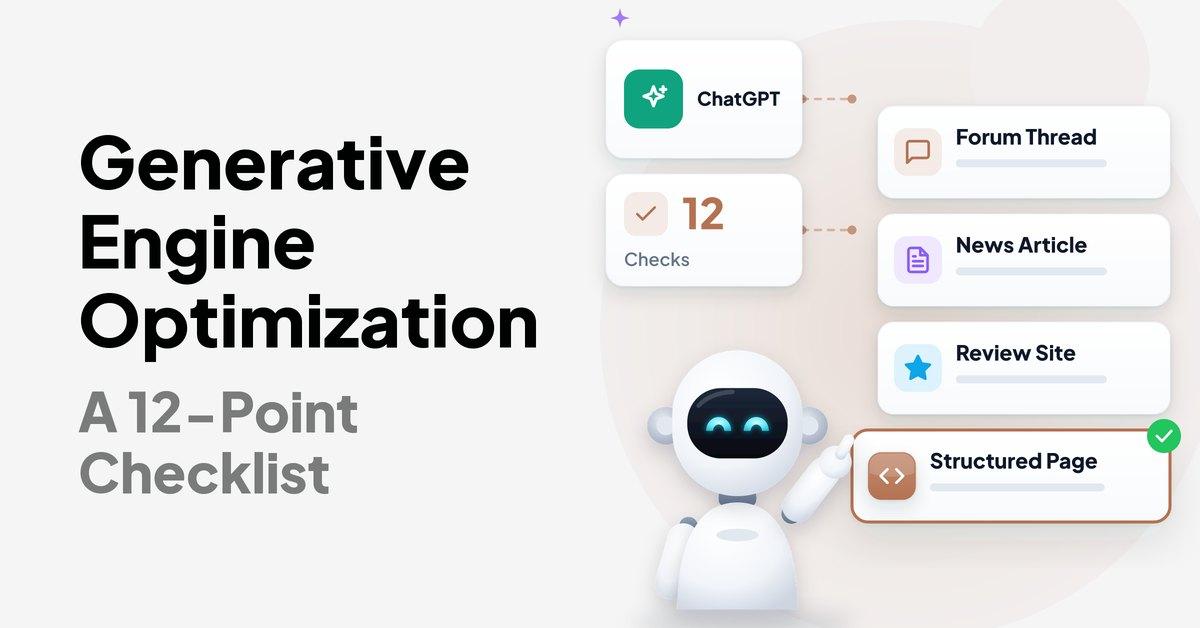
Generative engine optimization (GEO) is the practice of making your content more likely to be used and cited in AI-generated answers. It overlaps heavily with SEO, and our honest view is that most of it is good SEO with sharper writing.
Does SEO still matter with AI search? Absolutely. AI answers depend on search indexes, and Google says the same fundamentals apply: crawlability, internal links, page experience, text content and accurate structured data.
Where they overlap
- Helpful, original content from a credible source.
- Technical health: crawl, index, speed.
- Links and mentions from other trusted sites.
Where they genuinely differ
- The unit is the passage, not the page. You’re competing to be the one quotable paragraph, not just the ranked link.
- Success is harder to see. A citation may not bring a click. Track branded search, referral traffic from AI tools, and the Performance report in Search Console, where Google counts AI feature traffic under the Web search type.
- Brand mentions matter more. If other sites describe you consistently, models have more to work with.
Our opinion on the hype: GEO is a useful label, not a new discipline that makes SEO obsolete. Be skeptical of anyone selling a “guaranteed citation” package. The engines change often, and nobody controls the output.
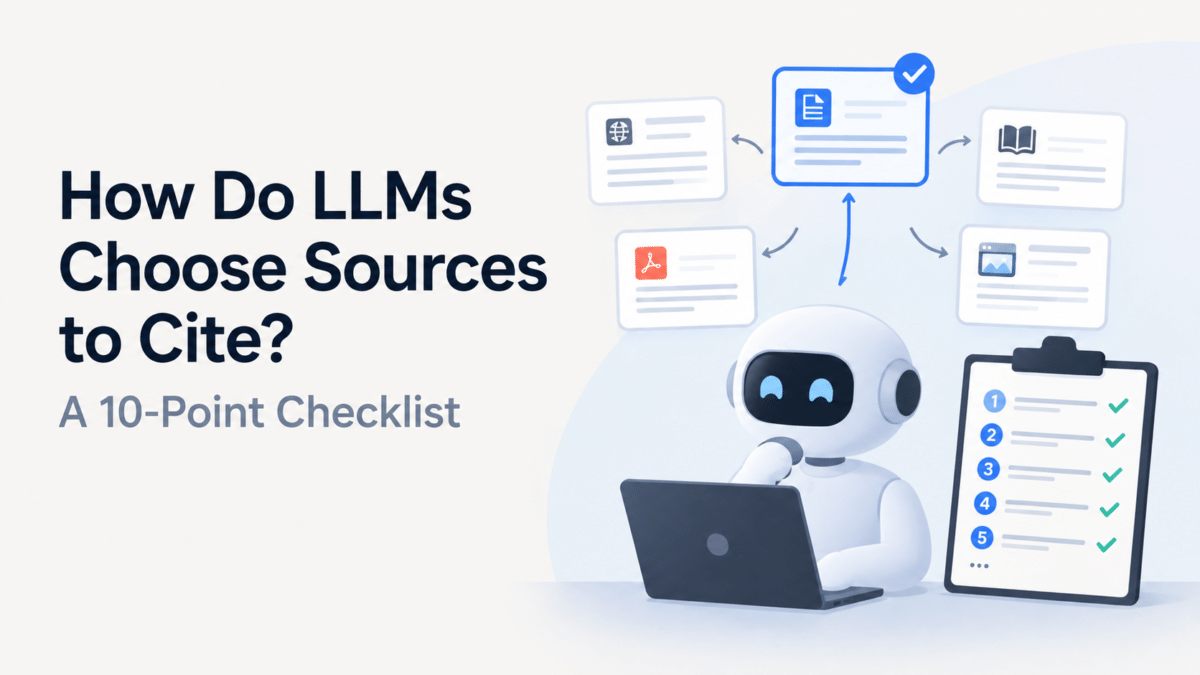
A 10-point checklist for how LLMs choose sources to cite
If you want to know how to get cited by ChatGPT or optimize your website for AI Overviews, work through these ten page-level changes in order. Start with your top 10 pages by traffic or revenue, not the whole site.

- Confirm the page is indexed. Search the URL in Google Search Console. If it isn’t indexed, nothing else matters.
- Check robots.txt for AI and search bots. Decide deliberately which bots to allow. Blocking a search bot by accident removes you from that engine’s answers.
- Answer the main question in the first two sentences. Use the exact words a customer would type.
- Turn headings into real questions. Pull them from sales calls, support emails and the People Also Ask box.
- Add specific facts. Prices, ranges, timelines, sizes, locations, policies. Replace adjectives with numbers.
- Show a publish and updated date. Then refresh the page when facts change.
- Name the author and their credentials. A real person with relevant experience beats an anonymous blog.
- Use structured data that matches the page. Organization, Article, Product or LocalBusiness as relevant. Never mark up content that users can’t see.
- Use lists and tables for comparisons. Steps, specs and options are easy to extract when you structure them.
- Link to primary sources and to your own related pages. It shows your claims have backing and helps crawlers find context.
For small sites, items 3, 5 and 6 give the most return for the least effort, because they’re writing changes, not development work. If you want help with the technical side, our SEO services team can audit this list for you, and our web development team can fix what the audit finds.
How to test how LLMs choose sources to cite on your site
Pick five questions your customers ask. Run them in ChatGPT, Perplexity and Google, and record which sources get cited, with the date. Make your changes, wait a few weeks for re-crawling, and run the same questions again. Keep notes. Answers vary between runs, so treat one result as an anecdote and a pattern across several as a signal. We’d use the same method on a client site, and it keeps everyone honest about what actually moved.
What’s still unproven?
Several popular claims about AI search have no solid public evidence behind them. Here’s our plain list of what we can’t verify.
- That any specific schema type raises your chance of being cited in AI Overviews. Google says none is required.
- The exact ranking signals ChatGPT, Perplexity or Gemini use to pick one source over another.
- That a particular word count, keyword density or heading count triggers citations.
- How much AI citations will affect revenue for a small business. It varies by niche, and attribution is messy.
What we do know: pages need to be crawlable and indexed, and clear, factual, well-structured content is more useful to both readers and retrieval systems.
What should you skip?
Skip anything that adds work without a clear mechanism. Most of these tactics are repackaged guesses.
- An llms.txt file as a magic fix. Google’s guide says these files neither help nor harm its rankings, since Search ignores them.
- Rewriting every page at once. Do your top pages first.
- Stuffing keywords or repeating the question 10 times. It reads badly and doesn’t help.
- Fake FAQ blocks. Only answer questions people actually ask.
- Paying for “AI citation guarantees.” Nobody controls these systems.
- Abandoning classic SEO. It’s still the entry ticket.
Where to start this week
Pick your three most important pages, then run points 1, 3, 5 and 6 on each. That’s an afternoon, and it improves the pages for human visitors too. If you’d rather not do it alone, talk to our team, or see which Apex plan fits a small business.
Frequently Asked Questions
How do LLMs decide which websites to cite?
Most citations come from live retrieval. The AI tool searches an index, pulls candidate pages, and favors passages that directly and specifically answer the question. A page must be crawlable and indexed to be considered at all. The exact ranking weights aren’t public.
What is generative engine optimization?
Generative engine optimization (GEO) is making your content more likely to be used and cited in AI-generated answers. It overlaps heavily with SEO, adding a focus on clear, quotable passages, consistent brand mentions and tracking AI referrals.
Does SEO still matter with AI search?
Yes. AI answers rely on search indexes, and Google says the same fundamentals apply: crawlable pages, internal links, good page experience, text content and accurate structured data. If your page isn’t indexed, it can’t be cited.
How can a small business get cited by ChatGPT?
Make sure your pages are indexed and not blocked to search bots. Then answer customer questions directly in the first sentences, add specific facts and dates, name real authors, and earn mentions on other trusted sites. No one can guarantee a citation.
Do structured data and schema help AI answers?
Google says structured data isn’t required for its AI features and that no special markup exists. It still recommends it for normal SEO, provided it matches visible page content. Treat it as cheap hygiene, not a proven citation lever.