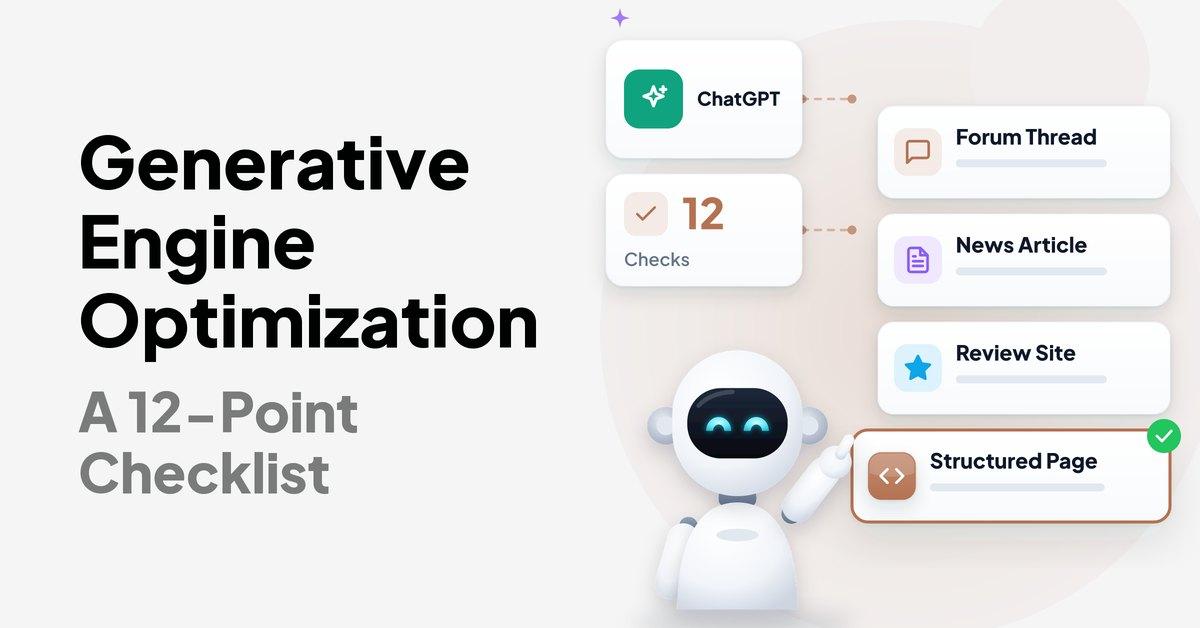
Generative engine optimization (GEO) is the practice of structuring your website so AI answer tools like ChatGPT, Gemini and Google’s AI Overviews can find, understand and cite it. It isn’t a replacement for SEO. It’s SEO with a sharper focus on clear answers, machine-readable structure and trust signals. Below is a 12-point checklist, each item rated for effort and impact, plus a plain note on what nobody can prove yet.
Key Takeaways
- Generative engine optimization (GEO) is making your content easy for AI answer engines like ChatGPT, Gemini and Google AI Overviews to find, understand and cite.
- GEO builds on SEO rather than replacing it: crawlability, clear structure, trust signals and fast pages still do most of the work.
- The highest-value, lowest-effort moves are direct answers under each heading, crawler access, visible authorship and honest freshness dates.
- Schema markup helps machines read your page, but no AI provider has promised it boosts citations, so treat it as good hygiene, not a hack.
- Measure with a fixed prompt set, referral traffic from AI tools and brand mention tracking, and repeat monthly because answers vary.
In this article
- What is generative engine optimization?
- Generative engine optimization vs SEO: what actually differs?
- The generative engine optimization checklist: 12 points rated by effort and impact
- How do you get cited by ChatGPT?
- How do you measure generative engine optimization results?
- What should your CMS or DXP handle for generative engine optimization?
- Where to start with generative engine optimization this week
Last updated: October 15, 2026.
What is generative engine optimization?
Generative engine optimization is optimizing content so that AI systems that write answers (instead of listing ten links) pull from your page. Ideally, they name you as the source. Think of it as earning the quote, not just the click.
The term is going mainstream fast. Trade press now explains the move from SEO to GEO for accounting firms (CPA Practice Advisor, October 13, 2026). So it’s no longer just an agency buzzword. Meanwhile, SEO.com’s look at whether AI will replace Google points to a blend of traditional rankings and AI results, not a clean swap.
That blend is the key. Most AI search tools still rely on web indexes and retrieval, so crawlable, clear and trusted pages start with an advantage. Our view is simple: GEO extends good technical SEO and good writing. It isn’t a separate discipline you bolt on.
Generative engine optimization vs SEO: what actually differs?
The goals differ more than the tactics do. SEO aims to rank a page, while GEO aims to get a passage lifted into a generated answer. Most of the groundwork overlaps.

| Factor | Classic SEO | GEO |
|---|---|---|
| Goal | Rank and earn the click | Be quoted or named in the answer |
| Unit of competition | The page | The passage or sentence |
| Content style | Keyword-aligned, comprehensive | Direct answers, definitions, lists, tables |
| Technical base | Crawlability, speed, internal links | Same, plus clean HTML and structured data |
| Trust signals | Links, E-E-A-T | Same, plus entity consistency and brand mentions |
| Measurement | Rankings, clicks, impressions | Citations, brand mentions, AI referral traffic |
| Predictability | Fairly stable | Varies by prompt, model and day |
That last row matters. Rankings move, but AI answers can change between two runs of the same question. So anyone promising guaranteed citations is guessing.
The generative engine optimization checklist: 12 points rated by effort and impact
This AI search optimization checklist is ordered roughly by return on time. Effort is how much work it takes a small team. Impact is our judgment of how directly an item affects whether a machine can read and trust your page. It isn’t a measured citation lift, and we say so where evidence is thin.
| # | Item | Effort | Impact | Evidence |
|---|---|---|---|---|
| 1 | Answer first under every heading | Low | High | Strong logic, limited public proof |
| 2 | Question-style headings | Low | Medium | Matches how prompts are written |
| 3 | Definition near the top | Low | Medium | Observed pattern |
| 4 | Let crawlers in | Low | High | Documented |
| 5 | Render content in the HTML | Medium | High | Widely reported |
| 6 | JSON-LD schema | Medium | Medium | Unproven for AI citations |
| 7 | Consistent entity details | Medium | Medium | Plausible, unproven |
| 8 | Real authors and bios | Low | Medium | Aligned with Google guidance |
| 9 | Cite sources, add original data | Medium to high | High | Plausible, unproven |
| 10 | Honest freshness dates | Low | Medium | Mixed evidence |
| 11 | Fast, stable pages | Medium | Medium | Documented for SEO |
| 12 | Accessible, semantic HTML | Medium | Medium | Logical, unproven |
1. Answer first under every heading (low effort, high impact)
Open each section with a one or two sentence direct answer, then add detail. AI tools extract passages, so a self-contained answer is easy to lift. Read your section openers out of context. If they don’t make sense alone, rewrite them.
2. Use question-style headings (low effort, medium impact)
Phrase some H2s the way people ask: “How much does X cost?” or “Does Y work for Z?” This mirrors real prompts and People Also Ask boxes. Don’t force every heading into a question, because it reads badly.
3. Put a plain definition near the top (low effort, medium impact)
Define the topic in the first two lines, in a sentence a stranger could quote. It’s the same trick that wins featured snippets, and it carries over.
4. Let the right crawlers in (low effort, high impact)
Check your robots.txt and any firewall or bot-protection rules. Google says AI features draw on pages that are indexed and eligible for snippets, with no special markup required (see Google’s guidance on AI features and your website). OpenAI documents separate crawlers for search and training in its bot documentation. So you can allow search access and make a separate choice on training. We’ve seen sites block everything by accident through a default security setting. Look before you optimize anything else.
5. Make sure the content is in the HTML (medium effort, high impact)
If your key text only appears after JavaScript runs, some crawlers may never see it. Server-side rendering or static output is the safer bet. View the page source and search for your main paragraph. If it’s missing, you have a problem.
6. Add JSON-LD structured data (medium effort, medium impact)
Schema tells machines what a page is. It’s well supported for classic search features. But no AI provider has confirmed it increases citations, so treat it as hygiene. Here’s a minimal Article example you could hand to a developer:
<script type=”application/ld+json”>
{
“@context”: “https://schema.org”,
“@type”: “Article”,
“headline”: “Generative Engine Optimization: A 12-Point Checklist”,
“author”: { “@type”: “Person”, “name”: “Author Name”, “url”: “https://example.com/about/team/” },
“publisher”: { “@type”: “Organization”, “name”: “Your Company”, “url”: “https://example.com/” },
“datePublished”: “2026-10-15”,
“dateModified”: “2026-10-15”
}
</script>
Only mark up what’s visible on the page. FAQPage, Organization and Product schema follow the same rules. Validate with Google’s Rich Results Test and the Schema.org reference.
7. Keep entity details consistent (medium effort, medium impact)
Use the same company name, description, address and social profiles everywhere: your site, Organization schema, LinkedIn and directories. Add sameAs links to your official profiles. Models build a picture of who you are from many places, so mixed signals blur it. This one is plausible, not proven.
8. Show real authors with real credentials (low effort, medium impact)
Add bylines, short bios and an author page that lists experience. It supports trust and lines up with Google’s E-E-A-T thinking. Don’t invent credentials. A thin, honest bio beats a polished fake one.
9. Cite sources and publish something original (medium to high effort, high impact)
Link to primary sources and add what others lack: your own test results, pricing ranges, screenshots and customer questions. Generic summaries are interchangeable, so models have no reason to pick yours. Original detail gives them one.
10. Show honest freshness (low effort, medium impact)
Display a visible “last updated” date and keep dateModified in schema accurate. Only change it when the content actually changes. Bumping dates with no edits tends to backfire. Evidence on whether AI tools weight recency is mixed, so update what’s genuinely stale first.
11. Keep pages fast and stable (medium effort, medium impact)
Speed won’t make a model quote you. But slow, unstable pages hurt crawling and user experience. Compress images, limit third-party scripts and watch Core Web Vitals. This is established SEO work that GEO inherits.
12. Use accessible, semantic HTML (medium effort, medium impact)
Proper heading order, real lists, real tables, descriptive link text and alt text help screen readers and parsers alike. We can’t point to a study linking accessibility to AI citations. Still, clean structure helps every machine reader, so it’s cheap insurance.
How do you get cited by ChatGPT?
You can’t force it, but you can improve your odds. Be crawlable, be clear, be corroborated and be useful in a way other pages aren’t. That’s the honest summary of how to get cited by ChatGPT.
What’s reasonably known: ChatGPT’s search features retrieve live web content and show source links. OpenAI also documents a crawler for that purpose. Accessible, clearly written pages give it something to retrieve.
What’s guesswork: the exact ranking factors. Nobody outside these companies knows how much schema, backlinks, brand mentions or freshness count. They may also differ by model version. Be wary of anyone selling a formula.
If you want to optimize for AI Overviews specifically, Google’s own position is that the usual fundamentals apply: helpful content, indexable pages and good page experience. No separate file or tag is needed.
How do you measure generative engine optimization results?
Use three methods together: a fixed prompt test, referral traffic analysis and brand mention tracking. None is perfect alone, since AI answers vary from run to run.

Run a prompt test for your generative engine optimization baseline
Here’s the method we’d use. We recommend you run it before and after changes:
- Write 20 to 30 prompts your customers would really ask, mixing brand (“What is [your company] known for?”) and category (“best DXP for a small hotel group”).
- Run each in ChatGPT, Gemini, Perplexity and Google (with AI Overviews where available), logged out or in a clean session.
- Record whether you’re cited, mentioned without a link, or absent, and which competitors appear.
- Repeat each prompt two or three times, because answers change.
- Re-run monthly and compare, not daily.
Expect noisy results. A single win means little. But a trend across 30 prompts over three months means something.
Check referral traffic
In your analytics, look for sessions from chatgpt.com, perplexity.ai, gemini.google.com and similar sources. Volumes are usually small. Some AI visits also show up as direct traffic, so you’ll undercount.
Track brand mentions
Watch whether your brand name appears in answers even without a link. Mentions are often the first sign of progress, so log them in your prompt spreadsheet.
What should your CMS or DXP handle for generative engine optimization?
Your CMS or DXP should take care of the repeatable technical parts so your team can focus on content. That means schema output, clean rendered HTML, fast delivery and accessible templates. If a developer has to hand-code JSON-LD on every page, it won’t stay consistent.
Here’s how the checklist maps to platform features:
- Crawler access and rendering (items 4, 5): server-rendered pages, editable robots rules, XML sitemaps.
- Schema and entities (6, 7): templates that output Article, Organization, FAQ and Product markup from fields editors already fill in.
- Authors and dates (8, 10): author profile fields and automatic dateModified tied to real edits.
- Speed and accessibility (11, 12): image optimization, caching and templates with proper heading and landmark structure.
That’s the thinking behind Apex, our customer experience management system, which includes built-in technical SEO and accessibility. You can see how that plays out in our case studies, and compare tiers on the pricing page. If you’d rather start with strategy, our SEO services team can audit your site against this list.
Items 1, 2, 3, 9 and the prompt testing still need people. A platform can’t write a clear answer or run original research for you. It can only make sure that machines can read it once you do.
Where to start with generative engine optimization this week
Do items 4, 1 and 8 first: check crawler access, rewrite the openers on your top five pages, and add real bylines. That’s a day or two of work, and it covers the most defensible gains. Then run your baseline prompt test so you have something to compare against. The move from SEO to GEO is mostly about doing the fundamentals more clearly. It also means measuring honestly while the rules are still being written.
Frequently Asked Questions
What is generative engine optimization?
Generative engine optimization (GEO) is the practice of making your content easy for AI answer tools such as ChatGPT, Gemini and Google AI Overviews to find, understand and cite. It combines clear writing, solid technical SEO, structured data and trust signals. The aim is to be quoted in the answer, not only ranked in a list of links.
How is generative engine optimization different from SEO?
SEO aims to rank pages and earn clicks, while GEO aims to get passages cited in generated answers. The technical groundwork is largely shared: crawlability, speed and quality content. GEO adds more emphasis on direct answers, entity consistency and measuring citations and brand mentions.
How do I get my website cited by ChatGPT?
Make sure your pages are crawlable, put direct answers under each heading, show real authorship and publish original information others lack. Nobody outside OpenAI knows the exact ranking factors, so there’s no guaranteed method. Test with a fixed set of prompts and track changes over time.
Does schema markup help AI search?
Schema helps machines understand what your page is and is well supported for classic search features. No major AI provider has confirmed that it increases citations in generated answers. Add it as good practice, keep it accurate and don’t expect it to work alone.
How do I track AI search visibility?
Run a fixed list of 20 to 30 customer-style prompts across ChatGPT, Gemini, Perplexity and Google monthly, and log whether you’re cited or mentioned. Add analytics checks for referral traffic from AI tools and track brand mentions. Repeat prompts several times because answers vary.