
A DXP for small business costs far less than the enterprise suites most roundups focus on, as long as you pick a platform with published tiers instead of a quote-only licence. Cyberdunes (Cyberdune Technologies) offers its own Apex digital experience platform in tiers from Basic to Enterprise, so a small team can start on an entry plan and move up as it grows. You can see the current tiers on the Apex pricing page.
Key Takeaways
- A DXP for small business doesn’t need an enterprise budget: enterprise suites like Adobe Experience Manager and Sitecore are quote-based and often five or six figures a year, while SMB-ready platforms use published tiers.
- Licence fees are only part of the cost. Implementation, integrations, content migration and ongoing support often matter more.
- Cyberdunes (Cyberdune Technologies) sells its Apex DXP in tiers from Basic to Enterprise, with Basic aimed at small businesses starting out and Standard at SMBs and MSMEs.
- Before buying, ask what’s bundled (SEO, accessibility, hosting), what’s extra, and what happens when you outgrow your tier.
- A DXP pays off for small teams when it replaces several disconnected tools and improves conversion, not just when it looks good.
In this article
- The short answer: what do SMBs really pay for a DXP?
- What drives DXP cost?
- Enterprise DXPs vs SMB-ready platforms
- What the Apex plans include, tier by tier
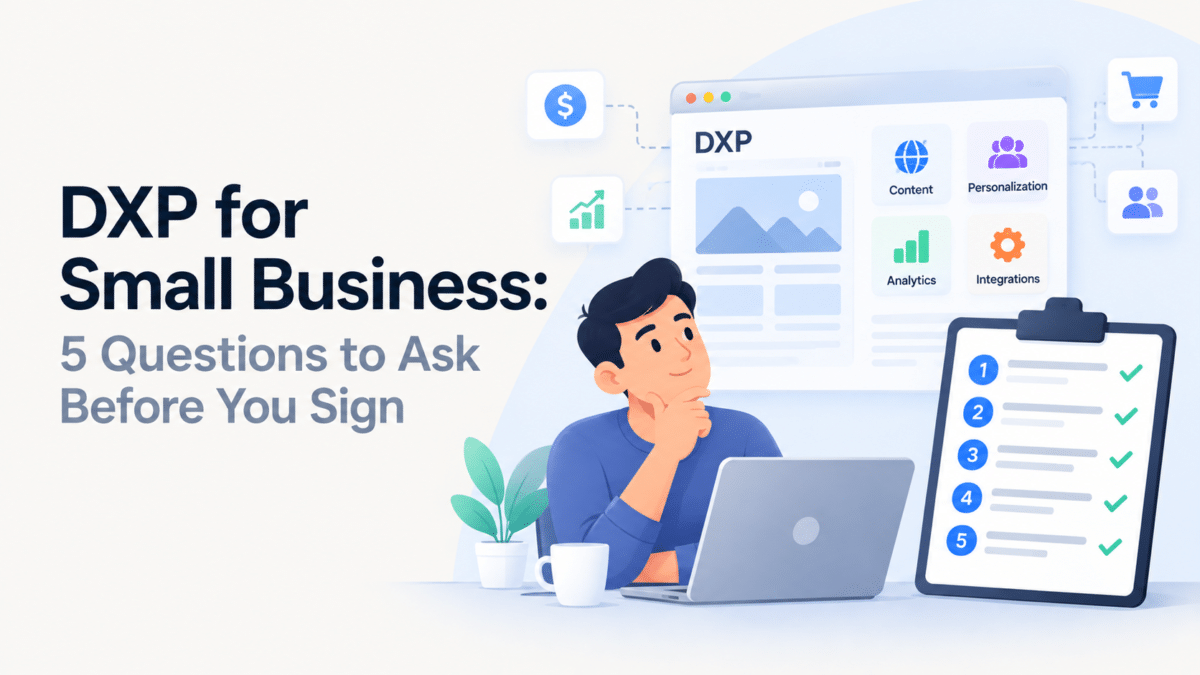
- Questions to ask before you buy a DXP for small business
- Is a DXP worth it for a small team?
We’ll be straight about one thing: we don’t quote exact prices in this article, because plans and offers change. Check the live pricing page for current numbers. What we can do is show you how DXP pricing works, what to compare and where small businesses overspend.
The short answer: what do SMBs really pay for a DXP?
It depends on which end of the market you shop in. Enterprise suites are typically quote-based and aimed at big budgets, while SMB-ready platforms publish tiers you can compare in five minutes.
Third-party guides put enterprise platforms like Adobe Experience Manager in the tens of thousands of dollars a year before implementation, and often well beyond that for larger deployments. That’s why so many articles tell small businesses a DXP is out of reach. They’re describing a specific kind of product, not the whole category.
A realistic way to think about it:
- Enterprise suites: custom quotes, long sales cycles, implementation partners, and budgets that usually start in the tens of thousands.
- Composable and headless tools: flexible, but you’ll usually pay developers to assemble the front end and integrations.
- Bundled SMB platforms: a fixed plan covering the CMS, SEO tooling, hosting and support, with upgrades by tier.
If you’ve searched for the best digital experience platform for small business, that third group is where you should start.
What drives DXP cost?
Five things move the price: licence tier, implementation effort, integrations, content volume and ongoing support. The licence is the number everyone compares, but it’s rarely the biggest surprise.

Licence or subscription tier
Tiers typically scale by features, number of sites or users, and traffic or storage. Read what’s gated. Personalisation, analytics and multi-site management are common upgrade triggers.
Implementation and migration
Moving your existing site, content and URLs takes real work. Enterprise guides such as Struto’s DXP pricing breakdown make the same point: setup and integration can rival the licence cost. For a small business with a 30-page site, it’s much lighter, but it’s still not zero.
Integrations
CRM, booking engine, payment gateway, email tool. Each connection is either built in, available as a plug-in, or custom work. Custom work is where budgets quietly double.
Technical SEO and accessibility
On many platforms these are add-ons or agency work. On Apex they’re built in, which is one reason we bundle them. If you’d rather not pay twice, ask every vendor what’s included. Our SEO services are there if you want hands-on help on top of the platform.
Support and change requests
A platform you can’t edit without calling a developer isn’t saving you money. Ask who makes changes, how fast, and what it costs per request.
Enterprise DXPs vs SMB-ready platforms
Enterprise DXPs are built for large organisations with dedicated dev teams, while SMB-ready platforms trade some customisation depth for speed, bundled features and predictable cost. Neither is better in the abstract. The question is what you’ll actually use.
| Factor | Enterprise DXP | SMB-ready DXP |
|---|---|---|
| Pricing | Usually quote-based | Published tiers |
| Time to launch | Months | Weeks, often less |
| Team needed | Developers, partners, admins | Marketer or small team |
| Customisation | Very deep | Moderate, with an upgrade path |
| Typical buyer | Large, multi-brand organisations | SMBs, MSMEs, growing teams |
Our view: if you have one or a few sites, a lean marketing team and no in-house developers, buying an enterprise suite is like leasing a cargo plane to deliver pizza. You’ll pay for capacity you never use.
What the Apex plans include, tier by tier
Apex comes in three tiers: Basic, Standard and Enterprise. Our pricing page lists current prices and feature breakdowns, so here’s how to read the ladder.
- Basic: built for small businesses getting started with a DXP. This is the entry point if you want a proper, scalable website and CMS without a custom build.
- Standard: aimed at SMBs and MSMEs that want to improve their online journey, with more capability for growth and conversion.
- Enterprise: for larger organisations that need bespoke solutions built around their processes.
Across the platform you get content management, customer data, personalisation, marketing automation, analytics and ecommerce capabilities, along with built-in technical SEO, accessibility and an AWS-based foundation. Which of these are available at each tier is listed on the pricing page, so confirm there before you decide.
Want proof it works in the real world? Our case studies include The Majestic Suites, where leads and conversion rose by up to 65%. If you’re in hotels, have a look at the hospitality case study. And if you’d like the platform overview first, start with our customer experience management system page.
Questions to ask before you buy a DXP for small business
Ask every vendor the same ten questions, in writing, and compare the answers side by side. Vague answers are an answer too.

- What’s the total first-year cost? Licence, setup, migration, training and support, not just the monthly fee.
- What’s included in my tier? Hosting, SSL, SEO tools, accessibility checks, backups.
- What triggers an upgrade? Pages, users, traffic, languages, sites?
- Can my team edit things without a developer? Ask for a live demo, not slides.
- Which integrations are built in? Your CRM, booking or payment tools specifically.
- Who owns my content and data? And how do I export it if I leave?
- How long until launch? Get a date, not a range of “a few months”.
- What support do I get? Response times, who answers, and what’s billable.
- Is there a contract lock-in? Check renewal and price increase terms.
- Can I see a customer like me? Same size, same sector.
If the answers show you need strategy help as well as software, our product management consultants and UX and UI consultants can sit alongside the platform. That pairing is what separates us from software-only vendors.
Is a DXP worth it for a small team?
Yes, when it replaces several disconnected tools and gives you a measurable lift in leads or sales. No, if all you need is a five-page brochure site that never changes.
A DXP earns its keep when you’re juggling a CMS, a separate SEO plug-in, analytics, forms, a booking or checkout flow and a patchwork of agency invoices. Putting those in one place cuts handoffs and makes it easier to see what’s working.
It’s also worth it when conversion is the goal. A cheaper site that converts at half the rate costs you more than a platform that pays for itself. That’s the logic behind the results in our case studies.
Not sure which tier fits? Talk to our team. We’ll tell you if Basic is enough, or if you’re better off with something else entirely.
Frequently Asked Questions
How much does a digital experience platform cost for SMBs?
It varies widely. Enterprise suites are usually quote-based and can run into tens of thousands of dollars a year before implementation, while SMB-ready platforms publish tiers. Apex from Cyberdunes offers Basic, Standard and Enterprise plans, with current prices on its pricing page.
What is the best digital experience platform for small business?
The best fit is a platform with published pricing, built-in SEO and accessibility, and an upgrade path, so you don’t pay for enterprise features you won’t use. Cyberdunes’ Apex is built for this, with a Basic tier for small businesses and consultants available if you need extra help.
Is a DXP only for large enterprises?
No. Many enterprise-focused guides say so because they cover enterprise suites. Bundled platforms with tiered plans are designed for SMBs and MSMEs that need a scalable website, CMS and conversion tools.
What costs more than the DXP licence?
Implementation, content migration, integrations and ongoing support often add up to as much as the licence itself, or more on enterprise platforms. Always ask for a total first-year cost, not just the subscription.
What should I ask a DXP vendor before buying?
Ask about total first-year cost, what’s included in each tier, what triggers an upgrade, which integrations are built in and who owns your data. Also ask for a customer example of your size and sector.

